
 Persian
 Arabic
 Russian


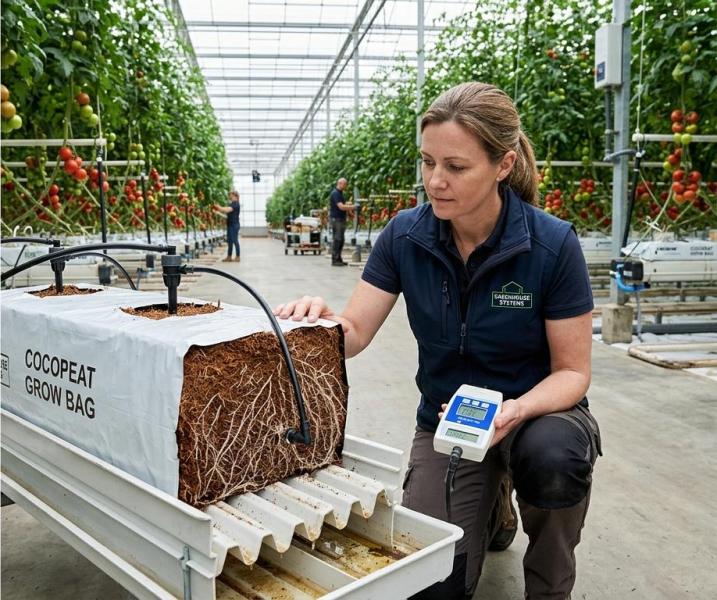
Choosing the Right Growing Medium for Greenhouse Tomatoes: A Technical and Economic Analysis of Cocopeat in Root-Zone Management
Analytical Framework
1. Technical Assumption
This article assumes that, in commercial greenhouse tomato production, cocopeat is not merely a material that supports the roots. It is part of the root-zone management infrastructure and can influence irrigation behavior, nutrient availability, drainage, oxygen supply, crop uniformity, and production risk.
This does not mean that cocopeat is automatically superior to every other growing medium. Its performance depends on its physical and chemical specifications, irrigation design, fertigation strategy, water quality, greenhouse climate, crop variety, and technical management capacity.
2. The Buyer’s Economic Problem
The buyer is not simply choosing between different prices per kilogram or per bag. The real decision includes transportation, preparation, rinsing, labor, irrigation management, quality variation between shipments, crop losses, replacement requirements, and the reliability of future supply.
3. Main Decision Variables
- Particle-size distribution
- Total porosity and air-filled porosity
- Water-holding capacity and available water
- Initial EC and pH
- Washing and buffering status
- Structural stability during the crop cycle
- Compatibility with fertigation and irrigation systems
- Cost per plant
- Shipment consistency
- Packaging, storage, and delivery conditions
- Supplier capacity and technical documentation
4. Difference from General Market Articles
This article does not present cocopeat as a generic agricultural product. It examines cocopeat through the relationship between root-zone conditions, fertigation, plant physiology, marketable yield, production risk, and the economics of bulk purchasing.
5. Information Requiring Technical Confirmation
The exact cocopeat type, particle composition, EC, pH, expansion ratio, washing and buffering process, packaging, certificates, monthly supply capacity, minimum order quantity, and export conditions must be confirmed by Mayadasht before final publication.
The Role of Cocopeat in Commercial Greenhouse Tomato Production
In Commercial Production, the Growing Medium Is More Than Root Support
In greenhouse tomato production, is the growing medium only a place for the roots to develop, or is it one of the factors that determines water management, nutrition, oxygen supply, and crop uniformity?
For a commercial greenhouse producing cluster tomatoes or Cherry tomatoes, the answer is strategically important.
The objective is not simply to keep plants alive and produce fruit. The grower must maintain the root environment with the lowest possible level of fluctuation throughout a long production cycle. Changes in moisture, oxygen availability, root-zone EC, pH, and drainage can influence vegetative growth, flower-cluster development, fruit filling, ripening uniformity, fruit quality, and the percentage of marketable production.
These effects cannot always be attributed to one factor. Temperature, radiation, humidity, plant variety, irrigation equipment, fertilizer formulation, root diseases, and crop load also play major roles. However, the growing medium is the environment in which many irrigation and nutrition decisions become real conditions around the roots.
For this reason, purchasing cocopeat should go beyond comparing the price of one bag, bale, or compressed block. The key question is not simply which product is cheaper. The real question is:
Which growing medium, with which specifications and under which management system, provides the most predictable root-zone conditions at an acceptable total production cost?
1. Root-Zone Management in Cocopeat Grow Bags and Slabs
In soilless tomato production, roots develop within a limited volume of growing medium. Unlike field soil, the root volume, water movement, air exchange, nutrient retention, and drainage behavior are strongly influenced by the structure and preparation of the grow bag or slab.
Each cocopeat unit therefore creates a specific physical and chemical environment for the root system. If these conditions differ significantly from one bag or slab to another, plants with the same variety and similar light exposure may still show different growth patterns and nutrient responses.
Particle-Size Distribution and Water Retention
Particle-size distribution is one of the main factors determining how cocopeat behaves. Finer particles usually create smaller pores and influence water retention, while larger fibers and particles can increase air space and alter the movement of water through the medium.
However, water retention alone is not an adequate quality criterion. The medium must retain enough water for root uptake while preserving sufficient air-filled porosity for root respiration.
If the medium remains saturated for too long, oxygen availability around the roots may decline. On the other hand, if it dries too rapidly or water is distributed unevenly, the crop may experience repeated fluctuations in root-zone moisture.
These fluctuations can make fertigation more difficult to control and may contribute to uneven plant growth, inconsistent fruit filling, and irregular maturity across the greenhouse.
Total Porosity and Air-Filled Porosity
Total porosity indicates the proportion of the growing medium occupied by pores. However, for tomato root management, the distribution between water-filled pores and air-filled pores is more important than total porosity alone.
Two growing media may have a similar total pore volume while behaving very differently in terms of water retention and oxygen supply. Tomato roots require both water and oxygen. Excessive water saturation can restrict oxygen movement, while excessive drainage or rapid drying can increase water stress.
This becomes particularly important when irrigation pulses are frequent. If irrigation frequency, pulse volume, and drainage are not adjusted to the characteristics of the cocopeat, some parts of the grow bag may remain saturated for extended periods.
Cocopeat Behavior During Repeated Irrigation Cycles
The performance of cocopeat during a single irrigation event does not necessarily represent its behavior over hundreds or thousands of irrigation cycles.
Repeated wetting, drainage, partial drying, and rewetting may influence moisture distribution, pore structure, and root-zone stability over time. A commercial grower should therefore evaluate whether the growing medium:
- Maintains relatively uniform moisture distribution;
- Preserves its structure during repeated irrigation;
- Avoids excessive moisture differences between areas of the same grow bag;
- Produces predictable drainage;
- Responds consistently to changes in temperature and crop transpiration;
- Remains compatible with the irrigation strategy throughout the production cycle.
These characteristics should be evaluated through technical documentation, sample testing, and, where possible, practical observation under greenhouse conditions.
Moisture Variation Within the Grow Bag
Moisture is not necessarily distributed evenly throughout a cocopeat grow bag or slab. Dripper position, greenhouse slope, drainage holes, root density, crop age, solar radiation, and bag geometry can all influence moisture distribution.
If irrigation water is concentrated in one zone, some roots may remain in an excessively wet area while others experience lower moisture availability. This can lead to differences in plant vigor, nutrient uptake, flower-cluster development, and fruit ripening.
In such cases, changing the fertilizer formula alone may not solve the problem. The irrigation layout, dripper position, drainage design, root distribution, and physical characteristics of the growing medium must be evaluated together.
Structural Settlement During the Crop Cycle
Settlement can gradually change the volume and distribution of pores within a growing medium. Its intensity depends on particle composition, fiber content, compression, moisture conditions, preparation quality, and the duration of use.
Structural settlement may result in:
- A reduction in effective growing-medium volume;
- Changes in water movement;
- Increased density in certain root-zone areas;
- Modified drainage and aeration compared with the beginning of the crop;
- Uneven root development between different sections of the grow bag.
Excessive Drying and Rewetting
If cocopeat becomes excessively dry, it may not rewet uniformly. Water may follow preferential pathways instead of distributing evenly throughout the medium.
This risk is especially relevant during periods of extreme heat, irrigation failure, equipment malfunction, or poorly adjusted irrigation volumes. Once a growing medium has dried excessively, simply increasing the volume of water may not restore uniform moisture distribution.
Irrigation recovery should therefore be gradual and monitored through drainage, moisture data, plant response, and root-zone EC. A fixed irrigation schedule is rarely sufficient under all greenhouse conditions.
Cation Exchange Capacity and Nutrient Management
Cocopeat may have a cation exchange capacity that allows it to retain and exchange certain positively charged nutrients. This characteristic is relevant to the management of potassium, calcium, and magnesium.
If the initial chemical status of the product is unknown, nutrients supplied through the fertigation system may interact with exchange sites in the medium. As a result, the chemical environment around the roots may not immediately reflect the composition of the incoming nutrient solution.
This does not mean that cocopeat automatically causes nutritional disorders. The critical issue is whether the initial condition of the medium is known and whether the fertigation program is adjusted accordingly.
[Technical information required: Cation exchange capacity, initial potassium, calcium and magnesium status, and buffering process of Mayadasht cocopeat]
Washing, Buffering, and Initial EC
Initial EC is an important factor when preparing cocopeat for tomato production. If the product requires washing or buffering, the process should be included in the production schedule and cost model.
Preparation may require water, labor, drainage management, additional space, and technical supervision. These costs may not be visible in the purchase price, but they affect the actual cost of using the growing medium.
Monitoring should include:
- EC of the incoming nutrient solution;
- pH of the incoming nutrient solution;
- EC and pH of drainage;
- Moisture behavior inside the grow bag;
- Changes in plant performance;
- Root health and root distribution.
The EC of the incoming solution alone does not provide a complete picture of the root environment.
2. How Root-Zone Conditions Influence Tomato Performance
The impact of the growing medium usually appears through a chain of interconnected processes:
Growing-medium properties → water and air behavior → root activity → water and nutrient uptake → vegetative and reproductive growth
If the roots develop in an environment with unstable moisture, excessive salinity, or limited oxygen, the uptake of water and nutrients may fluctuate. The consequences may appear in vegetative growth, cluster formation, fruit filling, fruit size, and ripening uniformity.
However, every production problem should not automatically be attributed to cocopeat. Temperature, radiation, humidity, root diseases, irrigation design, fertilizer balance, variety, grafting, and crop load must also be considered.
Cocopeat is part of a production system. It is not an independent guarantee of yield or quality.
3. Technical Comparison of Cocopeat with Alternative Growing Media
Agricultural Soil or Unmodified Soil
Agricultural soil may vary significantly in texture, salinity, organic matter, compaction, drainage, biological activity, and contamination risk. This variability can make irrigation and fertigation more difficult to standardize across a commercial greenhouse.
Soil may appear attractive because it is locally available or has a lower initial purchase cost. Nevertheless, the grower should also consider:
- Disinfection;
- Soil transportation;
- Drainage improvement;
- Structural compaction;
- Weed management;
- Root-disease risks;
- Difficulty of controlling the root-zone EC and pH;
- Long-term labor requirements.
The lower initial cost of soil does not necessarily represent a lower total production cost.
Peat Moss
Peat moss may be suitable for certain nursery and substrate-blending applications. However, its water retention, drying behavior, rewetting characteristics, weight, transportation cost, availability, and supply stability must be assessed in relation to the greenhouse climate and irrigation system.
[Source or technical confirmation required: Detailed comparison of peat moss under the target production and market conditions]
Perlite
Perlite is a lightweight mineral material commonly used to increase air space and improve drainage. Compared with an organic growing medium, perlite generally has limited nutrient retention and a different water-management behavior.
Perlite may be appropriate where high aeration and rapid drainage are priorities. However, a perlite-based system may require carefully designed irrigation frequency and pulse management.
The economic result depends on the relationship between water availability, irrigation technology, labor, and crop response.
Cocopeat and Perlite Mixtures
A cocopeat-perlite mixture may be designed to create a balance between moisture retention and air-filled porosity. The result depends on:
- The proportion of each component;
- Particle size;
- Fiber content;
- Mixing quality;
- Water quality;
- Irrigation frequency;
- Greenhouse climate;
- Crop stage.
A mixture is not automatically superior to either component used separately. If the mixing ratio and irrigation strategy are not clearly defined, the result may be inconsistent between bags or batches.
Unspecified Organic or Mineral Growing Media
Growing media with incomplete specifications present a high decision-making risk. Without information regarding EC, pH, particle distribution, porosity, moisture, contaminants, and structural stability, root-zone management becomes largely experimental.
For a commercial greenhouse, incomplete specifications make it difficult to:
- Design the fertigation program;
- Compare suppliers;
- Estimate preparation costs;
- Predict drainage;
- Control crop uniformity;
- Repeat the same production strategy in the next cycle.
4. Cocopeat and Tomato Plant Physiology
Development of Active Roots
Active roots require sufficient moisture, oxygen, temperature stability, and access to nutrients. Excessive compaction, prolonged saturation, severe drying, or high root-zone EC can affect root activity.
In cluster and Cherry tomato production, sustained root activity is particularly important because the plant must manage vegetative growth, flowering, cluster development, fruit filling, and continued production at the same time.
A growing medium that maintains more predictable moisture and aeration conditions may support more consistent root-zone management. However, this outcome depends on the entire fertigation and greenhouse management system.
Water and Nutrient Uptake
Water uptake is influenced by root health, moisture availability, transpiration, root-zone EC, plant demand, and temperature.
A plant may have water physically present in the growing medium but still experience difficulty absorbing it if the EC is high, the roots are damaged, or transpiration and root uptake are not balanced.
This is why fertigation should be evaluated through both incoming solution and drainage data. The nutrient concentration entering the system does not necessarily represent the conditions that develop around the roots.
Vegetative and Reproductive Balance
Excessive irrigation or unbalanced nutrition may encourage excessive vegetative growth, while water stress, high salinity, or root damage may affect flowering and fruit development.
A stable growing medium can make this balance easier to manage, but it cannot replace climate control, correct pruning, crop-load management, or a suitable fertigation program.
Heat Stress and Transpiration Fluctuation
During hot periods, evapotranspiration increases and the relationship between plant demand and the water-storage behavior of the growing medium becomes more important.
If the medium dries too quickly or if water is distributed unevenly, plant water status may fluctuate significantly. On the other hand, excessive irrigation intended to prevent drying may create:
- Prolonged saturation;
- Reduced root-zone oxygen;
- Excess drainage;
- Nutrient leaching;
- Higher water and fertilizer costs.
The appropriate response should be based on measurement rather than simply increasing irrigation volume.
Fruit Filling, Uniformity, and Marketability
Fruit filling is influenced by water supply, assimilate distribution, plant load, temperature, nutrient balance, and root activity. In cluster tomatoes, irregular root-zone conditions may contribute to variation in fruit size, ripening, and cluster uniformity.
For commercial growers, the relevant outcome is not only total harvested weight. The more important economic indicators may include:
- Percentage of marketable fruit;
- Uniformity of fruit size;
- Harvest synchronization;
- Rejection rate;
- Appearance and firmness;
- Compliance with buyer or export specifications.
There is no basis for claiming that cocopeat alone guarantees improvement in these indicators.
Blossom-End Rot
Blossom-end rot should not automatically be interpreted as a simple lack of calcium in the nutrient solution. Calcium movement to the fruit is influenced by:
- Water transport;
- Root health;
- Transpiration;
- Temperature;
- Relative humidity;
- Moisture fluctuations;
- Crop load;
- Growth rate;
- Nutrient balance.
When blossom-end rot occurs, the following should be assessed together:
- Moisture distribution in the grow bag;
- EC of the incoming solution and drainage;
- Root health;
- Greenhouse temperature;
- Relative humidity;
- Transpiration conditions;
- Fruit load;
- Fertigation balance;
- Uniformity of irrigation.
Cocopeat should not be identified as the sole cause without a complete root-zone and climate assessment.
5. Cocopeat During Summer and Autumn Crop Preparation
Summer has two major implications for cocopeat management. First, higher temperatures increase evapotranspiration and place greater pressure on water management. Second, summer is often the period when greenhouse operators evaluate inputs and prepare for the next autumn production cycle.
When Is Changing the Growing Medium Reasonable?
Changing the growing medium during summer may be reasonable when the existing root-zone problem cannot be solved through irrigation adjustment, drainage correction, fertigation management, or climate control.
Before changing the substrate, the grower should determine whether the main problem is related to:
- The physical properties of the growing medium;
- Irrigation design;
- Blocked or uneven drippers;
- Poor drainage;
- Fertigation errors;
- Root disease;
- Excessive temperature;
- Poor moisture management;
- Inappropriate crop load.
If the primary issue is the irrigation system, replacing the cocopeat without correcting irrigation may produce limited or temporary results.
Why Summer Can Be a Suitable Time for Evaluation and Procurement
Summer can provide an opportunity to:
- Request and evaluate samples;
- Review technical data;
- Compare suppliers;
- Test preparation and rinsing procedures;
- Calculate required volume;
- Plan autumn production;
- Organize warehouse space;
- Schedule transportation before the next crop begins.
A bulk purchase should be based on the production calendar, not only on a temporary price quotation. Preparation, transport, installation, irrigation setup, and crop establishment must all be included in the schedule.
6. The Economics of Bulk Cocopeat Purchasing
Why Price per Kilogram Is Not Enough
The purchase price is only one component of the total cost. Two products with different prices may produce very different economic results because of differences in:
- Transportation;
- Unloading;
- Preparation;
- Rinsing;
- Labor;
- Irrigation management;
- Product uniformity;
- Crop waste;
- Repeated purchases;
- Marketable yield;
- Shipment consistency.
The following analytical formula can be used as a starting point:
Real growing-medium cost = Purchase price + transportation and preparation + management cost + quality-variation risk cost − economic value of reduced waste and increased marketable production
This formula must be calculated using the actual data of each greenhouse. It is not a universal financial model.
Cost per Plant
The cost of the growing medium should be calculated per plant, not only per kilogram or per bag. The calculation should consider:
- Number of plants supported;
- Volume of growing medium;
- Preparation cost;
- Installation labor;
- Number of production cycles;
- Possible reuse;
- Disposal or replacement cost.
The weight of the product alone does not show how much usable growing volume will be available after hydration and preparation.
Transportation and Unloading Costs
Compressed cocopeat and ready-to-use substrate may have very different logistics profiles. The buyer should calculate:
- Weight per shipment;
- Number of units per truck or container;
- Pallet configuration;
- Loading and unloading requirements;
- Distance;
- Delivery destination;
- Storage conditions;
- Customs and border-related costs where applicable.
Preparation and Rinsing Costs
If the product requires washing or buffering before use, the buyer should include:
- Water consumption;
- Labor;
- Time;
- Drainage management;
- Space requirements;
- Equipment;
- Disposal of drainage water;
- Technical supervision.
These costs can materially change the comparison between suppliers.
Marketable Yield and Waste
The objective of a commercial greenhouse is not simply to increase total harvested weight. The more important objective is to increase the percentage of production that meets the requirements of the target market.
For cluster and Cherry tomatoes, the economic value of production may depend on:
- Fruit size;
- Uniformity;
- Color;
- Firmness;
- Cluster appearance;
- Cracking;
- Blossom-end rot;
- Harvest timing;
- Rejection rate;
- Export compliance.
The relationship between cocopeat selection and marketable yield must be verified through real greenhouse data. A guaranteed yield increase should not be claimed without controlled evidence.
Water and Fertilizer Consumption
A suitable growing medium may make water and nutrient management more predictable. However, actual consumption depends on climate, variety, crop stage, irrigation strategy, drainage targets, and fertigation control.
Any claim of reduced water or fertilizer use should be based on measured data from comparable production conditions. The type of growing medium alone does not determine total resource consumption.
7. When Is Bulk Cocopeat Purchasing Justified?
Bulk purchasing is more justifiable when the following conditions exist:
- The greenhouse area is clearly defined;
- Plant numbers are known;
- The production calendar is available;
- Expected consumption is predictable;
- Suitable storage space exists;
- The technical specifications are documented;
- Quality consistency between shipments can be assessed;
- Transportation and delivery dates are clear;
- The final tomato market has been evaluated;
- The greenhouse has the technical capacity to manage fertigation and drainage;
- A representative sample has been tested before the main purchase.
When Can Bulk Purchasing Become Risky?
Bulk purchasing may be a high-risk decision when:
- The decision is based only on the lowest price;
- There is no confirmed consumption plan;
- Storage conditions are unsuitable;
- The shipment specifications are incomplete;
- The sample cannot be matched with the bulk shipment;
- The growing medium is not compatible with the irrigation system;
- No technical team is available to monitor EC, pH, and drainage;
- The destination and delivery date are unclear;
- The supplier’s capacity for repeat orders is unknown;
- The greenhouse has no clear market for the final tomato crop.
8. Mayadasht as a Cocopeat Supplier and Exporter
Mayadasht should be evaluated as a supplier and exporter of agricultural cocopeat, not as a type of growing medium competing with cocopeat.
For greenhouse managers and agricultural importers, the value of a professional supplier is related to the ability to coordinate product specifications with the actual application. This may include:
- Bulk and commercial cocopeat supply;
- Reviewing the customer’s intended use;
- Matching the product with greenhouse requirements;
- Planning order preparation;
- Coordinating packaging and delivery;
- Considering destination and shipment volume;
- Connecting technical, sales, and export communication;
- Reducing purchasing risk for importers and greenhouse operators.
Mayadasht is capable of supplying agricultural cocopeat, preparing export orders, and arranging shipment to customers.
9. Technical Comparison of Growing Media
| Indicator | Standardized Cocopeat | Soil or Unspecified Growing Medium | Pure Perlite | Cocopeat–Perlite Mixture | Economic Implication for the Greenhouse |
|---|---|---|---|---|---|
| Structural stability | Depends on processing quality, particle composition, and settlement behavior | Often variable and affected by compaction | Generally mineral and structurally stable, but may move during handling | Depends on the stability of both components and the mixing ratio | More predictable structure can simplify irrigation and crop planning |
| Moisture management | Can retain moisture, but air-filled porosity must remain adequate | Less predictable and dependent on soil texture | Usually requires more precise irrigation management | Can be designed to balance moisture retention and aeration | Moisture fluctuation affects water use, root health, and crop uniformity |
| Air-filled porosity | Depends on particle size, fiber content, and compression | Highly dependent on texture and compaction | Commonly used to increase air space | Adjustable through the mixing ratio | Better aeration may reduce root-zone stress, but does not guarantee yield |
| Nutrient retention | Depends on initial chemical condition and cation exchange properties | May be high but difficult to predict | Usually limited compared with organic media | Determined by the behavior of both materials | Requires accurate fertigation and drainage monitoring |
| EC and pH control | More manageable when specifications and preparation status are documented | More difficult because of soil variability | Often chemically less active, but still requires testing | Depends on both components | Better predictability can reduce nutrient-management errors |
| Weight and transport | Depends on compression, moisture, and packaging | Often heavy and expensive to move | Lightweight, but volume affects logistics | Depends on the ratio and packaging | Transport cost must be calculated by actual weight and volume |
| Suitability for soilless cultivation | Suitable when its specifications match the system | More limited and often requires correction and disinfection | Suitable with appropriate irrigation design | Suitable with integrated management | Compatibility affects the cost of infrastructure changes |
| Standardization potential | Relatively high when technical specifications are controlled | Usually difficult | Possible, but particle grading remains important | Requires control of both materials | Inconsistency can increase variation between plants |
| Long-cycle behavior | Should be assessed for settlement and structural change | May compact and alter drainage | Generally stable, but moisture control remains important | Depends on both components | Useful life should be included in the cost per production cycle |
| Fertigation management | Requires monitoring of EC, pH, moisture, and drainage | More difficult and less predictable | May require frequent irrigation adjustments | Requires understanding of combined behavior | Technical management capacity is part of the total production cost |
| Shipment-to-shipment variation | Depends on supplier quality control | Often high | Depends on source and grading | Includes the risk of both materials | Consistency is critical for repeated commercial orders |
| Commercial availability | Must be verified through supplier capacity | Usually local and project-dependent | Depends on source and market | Requires reliable supply of both components | Supply interruptions can disrupt planting and sales contracts |
10. Decision-Oriented Conclusion
For Greenhouse Managers: When Is Cocopeat Worth Evaluating?
Cocopeat is worth evaluating when the greenhouse requires a more standardized root-zone environment and has the technical capacity to manage fertigation, drainage, EC, pH, and irrigation distribution.
It is more suitable for consideration when:
- The growing system is soilless;
- The irrigation system can be monitored and adjusted;
- The product has documented specifications;
- The preparation process is understood;
- The economic cost per plant has been calculated;
- The target market rewards uniform and marketable fruit.
Cocopeat cannot compensate for poor irrigation design, inadequate drainage, weak climate control, or incorrect nutrition. Changing the growing medium without correcting the rest of the system may produce limited results.
For Agricultural Importers and Traders: What Should Be Requested from the Supplier?
Before placing a bulk order, the importer should request:
- A technical specification sheet;
- A representative sample;
- EC and pH information;
- Washing and buffering status;
- Expansion and preparation instructions;
- Packaging details;
- Weight and volume per unit;
- Minimum order quantity;
- Monthly or seasonal supply capacity;
- Delivery schedule;
- Export documents;
- Payment and delivery conditions;
- Procedures for handling shipment discrepancies.
A price quotation without these details is not a sufficient basis for comparing suppliers.
For Investors: What Data Should Be Collected Before Calculating ROI?
Investors should collect:
- Greenhouse area;
- Number of plants;
- Production cycle length;
- Crop calendar;
- Growing-medium cost per plant;
- Transportation and preparation costs;
- Labor requirements;
- Water and fertilizer consumption;
- Marketable yield;
- Rejection and waste rates;
- Selling price and target market;
- Replacement and repeat-purchase costs;
- Potential for reuse;
- Cost of monitoring and fertigation equipment;
- Supplier reliability and delivery capacity.
Choosing cocopeat is a professional decision only when it goes beyond the purchase price and is evaluated within the economics of total production, root-zone management, and supply-chain reliability.
Frequently Asked Questions
1. Can cocopeat alone increase greenhouse tomato yield?
No. Yield depends on variety, climate, irrigation, fertigation, root health, crop load, light, and growing-medium properties. Cocopeat may support better root-zone management, but a guaranteed yield increase cannot be claimed without comparable production data.
2. Why is drainage EC important in cocopeat tomato production?
Drainage EC provides information about the chemical conditions developing around the roots. It may help identify salt accumulation, nutrient leaching, or differences between the incoming nutrient solution and the root-zone environment. Interpretation should be performed by a qualified technical team.
3. Does blossom-end rot mean that the cocopeat is unsuitable?
Not necessarily. Blossom-end rot may be associated with water transport, calcium movement, root health, transpiration, temperature, moisture fluctuation, crop load, and fertigation management. It should be investigated as a multifactorial problem.
4. Is a cocopeat and perlite mixture always better than pure cocopeat?
No. The result depends on the characteristics of both materials, the mixing ratio, the desired balance between moisture and air, and the irrigation system. A mixture should be evaluated according to the actual greenhouse conditions.
5. What should be requested before purchasing bulk cocopeat?
The buyer should request technical specifications, a representative sample, EC and pH data, washing and buffering information, expansion ratio, packaging details, minimum order quantity, supply capacity, delivery schedule, and export documentation.