
 Persian
 Arabic
 Russian


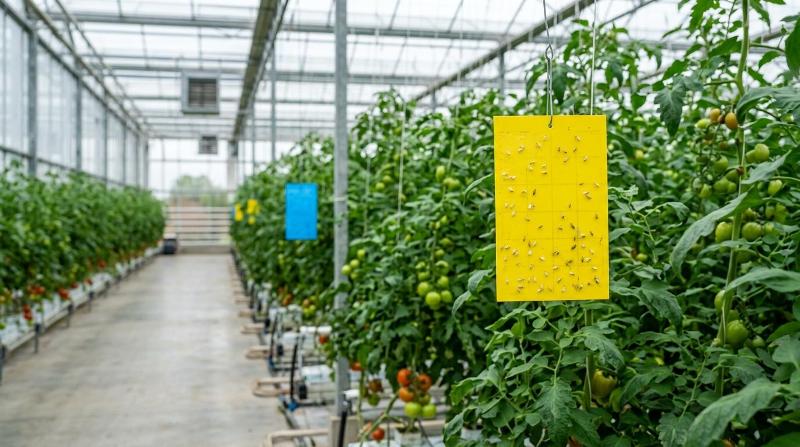
Flying insect pests can become a serious greenhouse issue before visible plant damage appears. Whiteflies may gather under leaves, aphids can enter through vents or new plant material, and thrips may remain hidden inside flowers and young growth. By the time symptoms are obvious, the population may already be established.
Yellow Sticky Cards, also called Yellow Sticky Traps or Yellow Sticky Glue Traps, provide a simple way to monitor flying pests and identify potential problems earlier. They are not a complete pest-control program on their own, but they are a useful part of routine crop inspection and integrated pest management.
This guide explains how yellow and blue insect-attracting cards work, where to install them, what they can indicate, and what buyers should consider when selecting them for greenhouse use.
What Are Yellow Sticky Cards?
Yellow sticky cards are bright yellow panels coated with adhesive. Their colour attracts certain flying insects, while the sticky surface holds insects after they land.
In commercial greenhouses, they are used mainly for:
- Monitoring pest activity
- Detecting pest entry at an early stage
- Comparing insect pressure between greenhouse zones
- Identifying likely entry points near doors, vents, or sidewalls
- Supporting decisions about crop scouting and pest-management actions
- Reducing a portion of the flying pest population when used in higher numbers
The main value of a sticky card is not simply the number of insects it catches. Its real value is the information it gives the grower: Which insects are present, where are they appearing, and is their activity increasing or decreasing?
Why Do Yellow Sticky Traps Attract Insects?
Many flying insects respond visually to bright colours. Yellow is particularly attractive to several common greenhouse pests because it resembles visual signals found in foliage, flowers, and young plant growth.
The yellow colour used in insect-attracting cards is commonly within a visible range that attracts insects such as:
- Whiteflies
- Winged aphids
- Fungus gnats
- Leafminers
- Fruit flies in some growing environments
- Other small flying insects
After an insect lands on the card, it becomes trapped in the adhesive layer.
However, attraction can vary by pest species, crop, greenhouse light conditions, season, and local pest pressure. A sticky card should therefore be used as a monitoring tool together with direct crop inspections—not as the only basis for pest identification.
Yellow Cards vs. Blue Sticky Cards
Yellow and blue cards are not interchangeable. Each colour is generally associated with different pest-monitoring purposes.
Yellow Sticky Cards
Yellow cards are widely used for monitoring general flying pest activity in greenhouses. They are commonly selected when growers want to watch for:
- Whiteflies
- Winged aphids
- Fungus gnats
- Leafminers
- General flying insect movement around the crop
They are suitable for many greenhouse crops, including tomatoes, cucumbers, peppers, eggplants, strawberries, ornamentals, herbs, and nursery plants.
Blue Sticky Cards
Blue sticky cards are typically used where thrips monitoring is important. Thrips can be difficult to detect because they are small and often hide in flowers, young leaves, and protected plant tissues.
Blue cards can help indicate thrips activity, but crop scouting remains essential. Inspecting flowers, growing points, leaf undersides, and areas near entrances can provide information that a card alone cannot show.
Should a Greenhouse Use Both Colours?
In many cases, using both yellow and blue cards can provide a broader picture of flying pest activity:
- Use yellow cards for whiteflies, aphids, fungus gnats, and general flying pests.
- Use blue cards where thrips are a known risk or have been found previously.
The right approach depends on the crop, the local pest history, the season, and the greenhouse pest-management strategy.
Where Should Yellow Sticky Cards Be Installed?
Card placement affects the quality of monitoring results. Hanging all cards in one location may not show what is happening throughout the greenhouse.
Important Locations for Installation
Install cards in a planned pattern, including:
- Near greenhouse doors and entrances
- Close to ventilation openings and sidewalls
- Around intake areas where insects may enter
- Near new seedlings or recently introduced plants
- Along greenhouse borders
- Between crop rows
- In areas with a previous history of pest activity
- Near weed growth or unmanaged spaces outside the greenhouse
Cards near doors and vents may reveal pest entry earlier than cards placed only in the centre of the greenhouse. Comparing results from different locations can help a grower identify high-risk zones.
What Is the Right Installation Height?
Sticky cards should generally be positioned near the crop canopy or slightly above it. As plants grow, the cards should be raised to remain visible and accessible to flying insects.
If a card is too low, leaves may cover it or reduce exposure. If it is positioned far above the crop, it may not reflect insect activity around the plants.
For vertically trained crops such as greenhouse tomatoes and cucumbers, checking card height regularly is especially important.
How Many Yellow Sticky Traps Are Needed?
There is no single number that fits every greenhouse. The required quantity depends on:
- Greenhouse size and layout
- Crop type and planting density
- Purpose: monitoring or mass trapping
- Pest history
- Number of entrances and ventilation points
- Whether biological control is being used
- Season and surrounding pest pressure
For monitoring, cards should be distributed across the greenhouse so that different zones can be compared. The objective is to obtain useful information, not simply to place as many cards as possible.
For mass trapping, more cards may be used, but it should be treated as one component of a wider pest-management plan. Increasing the number of cards will not solve the underlying problem if pests continue entering through damaged screens, open doors, infested transplants, or unmanaged weeds.
How to Monitor Insects Using Sticky Cards
A sticky card only becomes useful when it is checked consistently and its observations are recorded.
A Simple Monitoring Routine
- Label each card with its installation date and location.
- Inspect cards on a regular schedule.
- Record the main insects found on each card where possible.
- Compare current catches with previous inspections.
- Check the crop directly if catches increase in a specific zone.
- Look for likely causes, such as open vents, damaged insect screens, new plant material, weeds, or changes in weather conditions.
- Replace the card when it becomes full, dusty, damaged, or difficult to read.
A growing number of insects on a card does not automatically define the severity of crop damage. Still, it is a clear reason to inspect the relevant crop area more carefully.
When Should Sticky Cards Be Replaced?
Yellow Sticky Glue Traps should be replaced when their monitoring value declines. This can happen when:
- The surface is heavily covered with insects
- Dust, spray residues, or plant debris cover the adhesive
- The card becomes wet, damaged, or folded
- The adhesive no longer performs properly
- New catches are difficult to identify
- A new monitoring period needs to begin
For accurate records, replacing cards at planned intervals can also make comparisons easier.
Product Features to Consider When Buying Yellow Sticky Cards
Not all sticky cards are made to the same standard. For greenhouse buyers, product quality influences both insect capture and ease of use.
1. Clear and Consistent Colour
The yellow surface should be bright and uniform. Uneven, faded, or dull colour may reduce visibility and make consistent monitoring more difficult.
2. Reliable Adhesive Layer
The adhesive should capture insects effectively without drying too quickly under normal greenhouse conditions. It should also remain stable during handling and installation.
A non-toxic adhesive can be an important consideration, particularly for greenhouses focused on responsible pest-management practices.
3. Durable Card Material
For repeated handling and greenhouse humidity, the card material should resist tearing, bending, and unnecessary deformation.
Mayadasht Yellow & Blue Sticky Cards are produced with shiny PVC plastic designed for durability and visibility. A strong card body can make installation and monitoring easier in commercial growing conditions.
4. One-Sided or Two-Sided Adhesive
Depending on the product and installation method, cards may be adhesive on one or both sides. Double-sided cards can offer a larger catching surface, while the best option depends on the greenhouse layout and intended use.
5. Easy Installation
A practical card should be easy to hang from greenhouse wires, crop supports, or suitable fixing points. Buyers should also check whether holes, ties, hooks, or other installation accessories are included or need to be ordered separately.
6. Storage and Packaging
Sticky cards should be protected from excessive dust, direct heat, and damage before use. Proper packaging helps preserve the adhesive surface until installation.
Can Yellow Sticky Cards Be Washed and Reused?
Some PVC-based sticky card designs are marketed as washable and reusable. However, this should be assessed carefully in practice.
If washing removes insects but also weakens or removes the adhesive layer, the card may no longer work as intended. Before planning for reuse, buyers should confirm:
- Whether the adhesive remains effective after cleaning
- The recommended cleaning method
- Whether a replacement adhesive layer is required
- How many reuse cycles are realistically supported
- Whether reuse is appropriate for crop hygiene and pest-monitoring accuracy
For professional greenhouse monitoring, a clean, readable card with dependable adhesion is often more important than extending the use of an old card beyond its effective condition.
Common Mistakes When Using Yellow Sticky Traps
Installing Cards Only After Damage Is Visible
Sticky cards are most valuable when installed early—ideally before pest pressure becomes obvious. Waiting until plants show symptoms can reduce the opportunity for early action.
Placing All Cards in One Area
A single card near an entrance cannot represent the pest situation across an entire greenhouse. Use several monitoring points.
Forgetting to Adjust Card Height
As crops grow, cards can become hidden inside foliage. Keep them around canopy level or slightly above it.
Not Recording Locations and Dates
Without labels and records, it becomes difficult to compare pest activity over time or identify recurring problem areas.
Treating Sticky Cards as the Only Control Method
Cards can catch insects and support decisions, but they do not replace crop inspection, sanitation, exclusion methods, biological control, or other appropriate interventions.
Ignoring Beneficial Insects
Sticky cards may also capture beneficial insects. In greenhouses using biological control, card quantity and placement should be managed carefully to reduce unintended trapping of natural enemies.
Yellow Sticky Cards as Part of Integrated Pest Management
A well-managed greenhouse does not rely on one tool. Yellow sticky cards work best as part of an Integrated Pest Management (IPM) approach.
A practical IPM program may include:
- Regular crop scouting
- Inspection of incoming transplants
- Removal of weeds inside and around the greenhouse
- Clean working practices and greenhouse sanitation
- Well-maintained insect screens on vents and openings
- Monitoring of doors and high-traffic areas
- Biological control where suitable
- Careful, crop-specific control decisions when pest pressure increases
- Written records of pest observations and actions taken
This approach helps growers move from reactive pest control to earlier and more informed decisions.
Conclusion
Yellow Sticky Cards are simple tools, but when they are installed and monitored correctly, they can provide valuable early warning of flying pest activity in greenhouses. They help growers observe pest movement, compare different greenhouse zones, and direct crop inspections where they are most needed.
For broader monitoring, yellow cards are commonly used for pests such as whiteflies and winged aphids. Blue sticky cards can complement them where thrips are a concern. The best results come from correct placement, regular checks, clear records, and integration with a complete greenhouse pest-management program.
Frequently Asked Questions
What insects do yellow sticky cards attract?
Yellow sticky cards are commonly used to monitor whiteflies, winged aphids, fungus gnats, leafminers, and other small flying insects. Attraction differs between pest species and growing conditions.
Are yellow sticky traps enough to control greenhouse pests?
No. They can help monitor and capture some flying insects, but they should be used alongside crop scouting, sanitation, insect exclusion, biological control, and other suitable pest-management methods.
What are blue sticky cards used for?
Blue sticky cards are mainly used to monitor thrips in greenhouses and protected-crop systems.
Where should sticky cards be placed in a greenhouse?
Install them near crop level, especially around entrances, vents, sidewalls, new plant material, greenhouse borders, and areas with a previous history of pest activity.
How often should yellow sticky cards be checked?
They should be checked regularly according to the greenhouse monitoring routine. More frequent inspection may be needed when pest pressure is high or when a new crop is being established.
Can sticky cards trap beneficial insects?
Yes. Sticky cards can catch beneficial insects as well as pests. When biological control is used, placement and quantity should be considered carefully.