
 Persian
 Arabic
 Russian


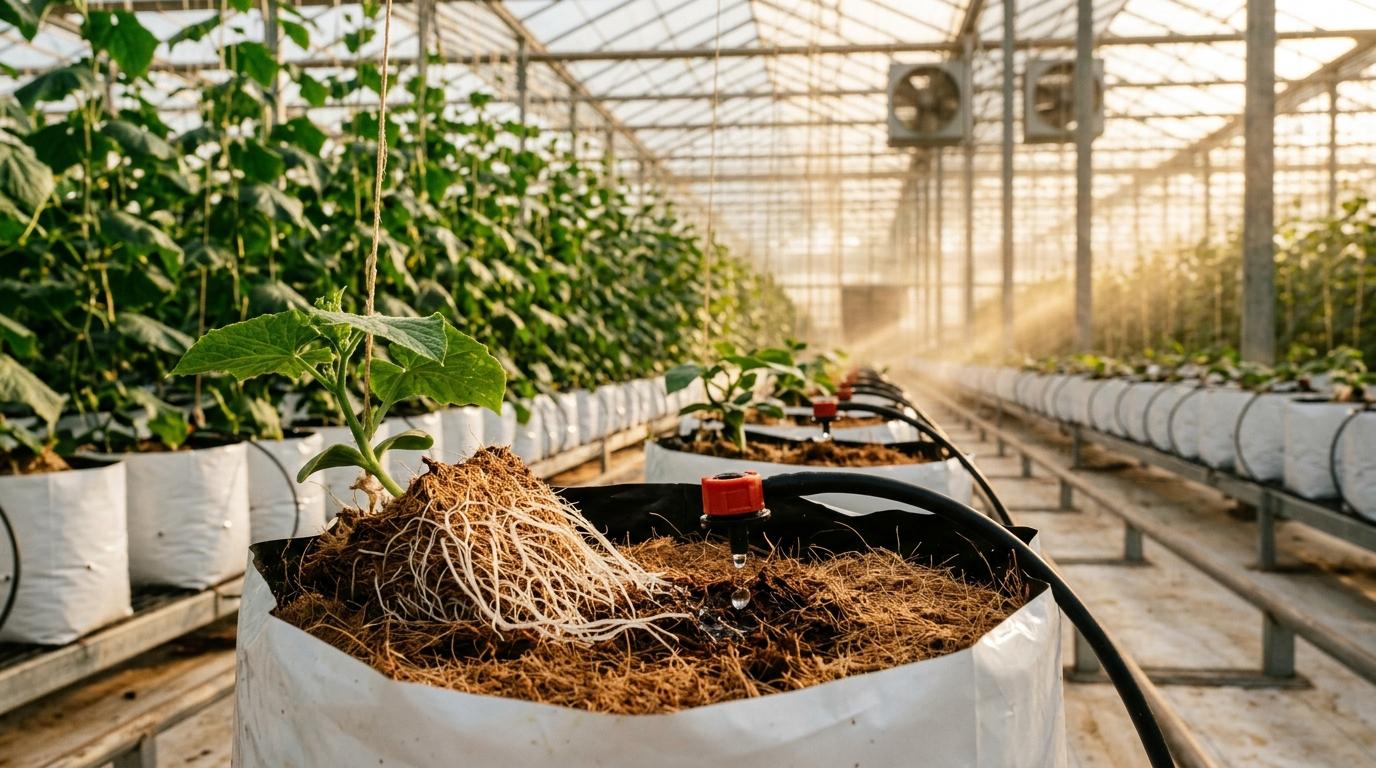
The hidden chemistry of cocopeat that no one explains to growers in Iraq and across the region
Every year the same story repeats across greenhouses from Baghdad to Basra, from Erbil to Karbala.
The grower transplants cucumber or tomato in the last weeks of summer. The first three weeks look excellent. Then, somewhere between week 4 and week 7, the crop quietly stops performing. Growth slows. New leaves cup or show marginal burn. Tomato fruit develops blossom-end rot in a season with no water shortage. Drain EC climbs even though nothing changed in the fertilizer recipe. Fruit set on the third and fourth truss is disappointing.
The grower blames the water. Or the seed. Or the fertilizer supplier. Or “bad cocopeat.”
Almost always, the real cause was decided on transplant day — by two invisible variables that were never measured: the exchange chemistry of the substrate, and the temperature of the root zone.
This article is about those two variables. If you produce under protected cultivation anywhere in Iraq, this is the most profitable ten minutes you will spend this month.
Part 1: The Most Expensive Misunderstanding in the Industry — “Low EC Means Good Cocopeat”
Ask any importer what makes cocopeat safe and you’ll hear one answer: low EC.
Low EC is necessary. But it is not sufficient. And believing that it is has cost regional growers millions of dollars in lost tonnage.
Here is why.
Coir is not an inert sponge. It is a chemically active exchanger.
Coconut coir has a genuinely high Cation Exchange Capacity (CEC) — commonly reported in the range of roughly 30–100 meq/100 g depending on origin, fiber-to-pith ratio and processing. Think of CEC as millions of microscopic negatively charged parking spaces on the surface of the coir.
In raw coconut husk, those parking spaces are naturally occupied mostly by potassium (K⁺) and sodium (Na⁺) — because the coconut grew in tropical, often coastal soils.
Now, what does washing actually do?
Washing flushes out the salts that are free in the water phase. That’s what your EC meter reads. Your EC drops, your Certificate of Analysis looks beautiful, and everyone is satisfied.
But washing does not empty the parking spaces. The K⁺ and Na⁺ held on the exchange sites are electrostatically bound. They are invisible to a simple EC test.
And then you start fertigating…
Your nutrient solution is rich in calcium (Ca²⁺) and magnesium (Mg²⁺) — divalent cations, which coir prefers far more strongly than monovalent K⁺ and Na⁺.
So the substrate does exactly what chemistry demands: it grabs your calcium and magnesium out of the solution and dumps sodium and potassium into the root zone in exchange.
The result, over the first 3–6 weeks after transplant:
| What the grower sees | What is actually happening |
|---|---|
| Blossom-end rot, tip burn, weak cell walls | Ca²⁺ adsorbed by substrate before roots can take it |
| Drain EC rising without reason | Na⁺ and K⁺ released from exchange sites |
| Mg deficiency (interveinal chlorosis) despite correct recipe | Mg²⁺ locked onto exchange sites |
| K:Ca ratio distorted, poor fruit firmness and shelf life | Excess K⁺ competing with Ca²⁺ and Mg²⁺ uptake |
| Sodium accumulation in root zone | Na⁺ displaced into solution, then concentrated by evaporation |
This is not a theory. It is standard substrate science — and it is the single most common reason a “perfectly washed, low-EC” cocopeat batch underperforms.
The solution: buffering (pre-charging)
Buffered cocopeat has been deliberately soaked in a calcium-rich solution (typically calcium nitrate) long enough for Ca²⁺ and Mg²⁺ to replace the Na⁺ and K⁺ on the exchange sites — and then rinsed to remove the displaced salts.
The exchange sites arrive at your farm already full of the right cations.
The difference in the field:
- Your nutrient recipe does what it says on paper from day one
- No unexplained Ca and Mg lock-up in weeks 3–6
- Sodium is not being released into the root zone
- Far more stable drain EC, so you can actually trust your measurements and steer the crop
Buy the chemistry, not the color. Two bags of cocopeat can look identical, share the same EC value, and behave like completely different products in week five.
Part 2: Why This Matters Far More in Iraq Than in Most Growing Regions
Here is the part that turns a technical detail into a business-critical decision.
Growers in Northern Europe buffer their coir as routine practice — but they irrigate with rainwater or RO water at near-zero sodium. They have a large margin for error.
Iraq does not have that margin.
Irrigation water quality across large parts of the country has deteriorated significantly over the past two decades. Reduced upstream flow in the Tigris and Euphrates, saline drainage return flows, and seawater intrusion into the Shatt al-Arab have pushed salinity and Sodium Adsorption Ratio (SAR) upward — with conditions in the far south considerably more severe than in the north. Many growers irrigate from wells or river water carrying a meaningful baseline of sodium and chloride before a single gram of fertilizer is added.
Now combine the two problems:
Saline, sodium-rich irrigation water + unbuffered cocopeat = two sodium sources feeding the same root zone, while your calcium is being stripped out.
Under those conditions the crop is fighting on two fronts simultaneously: an osmotic stress from the water, and an induced calcium deficiency from the substrate. Yields don’t collapse dramatically — they just quietly land 15–30% below potential, which is far more dangerous, because nobody investigates a crop that merely underperformed.
Flip it around, though, and there’s an opportunity most growers have never been told about:
A properly buffered coir substrate can work as a sodium buffer instead of a sodium source. Exchange sites loaded with calcium have a competitive advantage over sodium. Combined with a disciplined leaching fraction, substrate culture becomes one of the most practical tools available for producing high-value vegetables with imperfect water — precisely the situation facing most of Iraq’s protected cultivation sector.
For a country losing arable land to soil salinization every year, substrate cultivation is no longer a premium technique. It is an exit strategy from dying soil. But only if the substrate chemistry is right.
Part 3: The Second Silent Killer — Root-Zone Temperature in the Transplant Window
Now the timing question. Why is late August and September so decisive?
Because this is when Iraq’s autumn cucumber, tomato and pepper transplants go in — while ambient temperatures are still extreme.
Tomato and cucumber roots function best at roughly 20–25 °C. Above about 30 °C, root activity, oxygen availability and nutrient uptake begin to decline; sustained temperatures in the upper 30s cause real physiological damage.
Meanwhile, in a September greenhouse in central or southern Iraq, a black or dark grow bag sitting on a hot floor can easily push substrate temperature well beyond that threshold during the afternoon.
And here is the synthesis that almost nobody makes:
Calcium uptake is transpiration-driven and depends on active, healthy roots. Hot roots cannot absorb calcium. Unbuffered coir removes calcium from the solution. Together, they create a calcium crisis that no fertilizer program can fix — because the problem is not the recipe.
That is why the damage appears in November and December, while the cause was sitting in your greenhouse in September.
Practical countermeasures for the transplant window
- Use light-colored bags, sleeves or slab wraps. White or white-on-black outer film reflects radiation instead of absorbing it. This is one of the cheapest interventions available.
- Raise substrate off hot concrete or bare soil. Even a simple gutter, pallet or gravel layer reduces conductive heat transfer.
- Increase substrate volume where possible. More volume = more thermal mass = slower temperature swings. Autumn transplanting is the wrong moment to economize on litres per plant.
- Fully saturate and stabilize the substrate 24–48 hours before transplant — never plant into dry, hot coir.
- Use short, frequent irrigation pulses in the afternoon. Each pulse actively cools the root zone; water at 25 °C entering a 34 °C substrate is a cooling system you already own.
- Start your first-week irrigation earlier in the morning to avoid the plant beginning its day already in deficit.
- Inoculate biologicals at transplant, not later. Coir’s lignocellulosic structure is an excellent habitat for beneficial fungi and bacteria such as Trichoderma and Bacillus species. Heat and high moisture in the establishment phase also favor Pythium and Fusarium. Colonize the substrate before the pathogens do — the first two weeks are the window.
Part 4: The Grade You Choose in Summer Is a Winter Decision
This is another mistake with a long delay before the punishment arrives.
In September your greenhouse is hot, evaporation is high, and a fine, high-water-holding cocopeat feels perfect — it stays moist, it forgives irrigation errors, the crop establishes fast.
Then December arrives. Radiation drops, transpiration falls by more than half, and that same fine substrate no longer dries down between irrigations. Air-Filled Porosity (AFP) collapses. Roots go hypoxic. Root disease pressure rises. And your peak-price winter production window is exactly when the crop is weakest.
The substrate that is comfortable in summer becomes waterlogged in winter.
The answer is to select for the whole crop cycle, not the first month:
| Crop / situation | Suggested direction |
|---|---|
| Long-cycle cucumber & tomato, Sept → spring | Blend with a meaningful coarse chip fraction (commonly around 70/30 to 60/40 pith:chip) for winter AFP |
| Pepper and eggplant, long cycle | Coarser blends, higher AFP, careful winter dryback |
| Strawberry | Grade matched to plant density and container depth; drainage is critical |
| Nursery & propagation | Fine, uniform grade — short cycle, tight control, hygiene first |
| Saline irrigation water | Better drainage + higher leaching fraction; do not use the most water-retentive grade |
Part 5: The Economics Growers Miss — Cost Per Kilogram, Not Cost Per Bag
Substrate typically represents a small share of total production cost, yet it is often purchased on price per cubic metre alone. That is the wrong metric.
Two things change the calculation completely:
1. Reuse. With proper end-of-crop treatment — root removal, disinfection (steam or an approved method), re-testing and re-buffering — quality cocopeat can serve multiple crop cycles. Re-buffering matters, because the exchange sites do not stay conveniently loaded forever. Growers who master the reuse cycle can substantially reduce their effective substrate cost per season. Growers who reuse without disinfection and re-buffering usually pay for it with a disease outbreak.
2. Yield stability. A 20% swing in winter yield in a high-price window dwarfs the entire annual substrate budget. The right substrate is not a cost item — it’s insurance on your most valuable production weeks.
Part 6: Your 30-Day Autumn Protocol
Weeks 1–2 (now)
- Test your irrigation water: EC, pH, Na, Cl, Ca, Mg, HCO₃, SAR. Do not plan an autumn crop without this.
- Request a full Certificate of Analysis for your substrate — not just an EC number.
- Confirm your bag/slab color and whether substrate is insulated from the floor.
- Decide your pith:chip ratio based on your winter, not your September.
Week 3
- Place substrate in final position. Saturate fully. Check that every dripper delivers evenly (uniformity errors are amplified in hot weather).
- Verify pH and EC of the drain from a saturated bag before planting.
Week 4 — Transplant
- Transplant early morning or evening, never midday.
- Inoculate biologicals at planting.
- Run frequent short pulses; measure substrate temperature at root depth in the afternoon — not air temperature.
- Track drain EC and pH daily for the first 21 days. Stability here predicts your winter.
Part 7: What to Demand From Any Cocopeat Supplier
Do not accept a one-line EC claim. A serious supplier will provide:
- ✅ EC with the test method stated (1:1.5 volume extract vs. 1:5 — they are not comparable)
- ✅ pH
- ✅ Sodium, potassium, calcium, magnesium and chloride levels
- ✅ Confirmation of buffering — including what it was buffered with, not just the word “buffered”
- ✅ Air-Filled Porosity and Water-Holding Capacity
- ✅ Particle size distribution / pith-to-chip ratio
- ✅ Sand and impurity content (a common and expensive hidden problem)
- ✅ Moisture content and expansion ratio (so you know what you’re actually paying for per block)
- ✅ Batch number and traceability
- ✅ Phytosanitary certificate
If a supplier cannot answer these questions, they are selling you a bag. They are not selling you a growing medium.
Maya Dasht: We Sell Root Zones, Not Bags
At Maya Dasht, we produce and export washed and calcium-buffered cocopeat engineered for exactly the conditions our neighbours farm in: high heat, high radiation, and challenging irrigation water.
Why growers across Iraq work with us:
🔬 Full COA with every batch — EC (method stated), pH, Na, K, Ca, Mg, AFP, WHC, particle distribution, traceable batch number 🎯 Custom pith-to-chip blends formulated for your crop, your cycle length and your water analysis 🌡️ Buffered grades designed to protect your calcium program from day one 🚚 Fast, short-route logistics — land freight to Baghdad, Basra, Erbil, Najaf and Karbala via Iranian–Iraqi border crossings, with far shorter transit times and lower freight cost than sea shipments from South and Southeast Asia 🗣️ Technical support in Arabic, Kurdish, Persian and English — a real agronomist, not a call center 📦 Blocks, grow bags, slabs and open bales — plus consistent, repeatable supply, season after season
⏳ The window is closing
Autumn transplanting in Iraq happens in a matter of weeks. Substrate ordered too late gets planted in a rush, unstabilized, into a hot greenhouse — the exact scenario this article describes.
Take one of these three steps today:
- Request a free sample block + full batch COA — evaluate the product before you commit.
- Send us your water analysis and our agronomy team will recommend the specific grade, blend and leaching strategy for your farm — free of charge.
- Book a 20-minute technical call to review your autumn transplant plan before you plant, not after.
📩 Contact Maya Dasht — Ask for the Autumn Transplant Protocol, available in Arabic and English.
Your winter yield is being decided this month. Let’s decide it correctly.
FAQ
Is washed cocopeat the same as buffered cocopeat? No. Washing removes free salts from the water phase and lowers EC. Buffering replaces the sodium and potassium bound to the substrate’s cation exchange sites with calcium and magnesium. A batch can be well washed and still cause calcium lock-up if it was never buffered.
Can I buffer cocopeat myself on the farm? It is possible using a calcium nitrate solution with sufficient soaking time and a proper rinse, but consistency is difficult without volume control, water quality control and lab verification. Most growers get better and cheaper results with factory-buffered material.
Is cocopeat suitable for Iraq’s saline irrigation water? It can be an excellent choice — but only with buffered material, appropriate drainage, a sufficient leaching fraction, and a nutrient recipe adjusted to the water analysis. Substrate culture also allows you to grow independently of salinized soil.
Which cocopeat grade is best for autumn cucumber in Iraq? For a long autumn-to-spring cycle, a blend with a substantial coarse chip fraction is usually preferred, so that air-filled porosity remains adequate in low-transpiration winter months. The precise ratio depends on your irrigation system, container volume and water quality.
Can cocopeat be reused for a second crop? Yes, with root removal, effective disinfection, re-testing and re-buffering. Skipping disinfection or re-buffering is where reuse goes wrong.