
 Persian
 Arabic
 Russian


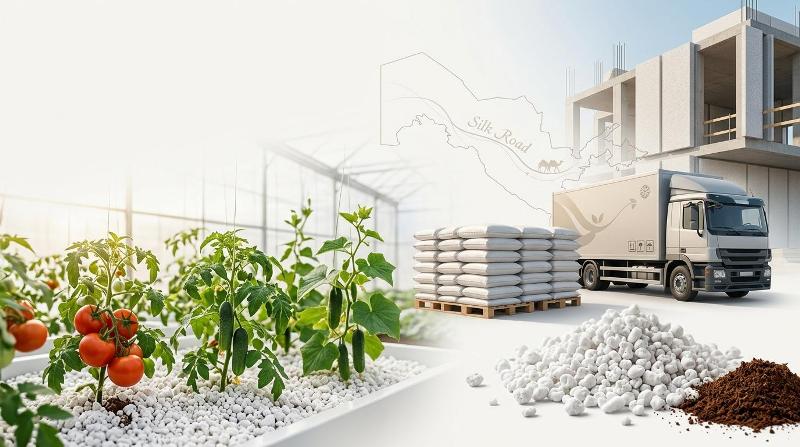
Perlite in Uzbekistan: Why This Mineral Is Becoming a Strategic Business Opportunity
Uzbekistan is developing two sectors with strong demand for efficient materials: agriculture and construction.
The expansion of greenhouse cultivation, the need for better water management and the growth of modern building projects are creating new opportunities for specialized materials. Among these materials, perlite has become increasingly important because it is lightweight, highly versatile, fire-resistant and suitable for both agricultural and industrial applications.
For Uzbekistani traders, importers and agricultural companies, perlite is not simply another product to add to a catalogue. It can become a valuable solution for customers who are looking to reduce production costs, improve efficiency and adopt more modern technologies.
The commercial opportunity is especially attractive for businesses that can provide more than the product itself: reliable quality, accurate technical information, competitive pricing and dependable delivery.
What Is Perlite?
Perlite is a naturally occurring volcanic mineral. When heated rapidly to a high temperature, it expands and forms a lightweight material with a porous structure.
This expanded structure gives perlite several important characteristics:
- Low bulk density
- High porosity
- Excellent aeration
- Good drainage
- Fire resistance
- Chemical stability
- Inorganic and durable structure
- Easy handling and transportation
Because of these properties, perlite is used in:
- Greenhouse cultivation
- Nurseries and seedling production
- Hydroponic systems
- Soil improvement
- Lightweight concrete
- Thermal insulation
- Fire-resistant construction materials
- Plaster and mortar production
- Industrial filtration
- Horticultural substrates
The commercial value of perlite depends on its grade, particle size, packaging, cleanliness, density and intended application.
Why Perlite Matters for Uzbekistan’s Agriculture
Agriculture remains one of the most important sectors of Uzbekistan’s economy. At the same time, agricultural producers face several technical challenges, including:
- Water management difficulties
- High summer temperatures
- Soil compaction
- Limited root-zone aeration
- Salinity in some growing areas
- Uneven soil quality
- Increasing demand for greenhouse production
- The need to improve the quality of fruits and vegetables
Perlite can support modern agricultural production by improving the physical condition of the root zone.
1. Better Root-Zone Aeration
Plant roots require oxygen as well as water and nutrients. When soil or growing media becomes compacted, air circulation around the roots decreases.
Perlite creates air spaces within the growing medium. This can help:
- Improve oxygen availability
- Support healthier root development
- Reduce compaction
- Improve drainage
- Create a more stable growing environment
This is particularly useful in greenhouse production, nurseries and container cultivation.
2. Improved Drainage
Excess water around the roots can create serious problems, including root disease, weak growth and nutrient imbalance.
Perlite helps excess water move through the growing medium while maintaining a degree of moisture around the roots. This makes it suitable for growing media that require a balance between:
- Moisture retention
- Drainage
- Air porosity
- Root stability
Perlite is often combined with cocopeat, peat-based media or other substrates to create a more balanced growing environment.
3. Supporting Efficient Irrigation
Perlite does not replace an irrigation system, but it can improve the physical performance of the growing medium.
When used correctly, it may help producers manage irrigation more efficiently by reducing waterlogging and improving the distribution of water within the root zone.
For greenhouse growers in Uzbekistan, this can be especially valuable when managing:
- High temperatures
- Frequent irrigation cycles
- Container-grown crops
- Seedlings
- Hydroponic systems
- High-value vegetables and ornamental plants
4. Suitable for Greenhouses and Nurseries
Perlite is widely used in commercial horticulture because it is lightweight, clean and easy to mix with other substrates.
Potential applications include:
- Tomato and cucumber production
- Pepper cultivation
- Strawberry growing
- Vegetable seedlings
- Ornamental plants
- Indoor and protected cultivation
- Rooting cuttings
- Hydroponic growing systems
The correct particle size should be selected according to the crop, container, irrigation method and production system.
Perlite and Cocopeat: A Practical Combination for Uzbek Growers
Perlite and cocopeat are often used together because they provide complementary physical properties.
- Cocopeat generally supports moisture retention.
- Perlite improves aeration and drainage.
A combined growing medium can be adjusted according to the needs of the crop and the environmental conditions of the greenhouse.
Example of application-based mixtures
| Growing Medium | Possible Advantage |
|---|---|
| Cocopeat with a small percentage of perlite | Higher moisture retention with improved aeration |
| Balanced cocopeat-perlite mixture | Suitable for many greenhouse applications |
| Higher perlite content | More drainage and air porosity for moisture-sensitive crops |
These are general starting points, not universal formulas. The final ratio should consider:
- Crop type
- Irrigation frequency
- Water quality
- Greenhouse temperature
- Container size
- Drainage capacity
- Production cycle
A professional supplier should help the buyer select the correct grade and combination instead of offering the same product for every application.
Perlite for Uzbekistan’s Construction Sector
Perlite also has important applications in construction. As Uzbekistan continues to develop residential, commercial and industrial buildings, the demand for lightweight and energy-efficient materials is increasing.
Expanded perlite can be used in:
- Lightweight concrete
- Insulating plasters
- Mortars
- Roof insulation
- Wall insulation systems
- Fire-resistant panels
- Chimney and industrial insulation
- Floor leveling compounds
- Precast construction products
1. Lightweight Construction
Expanded perlite has a low density compared with many traditional mineral aggregates.
When used in lightweight concrete or mortar, it can help reduce the dead load of certain building components. This may create advantages in:
- Roof systems
- Floor layers
- Partition walls
- Insulating panels
- Non-structural concrete
- Renovation projects
Reducing material weight can also simplify handling and improve installation efficiency.
2. Thermal Insulation
Uzbekistan experiences significant seasonal temperature differences. Buildings require materials that can help improve thermal performance during both hot and cold periods.
Perlite-based insulation materials can contribute to:
- Lower heat transfer
- Improved indoor comfort
- Reduced heating and cooling demand
- Better energy performance
- More efficient building envelopes
The actual performance depends on density, formulation, installation quality and the complete construction system.
3. Fire Resistance
Perlite is an inorganic mineral and is naturally non-combustible. This makes it attractive for applications where fire performance is important.
It may be incorporated into:
- Fire-resistant plasters
- Insulating boards
- Mortars
- Industrial insulation systems
- Chimney and furnace insulation
For construction companies and material distributors, fire resistance can be a strong commercial advantage when supplying projects that require higher safety standards.
4. Easier Handling
The lightweight nature of expanded perlite can reduce the physical effort required for mixing and installation. It can also be useful in projects where transportation, lifting and manual handling are important cost factors.
The Most Important Perlite Quality Factors for Uzbekistani Buyers
Not all perlite products are suitable for every customer. Before importing or distributing perlite in Uzbekistan, traders should evaluate the following technical factors.
Particle Size
Different applications require different grades.
- Fine perlite may be used in some soil mixes and specialized applications.
- Medium grades may be suitable for general horticulture.
- Coarser grades may provide greater aeration and drainage.
- Construction applications may require a specific grading and density.
The wrong particle size can reduce product performance and lead to customer dissatisfaction.
Bulk Density
Bulk density affects:
- Transportation cost
- Storage volume
- Mixing performance
- Final product weight
- Application efficiency
A trader should compare the price not only per ton but also according to the usable volume and performance of the product.
Moisture Content
Excess moisture can increase the effective transportation weight and reduce storage efficiency. Buyers should clarify whether the quoted weight is based on a dry or moist product.
Cleanliness and Consistency
Agricultural perlite should be clean and consistent. Irregular material can create problems during mixing, filling and irrigation.
For repeat commercial orders, consistency between shipments is particularly important.
Packaging
Perlite is lightweight but occupies considerable space. Appropriate packaging can reduce:
- Product loss
- Dust during handling
- Exposure to moisture
- Damage during transportation
- Warehouse problems
Packaging should be selected according to shipment size, destination and the customer’s storage conditions.
How Uzbekistani Traders Can Evaluate the Real Cost of Perlite
The lowest price per ton does not always represent the best commercial opportunity.
The actual cost should include:
Total Cost = Product Price + Packaging + Loading + Transportation + Handling + Storage + Delivery-Related Expenses
Traders should also calculate:
Cost per Usable Volume = Total Delivered Cost ÷ Usable Product Volume
This method is useful because two products with the same weight may have different bulk densities, packaging formats and usable volumes.
Before confirming an order, ask the supplier for:
- Product grade
- Particle-size distribution
- Bulk density
- Moisture content
- Packaging type
- Net weight per bag
- Number of bags per shipment
- Loading details
- Estimated preparation time
- Delivery options
- Technical data, if available
Clear information at the beginning helps prevent unexpected costs later.
Why Reliable Supply Is Essential for the Uzbekistan Market
For Uzbekistani agricultural and construction companies, delayed delivery can lead to more than inconvenience.
A delayed shipment may cause:
- Greenhouse planting delays
- Missed production cycles
- Project interruptions
- Higher warehouse costs
- Additional sourcing expenses
- Customer dissatisfaction
- Loss of commercial opportunities
This is why traders need a supplier that understands both the product and the logistics process.
A reliable supply partner should support the buyer with:
- Product selection
- Quantity planning
- Technical clarification
- Packaging coordination
- Price calculation
- Shipment preparation
- Transportation planning
- Delivery communication
- Repeat-order management
The ability to coordinate these steps can be more valuable than a small difference in the initial product price.
Why Mayadasht Can Be a Strategic Supply Partner
Mayadasht supplies perlite and other agricultural growing media for international buyers, including traders, greenhouse companies and agricultural professionals.
The focus is not limited to selling a mineral product. The objective is to provide a practical supply solution based on the buyer’s application, quantity and destination.
Advantages for Uzbekistani Buyers
Application-Based Product Selection
Perlite for hydroponics may not be identical to perlite for soil improvement or construction. Mayadasht can help buyers identify the appropriate product according to the intended use.
Competitive Commercial Planning
The quotation process can be evaluated according to:
- Required volume
- Product specification
- Packaging
- Delivery destination
- Transportation conditions
- Supply schedule
This provides a clearer understanding of the final commercial cost.
Agricultural and Technical Consultation
Professional guidance can help traders and agricultural companies avoid purchasing unsuitable grades or incorrect quantities.
Consultation may cover:
- Agricultural perlite
- Perlite and cocopeat combinations
- Greenhouse growing media
- Nursery applications
- Product packaging
- Bulk supply planning
Logistics Coordination
Fast and reliable transportation is an important part of international trade. Mayadasht works with buyers to coordinate the supply process and identify practical delivery options for Uzbekistan.
Long-Term Cooperation
For importers and distributors, one successful shipment is not enough. Consistent product quality, clear communication and repeat-order capability are essential for building a profitable market position.
A Practical Business Model for Perlite Importers in Uzbekistan
Traders can develop several commercial models around perlite:
1. Distribution to Greenhouse Suppliers
Perlite can be supplied to companies selling greenhouse equipment, irrigation systems and growing media.
2. Direct Supply to Agricultural Producers
Large greenhouse farms and nurseries may prefer direct purchasing in bulk quantities.
3. Retail and Small-Pack Sales
Smaller packaging can target:
- Nurseries
- Garden centers
- Small farms
- Urban growers
- Ornamental plant businesses
4. Combined Product Supply
Offering perlite together with cocopeat and coco chips can create a more complete solution for greenhouse customers.
5. Construction Material Distribution
Construction companies may require perlite for lightweight concrete, insulating plasters and fire-resistant applications.
Traders who understand both agricultural and construction uses can reach a wider customer base.
Questions Uzbekistani Buyers Should Ask Before Ordering Perlite
Before placing an order, request clear answers to the following:
- What type of perlite is available?
- Is it intended for agriculture, construction or both?
- What particle sizes are offered?
- What is the bulk density?
- What is the moisture content?
- How is the product packaged?
- What is the minimum order quantity?
- How quickly can the order be prepared?
- What is the estimated delivery time?
- Can the supplier support repeat orders?
- Is technical consultation available?
- Can perlite be supplied with cocopeat or coco chips?
A supplier that responds clearly and professionally is more likely to support a stable long-term business relationship.
Conclusion: Perlite Is a Business Opportunity, Not Just a Commodity
The demand for efficient agricultural and construction materials is creating new opportunities in Uzbekistan.
Perlite can serve multiple markets because it offers:
- Improved aeration for plant roots
- Better drainage
- Support for greenhouse production
- Lightweight construction solutions
- Thermal insulation benefits
- Fire-resistant characteristics
- Easier handling and transportation
However, commercial success depends on more than importing the product. Uzbekistani traders must pay attention to quality, grading, packaging, delivered cost, technical suitability and supply reliability.
The strongest opportunity belongs to companies that can offer customers a complete solution rather than a simple bag of material.
Mayadasht supports Uzbekistani traders, agricultural companies and construction-material distributors with perlite supply, related growing media, technical consultation and logistics coordination.
If you are looking for agricultural perlite, construction perlite or a combined supply of perlite and cocopeat for Uzbekistan, contact the Mayadasht team with the following information:
- Required quantity
- Intended application
- Delivery city
- Preferred packaging
- Expected delivery schedule
A well-planned supply process can help you reduce purchasing risk, improve customer satisfaction and build a stronger position in Uzbekistan’s growing agricultural and construction markets.