
 Persian
 Arabic
 Russian


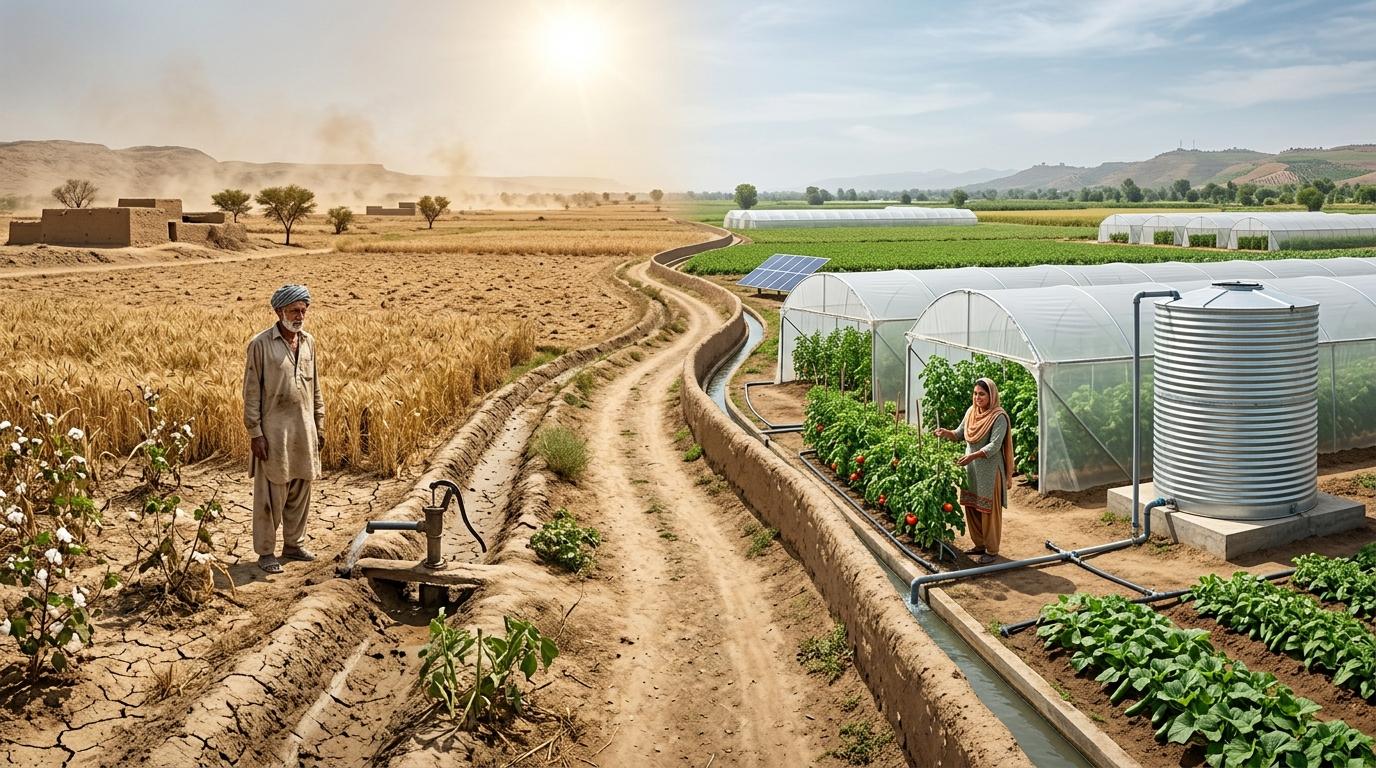
In Pakistan, agriculture is under pressure—but it is also entering a more technical era.
For many years, farm decisions were often driven by land availability, seasonal timing, and traditional cultivation methods. But today, the reality is changing. Water is becoming less predictable, weather stress is becoming more expensive, and growers are under growing pressure to protect yield, improve efficiency, and reduce avoidable losses.
This is why agricultural progress in Pakistan is no longer only about seeds, fertilizers, or irrigation schedules. Increasingly, it is about farm infrastructure.
And in many cases, the difference between vulnerable farming and resilient farming begins with simple but strategic equipment:
- prefabricated water tanks
- greenhouse plastic
- protective agricultural films
- and other support materials that make production more stable
These are not secondary products anymore. In modern farming systems, they are part of the production strategy.
Pakistan’s Agricultural Challenge Is Not Just Production—It Is Stability
Pakistan has strong agricultural potential, but potential alone is not enough in a climate-sensitive environment.
Growers across different regions face serious operational challenges:
- irregular access to irrigation water
- high evaporation losses
- heat stress
- weather fluctuations
- pressure on input efficiency
- and the need to protect crops during sensitive growth stages
Under these conditions, every weak point in the farm system becomes more costly.
A farm may have good land and strong crop demand, but if water cannot be stored reliably, if greenhouse covering performs poorly under heat, or if production structures are not protected properly, profitability becomes fragile.
This is why the conversation should shift from “what inputs do we buy?” to:
What infrastructure helps us protect production under real Pakistani conditions?
Why Prefabricated Water Tanks Matter More Than Many Farmers Realize
Water is not useful only when it exists.
It is useful when it is available at the right time, in the right volume, and under control.
That is where prefabricated agricultural tanks become important.
In many farming systems, water loss does not only happen in the field. It happens before irrigation even begins:
- poor storage
- leakage
- evaporation
- contamination
- or lack of sufficient holding capacity during critical periods
Prefabricated tanks help solve this problem by turning uncertain water access into planned water availability.
For farmers in Pakistan, this matters because irrigation timing often affects not just plant growth, but input efficiency, labor planning, and crop survival under heat.
A reliable storage solution can help growers:
- hold reserve water for critical irrigation windows
- improve irrigation planning
- reduce dependence on immediate water flow
- support greenhouse and nursery operations
- and create more confidence in dry or variable conditions
A tank is not just a container.
In many cases, it is the first line of production stability.
Greenhouse Plastic Is Not Just a Cover—It Is a Climate Tool
One of the most underestimated agricultural materials in developing markets is greenhouse plastic.
Many buyers still compare greenhouse film mainly by thickness, price, or visual appearance. But in reality, greenhouse plastic directly affects the crop environment.
It influences:
- light transmission
- temperature behavior
- humidity balance
- crop protection
- and overall growing stability
In Pakistan, where heat and radiation can become serious constraints, greenhouse covering should be evaluated as a performance material—not just a construction accessory.
Poor-quality plastic may lead to:
- faster degradation under sun exposure
- unstable greenhouse temperature
- reduced crop protection
- shorter service life
- and more frequent replacement costs
By contrast, the right greenhouse film can improve the microclimate, support better crop management, and reduce environmental stress inside the structure.
This is especially important for:
- vegetable growers
- tunnel farming systems
- nurseries
- off-season production
- and protected cultivation projects
In this context, greenhouse plastic becomes part of agricultural engineering—not just farm packaging.
The Real Opportunity: Better Infrastructure Before More Inputs
In many farms, when production problems appear, the first reaction is to add more fertilizer, more irrigation, or more correction.
But this is not always the smartest response.
If the farm lacks infrastructure, extra inputs often become less efficient.
For example:
- More fertilizer cannot compensate for irregular water storage.
- Better seeds cannot fully perform in unstable protected structures.
- Good irrigation planning loses value if water reserve systems are weak.
- High-value crops become riskier if greenhouse covering cannot protect the environment properly.
That is why the more advanced question in Pakistani agriculture is not only: What should we apply?
It is: What should we build first?
This is where equipment such as prefabricated tanks, greenhouse films, protective covers, and structural farm materials create long-term value.
Protected Farming in Pakistan Needs Better Materials, Not Just Bigger Structures
Protected farming is growing in Pakistan, but structure alone is not enough.
A greenhouse, tunnel, or covered cultivation system is only as strong as the materials that define its working environment.
If the covering material is weak, the internal climate becomes unstable.
If the water storage system is weak, irrigation becomes reactive.
If the support materials are low quality, the whole project loses reliability faster than expected.
This is a key issue for agricultural investors and commercial growers.
Because protected farming should not only be judged by installation cost. It should be judged by:
- durability
- performance consistency
- crop protection
- and operational efficiency over time
That means equipment decisions should be made with a system mindset.
In Pakistan, this mindset is becoming more relevant as growers move toward higher-value production and more controlled systems.
Why the Pakistani Market Is a Serious Opportunity for Agricultural Equipment
Pakistan is not only a country with agricultural demand. It is a market where infrastructure gaps still create major opportunities.
That is why agricultural equipment suppliers should not position products as simple items for sale. Instead, they should communicate how each product solves a production weakness.
For example:
- prefabricated tanks solve water timing and storage risk
- greenhouse plastic solves environmental instability in protected cultivation
- agricultural covers and films improve protection, durability, and crop management
- related farm materials help growers move from reactive farming to planned farming
This positioning is much stronger than product-only marketing.
Because serious buyers in Pakistan are not only buying material.
They are trying to improve control.
And in modern agriculture, control is one of the most valuable assets a farm can have.
Conclusion: The Future of Farming in Pakistan Will Depend on Better Agricultural Infrastructure
Pakistan’s agricultural future will not be shaped by inputs alone.
It will increasingly depend on how farms manage water, protect crops, and build systems that remain functional under stress.
This is why products like prefabricated tanks and greenhouse plastic deserve more attention. They are not side products. They are core tools for building more reliable agriculture.
When chosen correctly, these materials can help growers:
- use water more strategically
- protect production environments
- reduce preventable losses
- and make farming systems more resilient
In a market facing climate pressure, water uncertainty, and growing demand for efficiency, infrastructure is no longer optional.
It is strategic.
CTA | Build Smarter Farm Systems, Not Just Bigger Ones
At Mayadasht, we believe agricultural materials should not be offered as isolated products.
They should be matched to the real needs of the farm system.
If you are exploring:
- prefabricated agricultural tanks
- greenhouse plastic
- protective agricultural films
- or related farm infrastructure materials for Pakistan
our team can help you evaluate the right solution based on your project, climate conditions, and production goals.
Free Technical Consultation
Our specialists are ready to provide free consultation to help you make a more confident and practical decision before purchase.
👉 Contact Mayadasht to discuss the right agricultural infrastructure solution for your farm or project in Pakistan.