
 Persian
 Arabic
 Russian


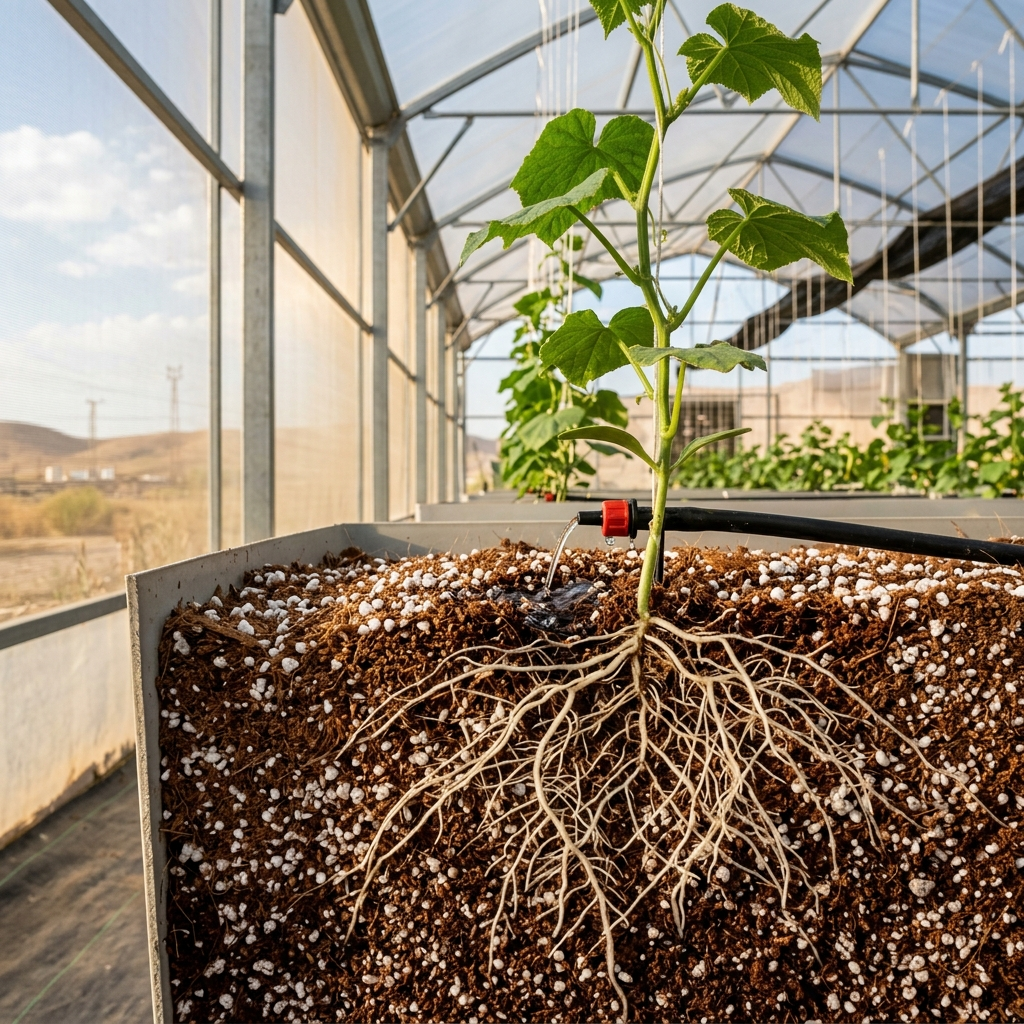
Iraq’s Agricultural Reality: One Substrate Does Not Fit All
Iraqi agriculture operates under extreme and highly variable conditions:
- High summer temperatures
- Fluctuating water quality (often elevated EC)
- Increasing greenhouse adoption
- Pressure for higher yield per square meter
- Limited margin for irrigation mistakes
In such an environment, choosing a growing medium is not a purchasing decision.
It is a risk management strategy.
Yet many growers still ask a simplified question:
“Should I use cocopeat or perlite?”
The more accurate question is:
“What substrate structure does my crop–water–climate system actually require?”
Cocopeat: Water Management Powerhouse
Cocopeat (coconut coir pith) is an organic substrate derived from coconut husk processing. When properly processed and buffered, it offers:
✅ High Water Holding Capacity
Ideal for hot climates where irrigation frequency is high.
✅ Strong Cation Exchange Capacity (CEC)
Helps retain nutrients like potassium, calcium, and magnesium.
✅ Structural Stability
Better resistance to compaction compared to traditional soil.
✅ Suitability for:
- Greenhouse vegetables (tomato, cucumber, pepper)
- Strawberry production
- Seedling propagation
- Hydroponic grow bags
In Iraq’s hot regions, cocopeat can reduce plant stress during peak temperatures by maintaining a more stable moisture environment around roots.
However…
Cocopeat is not a magic solution.
If water EC is high and drainage management is poor, cocopeat may accumulate salts.
If irrigation scheduling is incorrect, over-saturation can reduce oxygen availability.
Perlite: Oxygen and Drainage Specialist
Perlite, a volcanic expanded mineral, is fundamentally different:
✅ Extremely High Air-Filled Porosity
Excellent oxygen supply to roots.
✅ Inert and Chemically Stable
No nutrient interaction or buffering complications.
✅ Fast Drainage
Reduces risk of root diseases in humid or over-irrigated systems.
Perlite performs exceptionally well in:
- High-frequency irrigation systems
- Heavy fertigation programs
- Situations where root aeration is critical
But alone, perlite holds less water than cocopeat.
In Iraq’s extreme heat, pure perlite may require tighter irrigation control.
Cocopeat vs Perlite: It’s Not a Competition
This is where many suppliers oversimplify the conversation.
The decision is not:
- Cocopeat or
- Perlite
The real strategy often becomes:
- Cocopeat plus
- Perlite
A properly engineered blend can deliver:
| Cocopeat | Perlite | Result |
|---|---|---|
| Water retention | Air porosity | Balanced root zone |
| Nutrient buffering | Structural drainage | Stable EC control |
| Moisture stability | Oxygenation | Reduced stress |
For Iraqi greenhouse systems, mixed substrates frequently outperform single-component media.
What About Peat Moss?
Peat moss also plays a role in certain systems, particularly:
- Nurseries
- Seed trays
- Ornamental production
But in hot climates with water variability, peat-based systems may require additional drainage management.
The Bigger Issue: Substrate Engineering
The real competitive advantage in Iraqi agriculture is not choosing a product.
It is designing a substrate system based on:
- Crop type
- Root sensitivity
- Irrigation method
- Water EC and bicarbonate levels
- Climate zone
- Greenhouse vs open field
- Target yield per m²
A strawberry grower in Erbil may need a different substrate formula than a tomato producer in Basra.
A nursery operator may need different porosity than a hydroponic cucumber farm.
There is no universal answer.
Why Consultation Matters in Iraq
Many substrate failures in the region are not product failures.
They are design failures:
- Wrong particle size
- Incorrect blending ratio
- Poor drainage planning
- Ignoring water analysis
- Using imported substrate without regional adaptation
This is why professional consultation is becoming increasingly critical.
A proper recommendation should start with:
- Water analysis
- Climate profile
- Crop plan
- Irrigation strategy
- Production goals
Only then should the material be selected.
Strategic Takeaway for Iraqi Growers and Traders
Cocopeat is powerful.
Perlite is essential.
Peat moss has its place.
But the real opportunity lies in customized growing media solutions.
The future of high-efficiency agriculture in Iraq will not be built on selling substrates.
It will be built on engineering the root zone.
If you are:
- A greenhouse investor
- An agronomist
- A nursery manager
- An agricultural input trader
The question is no longer “What should I buy?”
The question is:
“What root-zone system gives me the lowest risk and highest performance under Iraqi conditions?”
And sometimes, the right answer is not one product —
but the right combination, backed by the right technical guidance.