
 Persian
 Arabic
 Russian


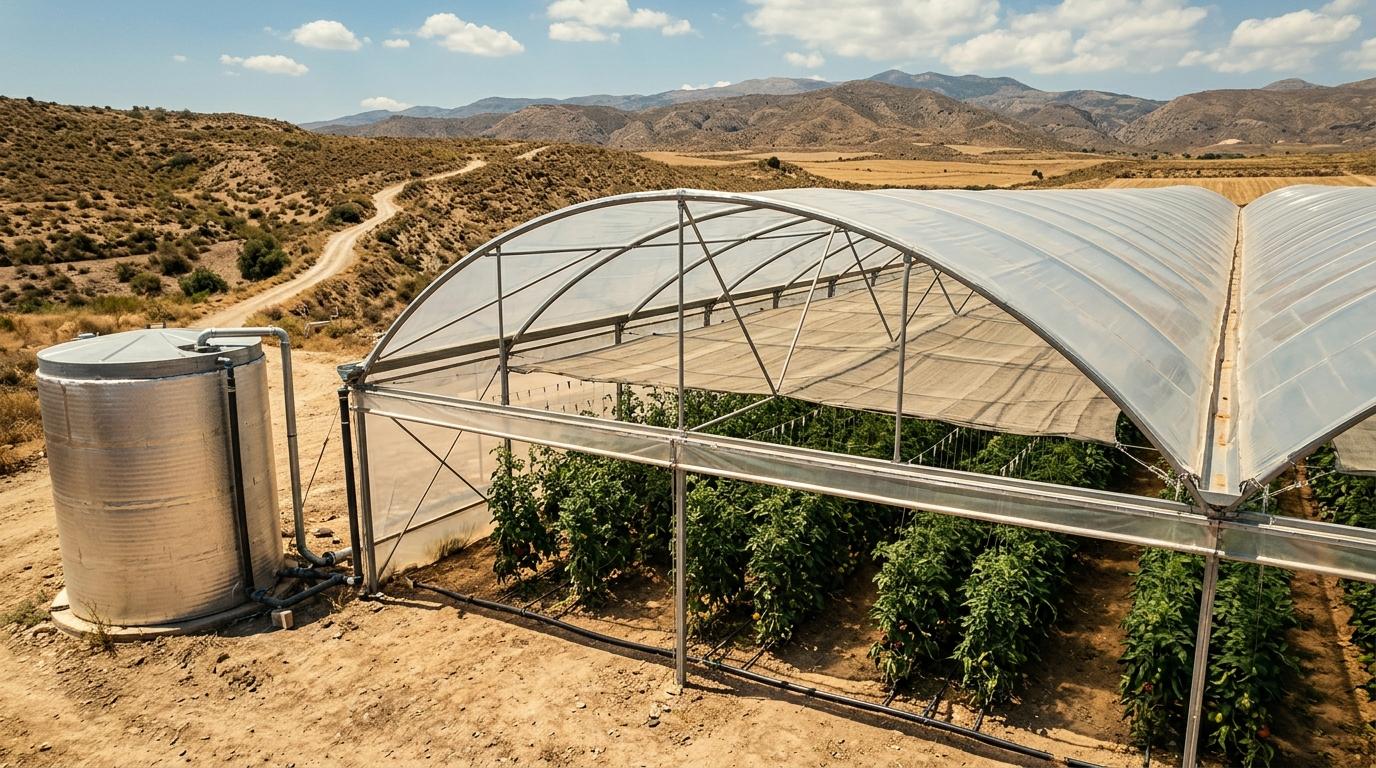
In hot-climate agriculture, greenhouse success is often discussed in terms of crop selection, irrigation scheduling, or climate control technology. All of these matter. But before any of them can perform well, one more basic question must be answered:
Is the greenhouse infrastructure strong enough to support stable production?
This is where many agricultural projects become vulnerable. A greenhouse may look complete from the outside, but if the supporting materials inside the system are weak, poorly selected, or treated as secondary, the entire project can become less efficient, more expensive, and harder to manage under environmental pressure.
For agricultural experts, greenhouse managers, and project planners, this is an important shift in thinking. A greenhouse should not be evaluated only as a structure. It should be understood as an integrated operational system — one that depends on the right materials for water storage, covering stability, irrigation accuracy, structural fixing, and heat management.
Among the many components used in protected cultivation, six infrastructure materials play a particularly important role in hot and water-sensitive agricultural environments:
- water tanks,
- greenhouse plastic,
- polyester wire,
- irrigation tape,
- spring and locking systems,
- and shade nets.
These are not just accessories. In many cases, they determine whether a greenhouse remains stable, efficient, and commercially reliable when conditions become more demanding.
1. Water Tanks: The Foundation of Operational Stability
In greenhouse agriculture, water is not only an input. It is the operating lifeline of the entire system.
This is especially true in hot climates, where irrigation demand rises quickly and any disruption in supply can create immediate stress in the crop. Under these conditions, a water tank is not simply a storage unit. It is part of the infrastructure that protects the greenhouse from operational instability.
A properly selected tank helps support:
- irrigation continuity,
- better scheduling,
- more controlled water availability,
- compatibility with fertigation systems,
- and reduced vulnerability to supply interruptions.
For technical decision-makers, this matters because the greenhouse environment is less forgiving than open-field production. When water delivery becomes inconsistent, stress accumulates faster and affects crops more uniformly.
That is why tank planning should be seen as part of greenhouse design, not something added later for convenience.
2. Greenhouse Plastic: More Than a Covering Layer
Greenhouse plastic is often treated as a simple covering material, but in reality, it is one of the most important performance layers in protected cultivation.
It directly affects the internal growing environment by influencing:
- light transmission,
- heat behavior,
- humidity balance,
- durability of the structure,
- and the stability of the crop environment.
In hot-climate agriculture, the quality of greenhouse plastic becomes even more important. A weak or poorly chosen film may reduce environmental control, age faster under strong sunlight, and increase long-term replacement and maintenance costs.
For specialists, the real question is not whether the plastic can cover the greenhouse. The real question is whether it can help create a controlled production environment over time.
This is why greenhouse plastic should be evaluated as an agronomic and operational material, not only as a construction item.
3. Polyester Wire: A Quiet but Critical Support Material
Some of the most important greenhouse materials are not always the most visible.
Polyester wire is a good example. It may appear secondary at first glance, but in practice, it plays an important role in supporting greenhouse covering systems, guiding structure, and helping maintain the stability of shade or support installations.
Its value lies in its practical performance:
- resistance to tension,
- lower vulnerability to corrosion compared with some alternatives,
- suitability for structural support roles,
- and usefulness in maintaining organized greenhouse systems.
In high-temperature agricultural environments, support materials must do more than simply hold parts together. They must remain reliable under stress, repeated use, and long periods of exposure.
For this reason, polyester wire should be understood as a technical support component, not just a minor accessory.
4. Irrigation Tape: Precision Matters More Than Water Volume
In agriculture under heat pressure, water efficiency matters as much as water availability.
This is why irrigation tape has become one of the most practical and essential materials in greenhouse and intensive cultivation systems. It supports targeted water delivery directly where it matters most: near the root zone.
This creates several important benefits:
- more efficient use of water,
- reduced surface evaporation,
- more controlled irrigation patterns,
- better support for crop uniformity,
- and lower waste compared with less precise watering approaches.
For technical experts, irrigation tape should not be viewed only as a low-cost irrigation tool. Its real value is in helping the greenhouse function as a precise agricultural system.
In hot climates, where both water pressure and crop sensitivity are higher, this level of irrigation control becomes strategically important.
5. Spring and Locking Systems: Small Components, Large Consequences
In greenhouse projects, some failures begin with very small weaknesses.
A covering system that loosens under wind pressure, a poorly fixed film edge, or an unstable shade installation may initially seem like minor technical issues. But over time, these weaknesses can affect covering performance, structural reliability, and maintenance cost.
This is why spring and locking systems matter.
They help:
- fix greenhouse plastic securely,
- support shade net or insect net installation,
- maintain tighter and more reliable covering positions,
- reduce the risk of movement or loosening,
- and improve the durability of the installation as a whole.
For professionals involved in greenhouse planning, these components represent a simple but important principle: infrastructure reliability is often built through the right details.
A greenhouse can only perform well when its covering and protection systems remain stable under real operating conditions.
6. Shade Nets: A Smarter Response to Heat and Light Pressure
As hot-climate agriculture becomes more challenging, shade management is no longer optional in many greenhouse and nursery systems.
Excessive solar radiation and heat load can increase plant stress, accelerate water loss, and reduce environmental stability. This is where shade nets become particularly valuable.
Their role goes beyond blocking sunlight. They help create a more balanced production environment by contributing to:
- reduced heat intensity,
- better light moderation,
- lower risk of sun stress,
- improved crop comfort,
- and in some cases, more manageable water demand.
For agricultural specialists, shade nets are part of climate strategy. They support the greenhouse not by replacing other systems, but by reducing pressure on them.
In hot periods, a well-planned shading approach can improve the overall behavior of the protected cultivation environment.
Why These Six Materials Should Be Seen as One System
One of the most common mistakes in greenhouse planning is to evaluate materials individually rather than operationally.
A tank, a plastic film, an irrigation line, a fixing system, a wire, and a shade net may appear to belong to different categories. But in practice, they interact with one another inside the same production environment.
A greenhouse becomes stronger when:
- water supply is stable,
- irrigation is precise,
- covering is durable,
- fixing systems are reliable,
- structural support materials perform consistently,
- and heat/light pressure is reduced intelligently.
This is why these six materials should not be treated as a list of products. They should be treated as coordinated infrastructure components.
For experts and decision-makers, this systems view is more useful than a purchasing view. Because the goal is not just to buy materials. The goal is to build a greenhouse environment that remains functional under pressure.
Conclusion: Strong Greenhouses Are Built Through Practical Infrastructure
In hot-climate agriculture, greenhouse performance is not determined by structure alone.
It is shaped by the practical materials that support daily operation, climate response, irrigation continuity, and environmental control. Water tanks, greenhouse plastic, polyester wire, irrigation tape, spring and locking systems, and shade nets each contribute to a different part of that stability.
Individually, they may seem simple.
Together, they define whether a greenhouse system can operate with confidence.
For agricultural experts, project planners, and greenhouse managers, this is the key takeaway: the quality of a greenhouse is often decided by infrastructure materials that are easy to underestimate.
In demanding climates, those materials are not secondary.
They are the difference between a greenhouse that merely exists and a greenhouse that truly performs.
CTA | Free Expert Consultation
If you are evaluating greenhouse infrastructure materials for a project in a hot-climate market — including water tanks, greenhouse plastic, polyester wire, irrigation tape, spring locking systems, and shade nets — our team can help you make a more informed technical decision.
Free Technical Guidance
We offer free expert consultation for agricultural specialists, greenhouse managers, and project decision-makers who want to choose the right materials before procurement.
👉 Contact our team to discuss the best greenhouse infrastructure strategy for your project.