
 Persian
 Arabic
 Russian


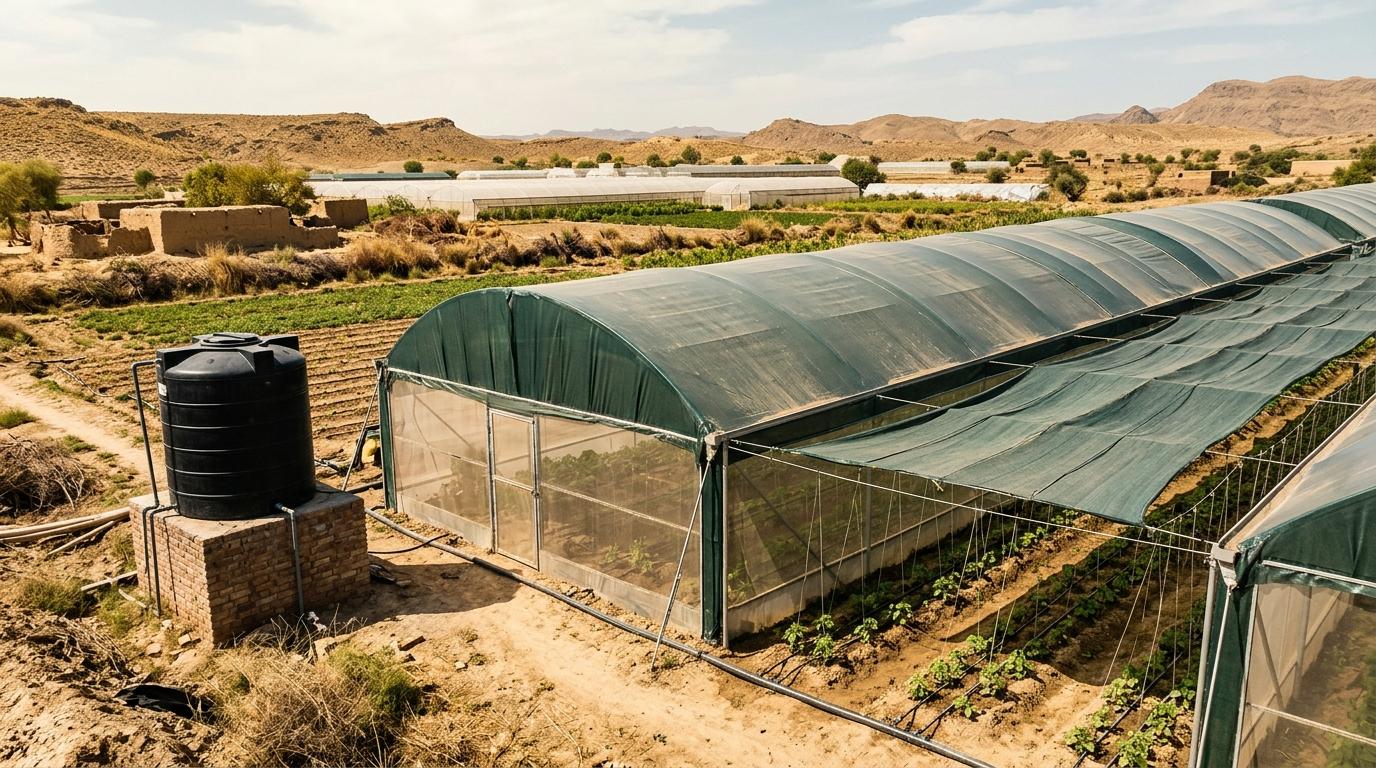
In Pakistan, greenhouse success is often discussed through crop choice, irrigation schedules, fertilizer programs, or seasonal opportunity. All of these matter. But in practice, many production systems become vulnerable much earlier — at the infrastructure level.
A greenhouse may appear complete from the outside, yet still operate with hidden technical weakness inside. Water storage may be unstable. Covering materials may perform poorly under heat. Irrigation may lack precision. Fixing systems may loosen over time. Shade management may be too weak for rising light and temperature pressure.
This is why greenhouse performance in Pakistan should not be evaluated by structure alone.
It should be evaluated by the materials that keep the structure functional under real agricultural conditions.
In hot-climate farming, especially in regions facing strong sunlight, rising summer pressure, and increasing sensitivity to water efficiency, practical infrastructure materials often decide whether a greenhouse remains stable or becomes difficult to manage.
Among these, six materials play a particularly important role: water tanks, greenhouse plastic, polyester wire, irrigation tape, spring and locking systems, and shade nets.
These are not minor accessories.
They are part of the working logic of modern protected cultivation.
1. Water Tanks: Stability Starts with Stored Water
In Pakistan’s agricultural conditions, water is not only a resource. It is a scheduling challenge, a cost factor, and in many cases, a production risk.
That is why water tanks should be viewed as part of greenhouse infrastructure, not just as storage units.
A properly selected tank supports:
- continuity of irrigation,
- more reliable water planning,
- improved fertigation preparation,
- reduced disruption during supply fluctuations,
- and better system resilience during hot periods.
For greenhouse managers and agricultural planners, this matters because crops under cover respond quickly to irrigation inconsistency. When water delivery becomes irregular, the effects are often faster and more uniform than in open-field cultivation.
In this sense, a tank is not just about holding water.
It is about protecting crop rhythm.
2. Greenhouse Plastic: The Cover That Defines the Climate
Many projects treat greenhouse plastic as a simple material used to complete the structure.
Technically, this is too limited.
Greenhouse plastic is one of the most important environmental control layers in the entire growing system. It affects:
- light transmission,
- internal temperature behavior,
- humidity balance,
- durability under strong sunlight,
- and the long-term stability of the protected environment.
In Pakistan, where intense sunlight and seasonal heat can place significant pressure on greenhouse performance, the quality of plastic film becomes much more than a purchasing decision.
It becomes a production decision.
A weak film may increase replacement frequency, reduce environmental consistency, and create unnecessary stress inside the greenhouse. A better-performing plastic layer helps maintain a more stable growing space and reduces operational uncertainty over time.
3. Polyester Wire: The Overlooked Material That Supports Structure and Order
Not all critical greenhouse materials are highly visible.
Polyester wire is one of those components that can easily be underestimated, even though it contributes to the stability and organization of the greenhouse system.
It can support:
- structural guidance,
- installation support,
- shade net systems,
- covering alignment,
- and general greenhouse order under working conditions.
Its practical advantages often include:
- good resistance to tension,
- lighter handling,
- useful durability in agricultural environments,
- and lower corrosion-related concerns compared with some metallic alternatives.
For agricultural professionals, this makes polyester wire more than a minor accessory. It becomes a support material that helps the larger system remain reliable.
4. Irrigation Tape: Precision Becomes More Valuable Under Heat
In a hot-climate market like Pakistan, irrigation efficiency is not only about saving water. It is about improving control.
This is where irrigation tape becomes highly valuable.
By delivering water more directly and more precisely, irrigation tape helps:
- reduce waste,
- limit unnecessary evaporation,
- improve moisture delivery near the root zone,
- support crop uniformity,
- and create more manageable irrigation patterns.
This is especially important for vegetables, nursery systems, and intensive cultivation, where inconsistency in water delivery can quickly influence crop quality and performance.
For technical buyers, irrigation tape should not be viewed as just another low-cost irrigation input. It should be understood as a tool that helps agriculture move from basic watering to more controlled production.
5. Spring and Locking Systems: Small Parts That Protect Larger Investments
In greenhouse systems, some of the most expensive problems begin with small technical failures.
A loose plastic edge, unstable fixing points, or weak installation details may seem minor at first. But under wind, repeated stress, and daily operation, these weaknesses can become much more serious.
That is why spring and locking systems matter.
They help:
- secure greenhouse plastic more effectively,
- improve the installation of shade or protective nets,
- maintain tighter and more stable covering positions,
- reduce movement under pressure,
- and improve the overall durability of the installation.
For project planners and greenhouse operators, these systems represent an important principle: reliable production often depends on reliable details.
6. Shade Nets: Smarter Protection for Light and Heat Pressure
As temperatures rise and sunlight becomes more intense, shade management becomes increasingly important across many agricultural systems in Pakistan.
Shade nets should not be viewed only as light blockers.
Their real value is broader.
They help:
- reduce heat intensity,
- soften excessive light pressure,
- lower plant stress,
- support a more balanced microclimate,
- and in some systems, reduce water pressure on the crop.
For nurseries, greenhouses, and sensitive crops, this can make a significant operational difference. A well-managed shade strategy does not replace irrigation or greenhouse covering, but it reduces environmental pressure on both.
That makes shade net one of the most practical tools for improving resilience during hotter periods.
Why These Materials Matter More Together Than Separately
One of the most common mistakes in agricultural procurement is to evaluate each material as an isolated product.
In reality, these components work together.
A tank supports continuity.
Plastic defines the protected climate.
Polyester wire helps support system order.
Irrigation tape improves water precision.
Spring and locking systems maintain installation stability.
Shade nets reduce heat and light pressure.
Together, they create a more coherent production environment.
And in Pakistan’s agricultural conditions, coherence matters.
Because many crop problems are not caused by one large failure.
They come from several small infrastructure weaknesses happening at the same time.
That is why these materials should be discussed as a system of support, not just a list of products.
Conclusion: In Pakistan, Greenhouse Performance Depends on Practical Infrastructure
For greenhouse agriculture in Pakistan, the future is not only about building more structures.
It is about building systems that can remain productive under stronger sunlight, rising heat, water pressure, and day-to-day operational demands.
That is where infrastructure materials make the real difference.
Water tanks, greenhouse plastic, polyester wire, irrigation tape, spring and locking systems, and shade nets may seem simple when viewed individually. But together, they shape the reliability, efficiency, and resilience of the growing environment.
For agricultural specialists, technical buyers, and project managers, this is the real opportunity: to move beyond product-based purchasing and toward infrastructure-based decision-making.
Because in hot-climate agriculture, strong results usually begin with practical systems — not just structures.
CTA | Free Expert Consultation
If you are planning or upgrading a greenhouse, nursery, or intensive farming project in Pakistan and need to evaluate the right infrastructure materials — including water tanks, greenhouse plastic, polyester wire, irrigation tape, spring locking systems, and shade nets — our team can help.
Free Technical Consultation
We offer free consultation for agricultural experts, greenhouse managers, and project decision-makers who want to choose more reliable materials before procurement.
👉 Contact our team to discuss the best greenhouse infrastructure strategy for your project in Pakistan.