
 Persian
 Arabic
 Russian


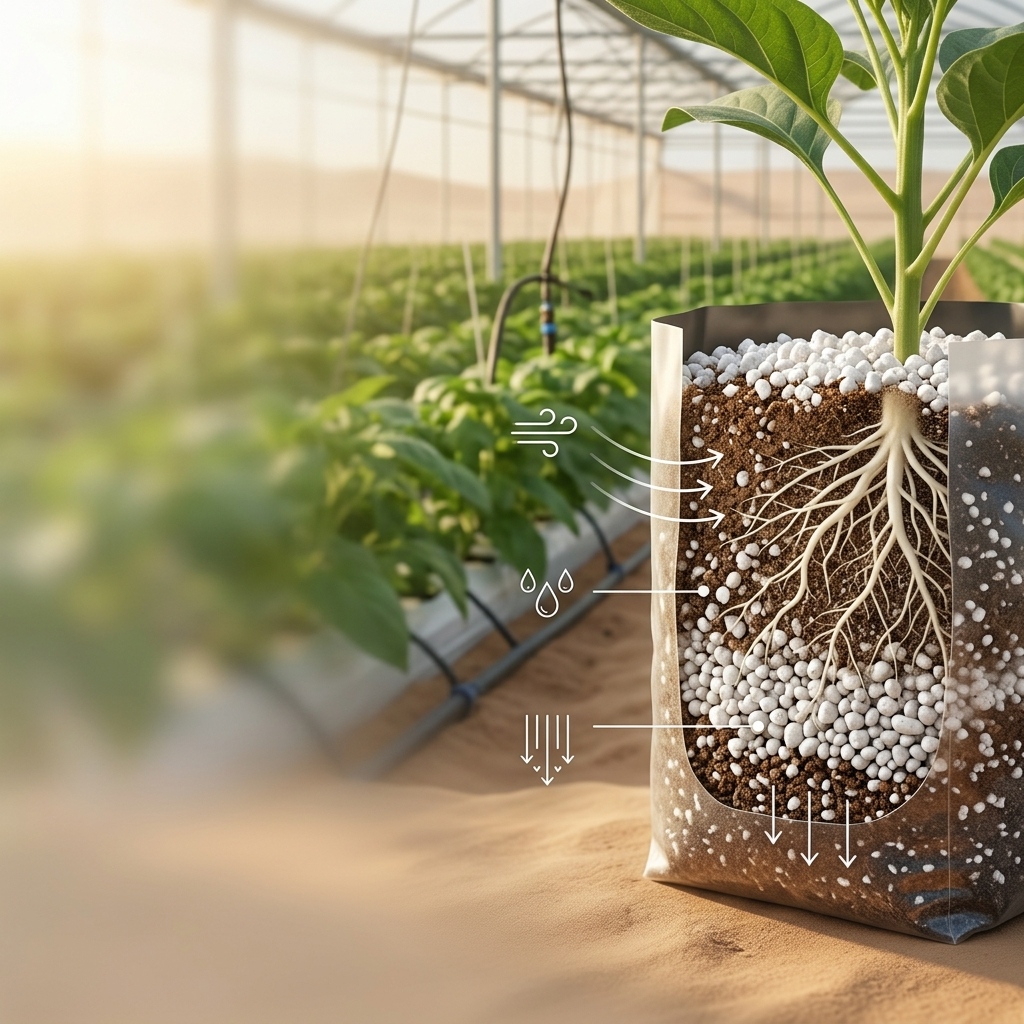
1. Perlite in Iraq: Not Just a White Granule, but a Risk Management Tool
Perlite is often introduced as “a lightweight white material that improves drainage and aeration.”
For a serious Iraqi agricultural professional or agribusiness buyer, that is an oversimplification.
In Iraq’s reality—high temperatures, irregular water quality, and pressure for higher yields—perlite is not a decorative input.
Used correctly, it becomes a strategic tool to:
- stabilize water and air around the root zone,
- reduce stress during transplanting and hot periods,
- support more predictable plant performance under challenging conditions.
In other words:
Perlite, when properly selected and applied, is less a “substrate additive” and more a risk-management component in your production system.
2. The Iraqi Context: Why Perlite’s Role Is Different Here
Let’s put the real field conditions on the table:
- Heat & evapotranspiration: summer conditions can push roots to their physiological limits.
- Water constraints: in many regions, water supply is limited, saline, or variable in quality (EC and bicarbonate issues).
- Soil structure problems: heavy, compacted, or poorly drained soils in some areas; light and weak soils in others.
- Pressure for performance: investors and growers expect higher productivity per unit area and faster payback.
Under these conditions, perlite can:
-
Buffer irrigation variability
When irrigation intervals are not perfectly precise, or water quality fluctuates, perlite acts as a buffer in the root zone:
it holds part of the water while maintaining air-filled porosity.
-
Reduce transplanting and establishment stress
In vegetable seedlings, fruit trees, date palm offshoots, and greenhouse crops, perlite in the growing media improves root establishment, reduces losses, and shortens the “shock” period.
-
Enable more active root systems
A well-aerated root zone means:
- stronger root exploration,
- better nutrient uptake,
- and more consistent response to fertigation programs.
So in Iraq, perlite is not a “nice-to-have” decorative material.
It is a functional component in the design of your growing media and water management strategy.
3. The Surge in Arabic Searches for Perlite: A Clear Market Signal
The growing number of Arabic searches such as “البيرلايت الزراعي”، “وسيط الزراعة بالبيرلايت”، “تربة البيرلايت” from Iraq is not a coincidence.
It tells us several things about your market:
-
Awareness is increasing
Agronomists, greenhouse managers, and input traders now understand that growing media is a performance driver, not just a container filler.
-
The market is moving from “What is perlite?” to “Which perlite and how?”
The questions are becoming more advanced:
- What particle size is suitable for greenhouse vegetables?
- What mixing ratio with peat, cocopeat, or local soil is optimal?
- How should perlite be used for tree crops and nurseries?
-
Information quality has not caught up with demand
Many answers available online are still generic, copy–paste style, and not adapted to Iraqi conditions.
This gap between high search volume and low-quality answers creates a strategic opportunity:
- For Iraqi agronomists: to differentiate themselves by offering more precise, context-specific recommendations.
- For Iraqi traders: to position themselves not just as suppliers of bags, but as partners offering complete growing media solutions, not just “perlite by the ton”.
4. The Biggest Mistake in the Market: Buying Perlite Before Designing the Growing Media
One of the most costly patterns we see in the region is this:
Step 1: buy perlite (based on price/ton).
Step 2: figure out later how to use it.
Professionally, the sequence should be the opposite:
Step 1 – Design the growing media system
Start from your production and risk objectives:
- Crop type (tomato, cucumber, leafy vegetables, ornamentals, citrus, date palm, etc.)
- Production system (greenhouse, open field transplants, nursery, container trees, urban landscaping)
- Region and climate within Iraq
- Water source (EC, bicarbonate, sodium issues if known)
- Technology level and budget (high-tech greenhouse vs. low-input field nursery)
Step 2 – Define the specific role of perlite in that system
Perlite can be used to:
- Increase aeration in heavy or fine-textured mixes
- Improve water-holding in coarse or sandy mixes
- Reduce bulk density in container substrates
- Enhance drainage and reduce root diseases in humid periods
But the exact percentage and particle size should be determined based on:
- Your irrigation strategy (frequency, volume, uniformity)
- The other components of your mix (peat, cocopeat, compost, local soil, sand)
- The target physical properties of the substrate (air-filled porosity, water-holding capacity, total porosity)
Step 3 – Select a supplier that supports the design, not just the delivery
At this point, the question is no longer:
“How much is your perlite per ton?”
The real questions are:
- Can you help define the right perlite characteristics for my specific application?
- Can you support me with practical mixing guidelines and ratios?
- Can you help me avoid over- or under-using perlite, so I don’t waste money or damage performance?
This is exactly where solution-driven suppliers stand apart from commodity traders.
5. From Commodity to Solution: How Mayadasht Positions Itself for the Iraqi Market
Mayadasht does not present itself as “just another perlite seller.”
It positions itself as a growing media and perlite solution partner for Iraqi professionals.
What does this mean in practice?
5.1. Export experience into Iraq, not just theory
Mayadasht has already worked with Iraqi customers and successfully shipped perlite to Iraq.
These real shipments have:
- Tested the logistics and documentation process into Iraq,
- Provided feedback from actual users in Iraqi conditions,
- Helped refine recommendations and internal quality criteria based on Iraqi needs.
For you, as an agronomist or buyer, that means:
- You are not the “first experiment”.
- You work with a team that has already gone through the learning curve of serving Iraqi clients.
5.2. A solution mindset instead of a product-only mindset
Mayadasht’s approach is:
“We don’t sell ‘perlite bags’.
We help you design and implement a perlite-based growing media solution for your specific conditions.”
Concretely, this includes:
- Asking detailed questions about your project before talking about price.
- Proposing different scenarios of perlite use (e.g., higher-performance vs. budget-optimized mixes).
- Being honest about:
- where perlite brings strong value,
- where its use can be reduced to save cost,
- and where it should not be forced into a system.
5.3. Access to agricultural specialists, not only sales staff
Behind Mayadasht, there is a team of agronomists and technical specialists, not only commercial staff.
That matters because they understand:
- The difference between a greenhouse in northern Iraq and an open field nursery in the south,
- How water EC and bicarbonates affect substrate design,
- What “root development issues”, “non-uniform stands” or “transplant shock” look like in the field, not just on paper.
This technical backbone allows Mayadasht to discuss with you at your level of expertise, not in generic marketing language.
6. Your Professional Reputation: Why the Right Perlite Decision Matters
Every time you, as an Iraqi agronomist or agricultural buyer, recommend or purchase perlite, you are making a professional statement:
- If the substrate fails—poor drainage, root asphyxiation, severe stress—the first person questioned is usually you, not the supplier.
- If the plants establish faster, show uniform root systems, and deliver stable performance under stress, your credibility grows.
Choosing perlite as a designed component of a well-thought-out substrate, supported by a technical team, allows you to:
- Reduce the risk of crop failures linked to substrate mistakes,
- Document your decisions with technical reasoning (physical properties, mixing ratios, expected effects),
- Present yourself not as “someone who buys what is available”, but as a designer of complete growing media strategies.
In a market where many still buy perlite on price alone, this is a real competitive edge.
7. Perlite as a “Silent Engineer” in Your System
A useful way to look at perlite is to see it as a silent engineer working underground:
- It stabilizes water and air relationships,
- Supports root exploration,
- Enhances the effect of your fertigation and irrigation strategy.
Mayadasht’s role is to:
- Help you choose which silent engineer you need (particle size, percentage, mix design),
- Place it correctly in your system (where, how much, with what partners in the mix),
- Ensure that, under Iraqi conditions, it actually performs as intended—not just in theory.
8. A Different Kind of Call to Action: Don’t Buy Perlite First. Design Your Solution First.
If you are:
- an Iraqi agronomist or crop consultant,
- a greenhouse manager,
- a nursery or orchard project manager,
- or an agricultural trader supplying serious growers,
and you want to:
- move from “buying bags of perlite” to implementing complete, tailored growing media solutions,
- understand exactly how perlite should be used in your specific context (crop, region, water, system, budget),
- rely on a partner that already has practical experience with Iraqi clients,
then the next step is not to ask for a price list.
The next step is to have a technical conversation.
What Mayadasht offers you – free of charge
Mayadasht’s consultants and specialists offer free, no-obligation consultations where they will:
-
Listen to your project details:
- location in Iraq,
- crop(s),
- production system (greenhouse, open field transplants, nursery, containers),
- water characteristics (if known),
- performance targets and budget constraints.
-
Propose one or two concrete perlite usage scenarios, including:
- suggested perlite proportion and particle size,
- recommended mix partners (peat, cocopeat, local soil, etc.),
- practical notes on mixing and implementation,
- common mistakes to avoid in Iraqi conditions.
-
Help you evaluate the technical and economic impact of each scenario, so you can make a decision that supports your yield, your budget, and your reputation.
You are not committing to a purchase by talking to them;
you are investing in a better-designed growing media strategy.
If you’d like, you can share the following basic information about your project, and a tailored perlite strategy can be drafted for you:
- Region in Iraq
- Crop type
- Production system (greenhouse / open field transplants / nursery / container trees / landscaping)
- Any information about your water quality (EC, salinity) if available
This is the kind of detailed, solution-focused approach that turns perlite from a commodity into a competitive advantagein Iraqi agriculture.