
 Persian
 Arabic
 Russian


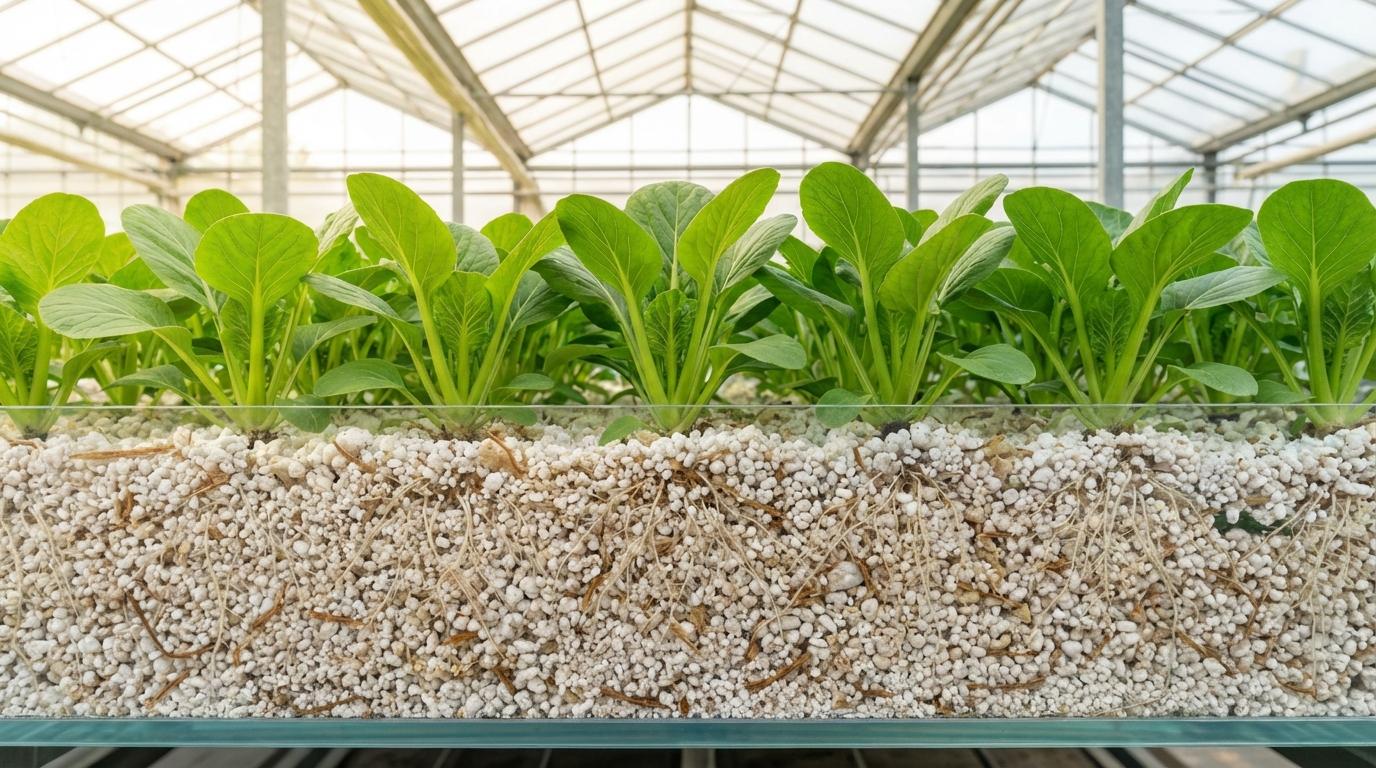
Agriculture in Iraq operates under constant pressure.
High temperatures, water limitations, and soil variability leave little room for error—especially in greenhouse and intensive cultivation systems.
In such environments, success is rarely defined by maximum yield.
It is defined by stability.
This is where perlite becomes more than a simple additive.
The Root Zone: Iraq’s Most Vulnerable Agricultural Point
In many Iraqi regions, soil structure presents multiple challenges:
- poor aeration
- uneven drainage
- rapid compaction under irrigation
These conditions directly affect the root zone—the most sensitive and least forgiving part of the plant system.
Perlite addresses this problem structurally, not chemically.
What Perlite Actually Does (Beyond the Basics)
Perlite is often described as a lightweight volcanic mineral.
But its real value lies in physical behavior under stress.
In growing systems, perlite:
- maintains air pockets even under frequent irrigation
- prevents root suffocation in high temperatures
- improves drainage without drying the root zone
These characteristics are especially critical in Iraq’s hot climate, where oxygen loss around roots accelerates crop stress.
Water Efficiency Is a Structural Issue, Not Just an Irrigation One
Water scarcity in Iraq is frequently discussed in terms of supply.
Less attention is paid to how efficiently water behaves after application.
Soils or substrates without sufficient structure:
- hold water unevenly
- create anaerobic root conditions
- increase disease pressure
Perlite improves water distribution and release, reducing both water waste and physiological stress on plants.
Perlite in Greenhouse Systems: Risk Reduction, Not Yield Boosting
In greenhouse production, perlite should not be evaluated as a yield enhancer.
Its real function is risk control.
Stable root environments mean:
- more predictable nutrient uptake
- fewer emergency corrections
- smoother crop cycles
For commercial growers, predictability is often more valuable than marginal yield increases.
The Common Mistake: Treating Perlite as a Filler Material
One of the most frequent mistakes in substrate formulation is using perlite merely to reduce cost or weight.
Low-quality or inconsistent perlite:
- collapses over time
- creates uneven root zones
- undermines the entire growing system
Professional growers evaluate perlite by:
- particle size consistency
- expansion quality
- long-term structural stability
Not by price per bag.
Why Perlite Fits Iraq’s Agricultural Direction
As Iraq increasingly adopts:
- greenhouse cultivation
- controlled irrigation
- protected agriculture
inputs that improve system resilience become strategically important.
Perlite supports this transition by addressing physical limitations rather than temporary symptoms.
Final Perspective
In Iraq’s agricultural reality, inputs that reduce instability protect profitability.
Perlite does not promise miracles.
It delivers structure, oxygen, and control—exactly what intensive agriculture requires under pressure.
For growers and agricultural decision‑makers, understanding this difference defines long‑term success.