
 Persian
 Arabic
 Russian


In Iraq, the next agricultural challenge is not waiting in the distance.
It is already forming.The heat is becoming harder to manage.
Water is becoming more sensitive to waste.
Greenhouse systems are becoming more vulnerable to root-zone instability.
And growers are under increasing pressure to produce more with less tolerance for error.In such conditions, agricultural success depends less on isolated inputs and more on how intelligently the growing environment is built.
This is where cocopeat becomes more relevant in Iraq.
Not as a trendy substrate.
Not as a simple replacement for soil.
But as a material that can help growers create a more balanced root-zone environment in a climate where imbalance is becoming more expensive.
Iraq Is Entering a Harder Agricultural Era
For many growers in Iraq, the old cultivation model is becoming less reliable.
The challenge is no longer just about planting, irrigating, and fertilizing on time. The real challenge is whether the production system can remain stable under increasing pressure:
- hotter seasons,
- stronger evaporation,
- irregular water quality,
- salinity stress,
- and more expensive agricultural inputs.
This matters because in such an environment, even small inefficiencies become costly.
A root zone that dries too quickly, stays too wet, or behaves unpredictably does not only reduce plant comfort. It weakens the entire production logic of the farm.
And in Iraq, where heat can accelerate stress very quickly, this becomes a serious operational issue.
That is why the future of growing media in Iraq should not be discussed only in terms of availability or price. It should be discussed in terms of how well a substrate helps the root zone stay stable under pressure.
The Real Problem in Hot-Climate Agriculture Is Not Just Heat — It Is Moisture Instability
When people talk about agriculture in hot weather, they often focus on temperature.
But temperature alone is not the whole story.The more dangerous issue is what heat does to the behavior of water in the root zone.
In hot climates like Iraq:
- evaporation increases,
- irrigation timing becomes more critical,
- moisture loss accelerates,
- and root stress can rise faster between irrigation cycles.
This means that a growing medium must do more than hold the plant upright.
It must help regulate water behavior.If the substrate loses moisture too aggressively, the plant suffers from repeated stress.
If it holds water poorly or unevenly, irrigation becomes inefficient.
If it behaves inconsistently, the whole greenhouse becomes harder to manage.This is exactly why cocopeat matters.
Its relevance in Iraq is not only that it is organic or widely used globally.
Its real value lies in its ability to support better moisture balance around the roots.
Why Cocopeat Deserves More Attention in Iraq
Cocopeat is often introduced with basic descriptions such as water retention, light structure, or suitability for greenhouse use. These are correct, but they do not fully explain why it may become more important for Iraq in the coming years.
1. Cocopeat helps buffer moisture fluctuations
In Iraq’s warm and drying conditions, sudden moisture loss can put crops under repeated stress. Cocopeat helps create a more buffered moisture environment, reducing the sharp swings that often weaken roots and crop uniformity.
2. It can support more stable irrigation management
When a substrate behaves more predictably in water retention and release, irrigation decisions become more precise. This matters in greenhouse production, nurseries, and intensive cultivation systems where overreaction or inconsistency can reduce efficiency.
3. It becomes more valuable when water use must be smarter
As water pressure increases, growers cannot afford wasteful substrate behavior. Cocopeat can help maintain useful moisture in the root zone longer than many weak or poorly structured media, making it relevant in systems where irrigation efficiency matters.
4. It helps reduce root stress in critical hot periods
A crop under heat does not only need water. It needs continuity. Repeated mini-stress cycles caused by unstable moisture can reduce performance even without dramatic visible symptoms. Cocopeat helps reduce these fluctuations and supports a calmer root environment.
In Iraq, Cocopeat Is Not Just About Growth — It Is About Continuity
Many agricultural decisions are still made with a growth-first mindset.
But in a climate like Iraq, especially as temperatures rise, continuity may be more important than aggressive growth.
Because the real threat is not only low performance.
It is interrupted performance.A crop that repeatedly experiences root-zone stress may continue growing, but with lower efficiency, weaker uniformity, more sensitivity to salinity, and less resilience under greenhouse pressure.
This is where cocopeat should be understood properly.
Its strategic value is not simply that it supports early development.
Its deeper value is that it can help the plant remain more stable through stressful periods.That makes cocopeat increasingly relevant not only for productivity, but for production continuity.
Why This Matters for Greenhouse Farming in Iraq
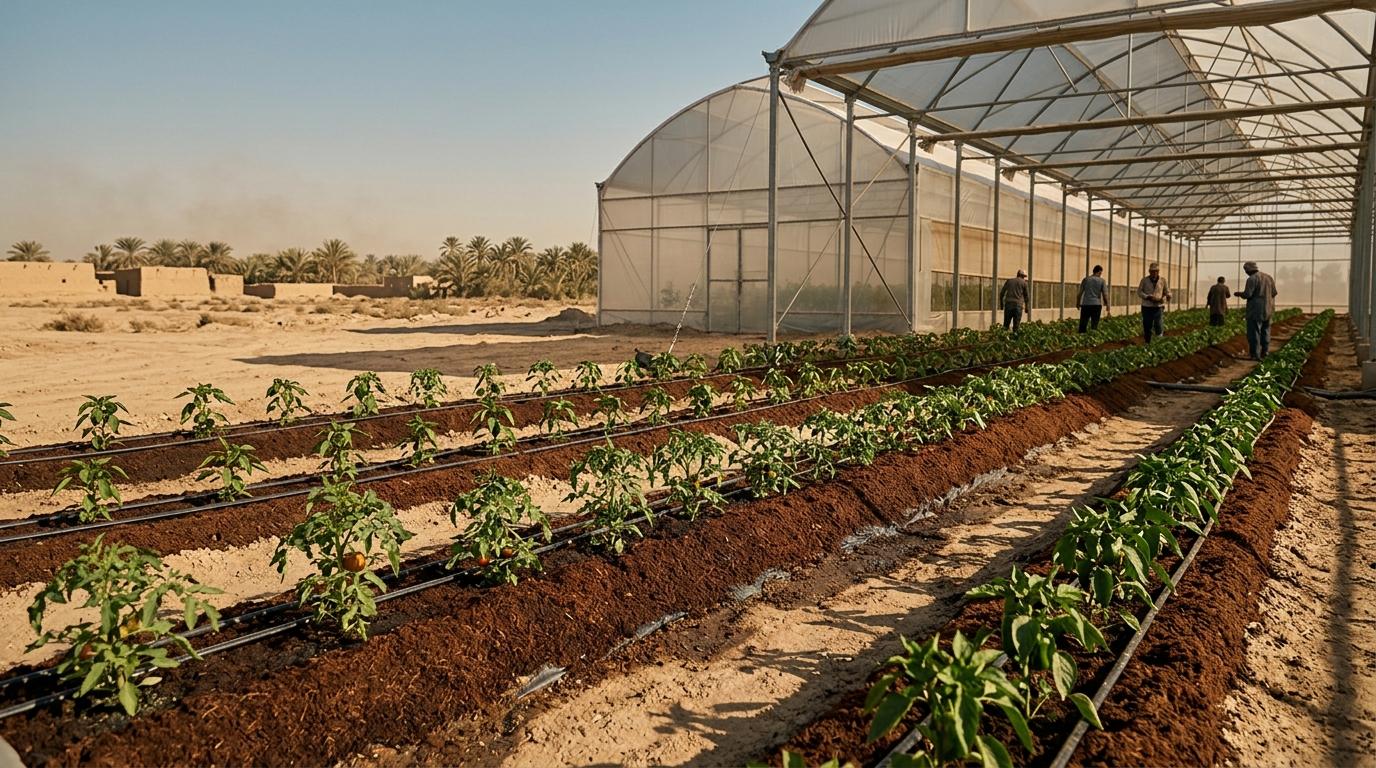
Greenhouse farming in Iraq is often discussed as a way to improve output and control seasonality.
But greenhouse systems also magnify substrate mistakes.
When the growing environment is controlled, the root zone becomes even more important. If the medium performs poorly, the entire greenhouse pays the price faster:
- moisture imbalance spreads quickly,
- stress becomes more uniform across the crop,
- nutrient management becomes less accurate,
- and recovery becomes slower under high heat.
For this reason, cocopeat has strong relevance in:
- vegetable greenhouses,
- nurseries,
- seedling production,
- intensive cultivation systems,
- and mixed media strategies where balance matters more than extremes.
In these systems, cocopeat is not just a substrate ingredient.
It is part of the environmental logic of the greenhouse.
The Coming Risks in Iraq Make Substrate Choice More Strategic
The future risks facing Iraqi agriculture are not theoretical.
They are practical, visible, and increasingly costly:
- hotter growing periods,
- greater pressure on irrigation management,
- possible disruptions in agricultural supply chains,
- more expensive fertilizers and imported inputs,
- and rising demand for predictable output.
Under such conditions, growers need more than cheap materials.
They need substrates that behave reliably.This is one of the strongest arguments for cocopeat in Iraq.
Because when uncertainty increases outside the farm, stability inside the root zone becomes more valuable.
And among all the things a grower cannot fully control — climate, regional tension, transport pressure, market volatility — the substrate remains one of the few decisions that can still be made intelligently in advance.
Cocopeat in Iraq Should Be Discussed as a Strategy, Not a Commodity
One of the biggest mistakes in agricultural marketing is presenting cocopeat as a generic product.
Serious growers do not just need “cocopeat.”
They need answers.They need to know:
- Is cocopeat right for my crop?
- Is it better alone or mixed with perlite?
- How does it behave in Iraqi heat?
- Can it help reduce irrigation stress?
- Does it support greenhouse stability under repeated hot cycles?
These are strategic questions, not shopping questions.
That is why the right way to position cocopeat in Iraq is not: we sell cocopeat
but: we help growers build more stable root-zone systems for hot and demanding conditions
That message is smarter, stronger, and more credible.
Conclusion: In Iraq, Cocopeat May Become More Important as Conditions Become Harder
Cocopeat matters in Iraq not because it is fashionable, but because the agricultural environment is becoming harder to manage.
In a future shaped by heat, water pressure, root-zone stress, and the need for better control, the choice of substrate becomes more strategic than ever.
Cocopeat offers something increasingly valuable in this context: moisture balance, root-zone continuity, and better tolerance against unstable growing conditions.
It should not be seen as just another medium.
It should be seen as part of a smarter response to the future of agriculture in Iraq.
Because in hot climates, survival is not built only through irrigation quantity.
It is built through better root-zone behavior.And that is exactly where cocopeat enters the conversation.
CTA | Free Technical Consultation for Iraqi Growers
If you are evaluating cocopeat for greenhouse farming, nursery production, or intensive cultivation in Iraq, the Mayadasht team is ready to help.
Our specialists can help you assess:
- whether cocopeat fits your production system,
- whether a cocopeat-perlite mix makes more sense,
- how to choose the right structure and use it correctly,
- and how to reduce costly mistakes before purchase.
Free Consultation
We offer free technical guidance for Iraqi agricultural experts, growers, and project managers who want to make more confident growing-media decisions.
👉 Contact Mayadasht to discuss the right cocopeat strategy for your crop and growing conditions in Iraq.
Cocopeat in Iraq: Why the Future of Root-Zone Stability May Depend on Better Moisture Management
11
May