
 Persian
 Arabic
 Russian


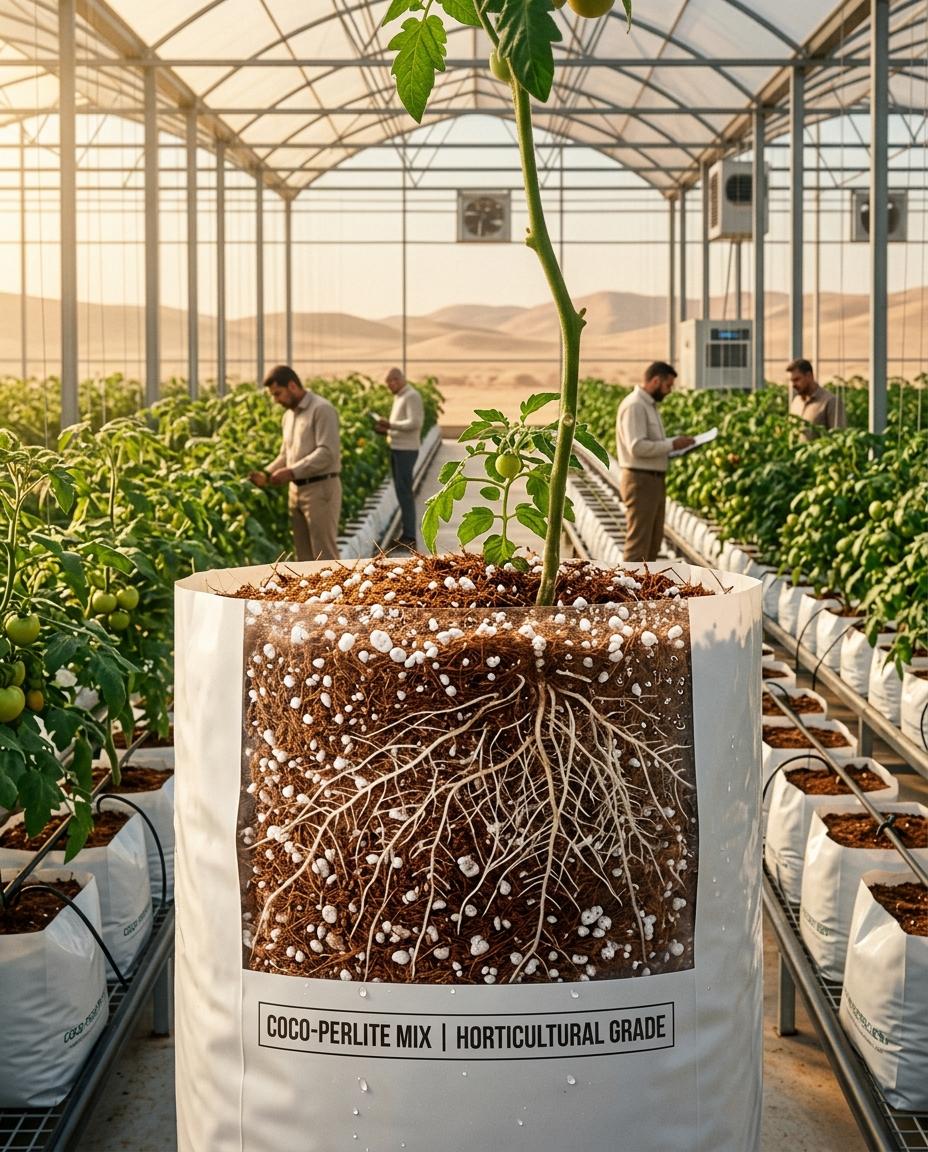
Agriculture in Iraq cannot be understood through product price alone.
Every agricultural input entering the Iraqi market must pass three difficult tests:
heat, salinity, and real production cost.
These three factors influence the decisions of farmers, greenhouse owners, agricultural companies, and traders. A material that may look like a simple growing medium in another market can become a risk-management tool in Iraq.
This is exactly where perlite and cocopeat become more important.
In the Iraqi market, perlite and cocopeat should not be presented only as materials used to fill pots, trays, or grow bags. A more professional view shows that these two products can become part of a technical growing system — a system designed to protect the root zone under harsh climate conditions.
In Iraq, the real question is not:
Which growing medium is cheaper?
The real question is:
Which growing medium can reduce cultivation risk under high temperatures, saline irrigation water, and rising production costs?
In many cases, the answer is not one material alone.
The answer is a well-designed combination of perlite and cocopeat.
Iraq: A Market Where the Root Zone Is Under Pressure
Many agricultural areas in Iraq, especially in central and southern regions, face high temperatures, strong evaporation, and variable water quality. In these conditions, the growing medium is not just a place where the plant stands. It becomes the living environment of the root system.
The root zone in Iraq is exposed to several pressures at the same time:
- high greenhouse and field temperatures;
- rapid water evaporation;
- salt accumulation around the roots;
- low oxygen levels in heavy substrates;
- irregular or excessive irrigation;
- unstable irrigation water quality;
- limited technical labor for precise irrigation and nutrition management.
When these pressures come together, even strong seeds, good fertilizers, and modern greenhouse structures may not be enough.
One weak point can affect the whole crop:
the root substrate.
If the substrate is not properly designed, plants enter stress faster.
If water stays too long, roots suffer from oxygen deficiency.
If water disappears too quickly, roots experience drought stress.
If drainage is weak, salts accumulate near the root zone.
If aeration is poor, root diseases become more likely.
In this market, perlite and cocopeat are not just products. They are tools for managing difficult growing conditions.
Perlite in Iraq: More Than a Lightweight Material
Perlite is often introduced as a white, lightweight, porous mineral used to improve aeration and drainage in growing media. This is true, but for Iraq, the explanation should go deeper.
In a hot climate like Iraq, perlite is not only a substrate lightener. It can act as a stable mineral structure inside the growing medium. Unlike many organic materials, perlite does not break down quickly under heat and can help maintain physical structure over time.
This matters in Iraqi summer conditions.
When greenhouse temperatures rise, plant roots can experience thermal and oxygen stress. If the substrate is too dense, dark, compacted, or poorly aerated, heat and moisture imbalance may become more severe around the roots.
Because of its porous structure and light color, perlite can improve the physical performance of the growing medium. In the right blend, perlite increases air-filled porosity, meaning that after irrigation, part of the substrate remains filled with air instead of water.
This is critical.
Roots do not only need water.
They also need oxygen.
In heavy substrates, especially when growers irrigate more frequently to fight heat stress, air space can disappear. The result may be root suffocation, reduced nutrient uptake, plant weakness, and higher disease risk.
Perlite helps the substrate hold both moisture and oxygen after irrigation.
In simple terms:
For Iraq, perlite is not just a light material. It is an oxygen-management component for the root zone.
The Technical Concept: Evaporative Void Spaces in Growing Media
One important point that is rarely discussed in commercial perlite marketing is the role of particle size in creating effective pore spaces inside the substrate.
When properly graded perlite — especially medium or coarse grade — is used in a growing media blend, it creates spaces between particles. These spaces can function as evaporative void spaces.
These voids do two important things:
- They help moisture move more evenly through the growing medium after irrigation.
- They reduce full compaction and help prevent the root mass from becoming a dense, overheated block.
In a hot climate such as Iraq, this can be highly valuable. Midday heat, especially in greenhouses in southern Iraq, can push the root environment into stress.
When the substrate is made only of fine or compacted materials, water and salts may become trapped in certain zones while other zones dry too quickly. This can create two dangerous conditions:
- dry blind spots;
- salt accumulation zones.
Properly graded perlite, when combined with cocopeat, can improve moisture distribution and reduce these critical zones.
This is one reason why professional substrate design matters more than simply buying a bag of growing media.
Cocopeat in Iraq: A Moisture Reservoir — But Only If Quality Is Controlled
Cocopeat is highly attractive for Iraq.
Its water-holding capacity, low weight, and fibrous structure make it useful for greenhouse production, seedling nurseries, horticulture, and soilless growing systems. In a country where heat and evaporation are major challenges, this is a strong advantage.
But there is a serious point:
Not every cocopeat is suitable for Iraq.
Some cocopeat products may have high EC if they are not properly washed or processed. EC refers to the level of soluble salts in the material. In Iraq, where irrigation water in many areas can already contain significant salinity, this becomes even more important.
If high-EC cocopeat enters the system and the irrigation water is also saline, the growing medium can quickly become stressful for plant roots.
From the outside, growers may think the problem is seed quality, fertilizer, disease, or heat.
But the real problem may be osmotic stress in the root zone.
The plant has water around the roots, but it cannot absorb it efficiently.
This is why low-EC cocopeat and properly washed or buffered cocopeat are important for Iraq.
Buffering: A Word the Iraqi Market Should Take Seriously
Cocopeat should not be sold in Iraq with only one simple sentence:
“Cocopeat is light and holds water.”
That statement is true, but it is not enough.
Cocopeat should be evaluated based on:
- EC;
- pH;
- buffering;
- fiber-to-pith ratio;
- uniformity;
- expansion volume;
- compatibility with perlite blends.
Cocopeat naturally has cation exchange capacity, known as CEC. This means it can hold and exchange certain nutrient ions. If managed correctly, this can be useful. If not buffered properly, cocopeat may cause nutrient imbalance at the beginning of cultivation.
In saline water conditions, this becomes more important. Water with higher sodium levels can interfere with nutrient uptake. Calcium-buffered cocopeat can behave more predictably and reduce initial shock in the growing medium.
For Iraq, cocopeat should not be treated as a simple bulk material.
A suitable cocopeat for Iraq should be part of a technical solution:
- low EC;
- proper washing;
- acceptable buffering;
- uniform texture;
- suitable fiber and pith structure;
- compatibility with perlite;
- usability for greenhouse and nursery systems.
If these conditions are ignored, cocopeat can turn from an opportunity into a risk.
The technical message is clear:
In Iraq, cocopeat quality matters more than cocopeat appearance.
Why the Combination of Perlite and Cocopeat Matters More Than Either Product Alone
Perlite and cocopeat each have value, but their strongest advantage appears when they are combined correctly.
Cocopeat holds water.
Perlite improves air and drainage.
Cocopeat gives the root zone more stable moisture.
Perlite helps prevent root suffocation and substrate compaction.
Cocopeat helps the medium resist rapid drying under heat.
Perlite helps prevent that retained moisture from turning into a waterlogged root zone.
Together, they help balance two major risks:
- excessive drying;
- excessive moisture and low oxygen.
For Iraq, this balance is essential.
In high temperatures, many growers increase irrigation to protect crops. But if the substrate does not have enough aeration, more water does not always mean better growth. Sometimes, it means root stress.
A well-engineered perlite and cocopeat blend can make substrate performance more predictable.
Blend Ratios: Why One Formula Does Not Fit All of Iraq
One common mistake is recommending one fixed formula for every crop, region, and system.
For example:
50% cocopeat + 50% perlite
This can be useful in some situations, but it is not always the best answer.
The correct ratio depends on several factors:
- irrigation water EC;
- climate intensity;
- crop type;
- irrigation system;
- grow bag or pot size;
- perlite particle size;
- cocopeat texture;
- fertigation program;
- technical skill of the greenhouse team.
In hotter areas with frequent irrigation, a higher perlite percentage may help improve aeration. In systems where the substrate dries too quickly, cocopeat plays a stronger role in moisture retention.
For seedling production, the medium must be uniform, light, and easy to manage.
For greenhouse tomato and cucumber, drainage and oxygen availability are critical.
For ornamental plants, substrate weight and visual cleanliness also matter.
For nurseries, long-term physical stability becomes important.
The professional solution is not to sell one formula to everyone.
The professional solution is to design the substrate according to Iraq’s real growing conditions.
Field Performance in Southern Iraq: When Fertilizer Was Not the Main Problem
In several greenhouse operations in southern Iraq, especially around Basra and Nasiriyah, one common summer issue appears after the first weeks of cultivation.
Seedlings look healthy at the beginning. Then, as temperatures rise, root growth slows, leaves lose strength during hot hours, and growers often assume that the crop needs more fertilizer.
In one greenhouse project producing cucumber and tomato, the first reaction was to adjust the nutrition program. Fertigation was changed several times, but the crop response was not stable.
A closer look at the substrate showed a different problem.
The lower part of the grow bags was holding too much moisture, while the upper and side zones were drying and becoming saltier. This means the roots were exposed to two stresses at the same time:
- low oxygen in wet and compacted zones;
- salt accumulation in drier zones.
After changing the substrate to a more balanced blend of low-EC cocopeat and graded perlite, moisture distribution improved. Water moved more evenly through the growing medium. Dry blind spots were reduced. Perlite helped keep more air space after irrigation, while cocopeat maintained enough moisture between irrigation cycles.
The results became visible during the same cultivation cycle:
- lower seedling losses during hot weeks;
- reduced need for corrective irrigation;
- fewer heat-stress symptoms during midday;
- more uniform plant growth;
- more efficient fertilizer use;
- stronger early harvest performance.
The success did not come from one material alone.
It came from the combination of material quality, particle size, EC control, irrigation management, and climate understanding.
This is the difference between selling products and providing solutions.
Water Efficiency: A Claim That Must Be Explained Correctly
In the market, it is sometimes said that perlite and cocopeat reduce water consumption.
This can be true, but if said without explanation, it sounds like advertising.
The technical reality is more accurate:
Perlite and cocopeat do not create water, and they do not perform miracles. But when used in the right combination and managed with proper irrigation, they can improve water-use efficiency.
How?
Cocopeat holds moisture and slows rapid drying.
Perlite helps excess water drain and keeps oxygen in the root zone.
A balanced substrate allows more targeted irrigation.
Better moisture distribution reduces the need for over-irrigation to compensate for dry spots.
In some hot greenhouse systems, changing from a heavy or unbalanced substrate to an optimized perlite-cocopeat blend has made water management up to 30–40% more efficient during certain periods. However, this depends on crop type, irrigation system, water quality, and management skill.
The professional message is:
Perlite and cocopeat do not magically reduce water use. They make water easier to manage.
That difference matters.
Salinity Management: A Key Issue for the Future of Iraqi Growing Media
One of the most serious challenges in Iraqi agriculture is salinity. In hot regions, this problem becomes more severe because evaporation concentrates salts in the root zone.
When irrigation water contains salts and evaporation is high, salts remain in the substrate. If drainage is poor, salts accumulate around the roots. If the substrate dries too much, salt concentration increases. If irrigation is excessive, nutrients may be leached, and roots may suffer from oxygen deficiency.
A perlite-cocopeat blend can help build a more manageable substrate:
- perlite improves drainage and allows excess solution to leave the root zone;
- cocopeat holds moisture and reduces extreme dry-wet fluctuations;
- better substrate uniformity reduces local salt accumulation;
- controlled flushing becomes easier;
- roots stay in a more balanced environment of moisture and oxygen.
But there is an important warning:
If cocopeat has high EC or perlite has poor grading and too much dust, the solution becomes weaker.
In Iraq, raw material quality is part of salinity management.
For Iraqi Traders: Perlite and Cocopeat Are Not Just Products — They Are a Sales Portfolio
If the target audience were only farmers, this article could remain purely technical. But Iraq is also a strong trading market, and agricultural traders play a major role in product distribution and market education.
For Iraqi traders, perlite and cocopeat offer one important advantage:
They can be sold to several customer groups.
Potential buyers in Iraq include:
- greenhouse growers;
- seedling producers;
- nurseries;
- agricultural input shops;
- greenhouse construction companies;
- substrate producers;
- professional gardeners;
- ornamental plant producers;
- soilless farming projects;
- importers and regional distributors.
This means traders are not limited to one product for one customer.
They can build a growing media solution portfolio.
For example:
- cocopeat for moisture retention;
- perlite for aeration and drainage;
- peat moss for specific substrate mixes;
- greenhouse supplies for complete project support;
- technical consultation for stronger customer trust.
In this model, the trader is not just selling bags and blocks.
The trader becomes a supplier of professional growing solutions.
That positioning can improve margins, repeat orders, and customer loyalty.
The Real Price Is Not Only the Purchase Price
In Iraq, buyers are naturally price-sensitive. This is understandable. But for bulky and lightweight products such as perlite and cocopeat, the real price is not only the number on the invoice.
The real cost includes:
- purchase price;
- usable volume after expansion or application;
- packaging strength;
- dust percentage;
- transport cost;
- warehouse space;
- supply speed;
- quality consistency between orders;
- risk of customer dissatisfaction;
- return or complaint probability;
- resale confidence.
For perlite, particle size and real volume matter.
For cocopeat, EC, texture, expansion rate, and uniformity matter.
For both, packaging and logistics influence final cost.
Sometimes a product that looks cheaper at first becomes more expensive in the Iraqi market because it has unstable quality, poor logistics efficiency, customer complaints, or weak resale value.
A professional trader should not only ask:
How much is it?
A professional trader should ask:
What quality, what volume, what consistency, and what final delivered cost will I receive?
Why Mayadasht Can Be a Stronger Partner for the Iraqi Market
The Iraqi market needs suppliers who do more than offer products. In perlite and cocopeat, buyers need information, selection support, and reliable supply planning.
Mayadasht can create value in this market because its role is not only product supply. It is helping buyers choose and source the right growing media solution for Iraq’s real conditions.
For Iraqi traders, importers, and agricultural companies, Mayadasht can support several key areas.
1. Product Selection Based on Application
Not all perlite is suitable for every use.
Not all cocopeat is suitable for every water quality or climate.
Mayadasht can help buyers choose products for greenhouse production, seedling trays, nursery systems, substrate blending, or wholesale distribution.
2. Technical Blending of Perlite and Cocopeat
Some buyers ask for perlite only. Others ask for cocopeat only. But in many projects, the real value is in the right combination.
Mayadasht can help buyers understand which blend direction is more practical based on crop, climate, and irrigation system.
3. Competitive Pricing with Trade Logic
Price matters in Iraq, but it should be evaluated with quality and final landed cost. Mayadasht helps buyers make decisions that are not only attractive in the first purchase but also reliable for future resale.
4. Supply and Logistics Experience
In Iraqi trade, supply route, response speed, shipment coordination, and reduced uncertainty are very important. A product that arrives late or with unclear conditions can make the transaction difficult even if the product itself is good.
Mayadasht’s regional trade experience can help make the purchasing process simpler and more predictable for Iraqi buyers.
5. Turning Product Sales into Solution Sales
Mayadasht can help traders explain the value of perlite and cocopeat to their own customers. Instead of selling only by price, the trader can sell by application: greenhouse, seedling, nursery, root-zone control, water management, and salinity management.
This creates more professional sales.
The Best Sales Message for Iraq
For the Iraqi market, the strongest message is simple but technical:
In Iraq’s hot and saline growing conditions, crop success depends not only on seed and fertilizer. The root zone must be engineered. The right blend of perlite and cocopeat can help manage moisture, oxygen, drainage, and salinity — reducing risk and improving production control.
For traders, the message is:
Perlite and cocopeat can serve multiple market segments in Iraq, from greenhouse production and nurseries to agricultural shops and substrate producers.
For growers, the message is:
This blend can make the root environment more manageable under heat and salinity stress.
For agricultural companies, the message is:
A properly designed substrate makes greenhouse projects more professional, more defensible, and more sustainable.
Decision Table for the Iraqi Market
| Criteria | Heavy Traditional Soil/Substrate | Cocopeat Alone | Perlite Alone | Engineered Perlite-Cocopeat Blend |
|---|---|---|---|---|
| Moisture retention | Medium to uneven | High | Low to medium | Balanced and manageable |
| Root aeration | Weak to medium | Medium | High | High and stable |
| Salt accumulation risk | High with saline water | Depends on EC and drainage | Lower but needs blending | More manageable |
| Substrate weight | Heavy | Light | Very light | Light and practical |
| Suitability for Iraqi greenhouses | Limited | Good if quality-controlled | Good in blends | Strong when designed correctly |
| Suitability for seedlings | Depends on correction | Good if low EC | Good in proper ratio | Very useful |
| Root suffocation risk | High | Medium | Low | Lower |
| Commercial value for traders | Limited | Good | Good | Very strong as a solution package |
| Need for technical guidance | Medium | High | Medium | High but highly valuable |
Quick Buying Guide for Iraqi Buyers
Before purchasing perlite and cocopeat for Iraq, buyers should ask these questions:
- Is the irrigation water in the target region high in EC?
- Is the product for greenhouse production, seedlings, nurseries, or wholesale distribution?
- Does the substrate need more water retention or more drainage?
- Is the cocopeat washed and low in EC?
- Is the perlite properly graded with controlled dust?
- Is the packaging suitable for transport and storage?
- Is the recommended blend designed for Iraq’s climate or copied from a general formula?
- Does the supplier provide product selection support or only sell material?
- What is the final delivered cost after logistics?
- Will quality remain consistent in future orders?
A professional Iraqi buyer does not only buy products.
A professional buyer manages risk.
Conclusion: The Future of Growing Media in Iraq Is Engineered
Agriculture in Iraq is moving toward more control, higher efficiency, and smarter resource management. Heat, salinity, and production costs make traditional decisions less reliable.
In this market, perlite and cocopeat can play a serious role — but not as simple materials.
Perlite brings structure, aeration, and drainage.
Cocopeat brings moisture retention, lightness, and root-zone stability.
Together, when selected and blended correctly, they create a more manageable growing environment.
For Iraqi growers, this means lower risk under heat and salinity.
For greenhouse owners, it means better root and irrigation control.
For agricultural companies, it means a stronger technical offer.
For traders, it means a product portfolio with multiple sales channels and repeat demand.
Mayadasht is ready to support Iraqi traders, importers, greenhouse operators, and agricultural companies in selecting, sourcing, and planning perlite and cocopeat supply for the Iraqi market.
If your goal is not only buying material, but choosing a more reliable solution with competitive pricing, better logistics support, and expert consultation, a conversation with Mayadasht can be the right starting point.
Looking for perlite and cocopeat for Iraq?
Mayadasht can help you choose and source perlite and cocopeat for greenhouses, seedling production, nurseries, substrate blending, and wholesale distribution in Iraq.
Contact Mayadasht for expert consultation, competitive pricing, and supply planning.
In Iraq, growing media is not just where plants grow — it is where heat, water, salinity, and profitability are managed.