
 Persian
 Arabic
 Russian


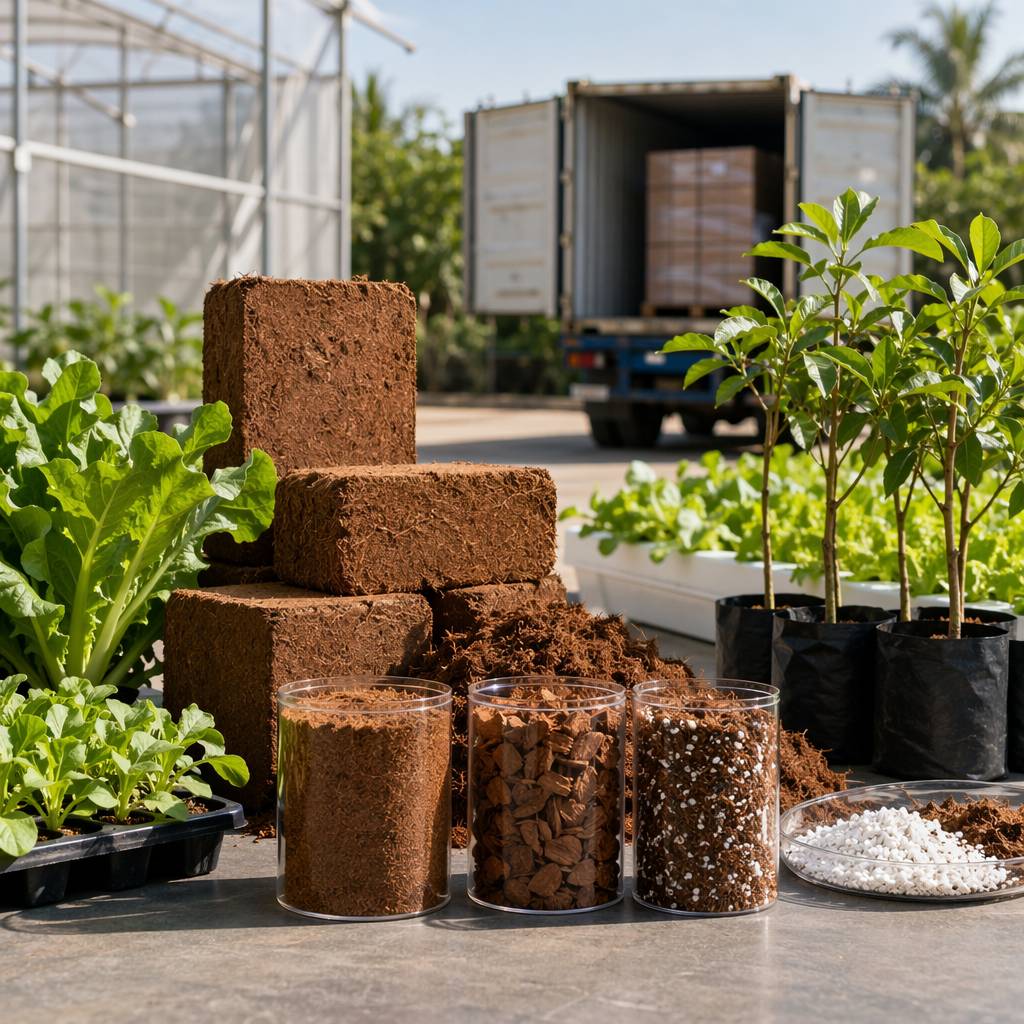
At the end of spring, the Iraqi agricultural market enters a different phase.
The weather becomes hotter.
Greenhouse irrigation becomes more sensitive.
Nursery production becomes more demanding.
Growing media mistakes become more expensive.
And traders who supply agricultural materials start facing a simple but serious question:
Can I deliver the right product, at the right time, with the right quality and final cost?
For cocopeat, this question is especially important.
Many Iraqi traders already know cocopeat. They know it is used in greenhouse farming, seedling production, nurseries, potting mixes, and soilless cultivation. They may also know that cocopeat can help with moisture retention, root-zone stability, and substrate structure.
But knowing the product is not enough.
In real trade, the difference between a successful cocopeat deal and a difficult one is rarely the name of the product.
The difference is usually in the supply decision:
- which cocopeat quality is selected,
- whether EC and salt levels are suitable,
- whether the product is properly washed or buffered,
- whether the block expands consistently,
- whether the particle structure fits the application,
- whether the final cost remains competitive,
- and whether the shipment arrives before the market opportunity becomes weaker.
This is why cocopeat for Iraq should not be discussed only as a growing medium.
It should be discussed as a commercial and technical decision before summer.
1. The Iraqi Market Does Not Need “Any Cocopeat” — It Needs the Right Cocopeat
One of the biggest mistakes in agricultural trading is assuming that all cocopeat is the same.
It is not.
Cocopeat may look similar from the outside, especially when it is compressed into blocks, slabs, bales, or grow bags. But for the end user, the difference appears after hydration, irrigation, planting, and crop response.
For Iraqi traders, this matters because the final customer may be a greenhouse grower, seedling producer, nursery operator, substrate blender, or agricultural distributor. Each of them may expect different performance.
Some customers may need cocopeat with better moisture buffering.
Some may need lower EC for sensitive crops.
Some may need a specific structure for root aeration.
Some may use cocopeat with perlite to balance water retention and drainage.
Some may need grow bags or blocks for greenhouse systems.
Some may need a product that expands uniformly and does not create complaints after delivery.
So the real question is not:
“Can I buy cocopeat?”
The better question is:
“Which cocopeat can I confidently sell to my market?”
That is where serious trade begins.
2. In Late Spring, Cocopeat Becomes More Strategic for Iraq
Timing matters.
At the end of spring, Iraq is moving toward a season where heat, irrigation frequency, and root-zone pressure increase. In this period, growers become more sensitive to the behavior of their growing media.
A weak substrate may perform acceptably in mild weather.
But under higher temperatures and stronger evaporation pressure, its weaknesses become visible.
Poor-quality cocopeat may create problems such as:
- unstable moisture behavior,
- high EC or salt stress risk,
- poor expansion,
- excessive fine particles,
- weak aeration,
- uneven water distribution,
- and inconsistent performance between batches.
For a grower, these issues may affect root development, irrigation management, crop uniformity, and production confidence.
For a trader, the risk is different but equally serious:
customer complaints, delayed repeat orders, price pressure, and loss of trust.
This is why the final weeks of spring are not only a good time to sell cocopeat.
They are the right time to supply it intelligently.
Because once the hot season becomes intense, buyers do not want complicated explanations.
They want reliable material, fast delivery, and a supplier who already understands the season.
3. The Technical Side: What Serious Iraqi Buyers May Ask About Cocopeat
A trader who wants to sell cocopeat professionally in Iraq should be ready for more technical questions.
Agricultural buyers are becoming more aware. Greenhouse operators, seedling producers, and substrate mixers may not ask only about price. They may ask about performance.
Important technical points include:
EC and Salt Level
Cocopeat can naturally contain salts depending on source and processing. For agricultural use, especially seedlings and sensitive crops, EC must be considered carefully. High EC can create stress in the root zone and affect early growth.
pH Range
Most crops require a reasonably suitable pH range in the substrate. Cocopeat normally has a favorable range when processed correctly, but consistency matters.
Washing and Buffering
Washed cocopeat helps reduce soluble salts. Buffered cocopeat is important where calcium and magnesium balance matters, especially in more technical growing systems.
Expansion Ratio
Compressed cocopeat should expand predictably. If expansion is weak or inconsistent, the customer may feel the product is underperforming even if the block weight looks correct.
Particle Structure
Fine cocopeat, chips, fiber, and mixed structures behave differently. Fine material holds more water but may reduce aeration if not balanced. Chips can improve structure and air space. Blends can be designed for specific crop needs.
Moisture Content
Too much moisture in compressed product can affect weight, storage, handling, and commercial confidence. Proper moisture control matters for both quality and trade.
Dust and Uniformity
Excessive dust or inconsistent particle size may cause dissatisfaction, especially for professional substrate producers and greenhouse users.
These are not small details.
They are the difference between selling cocopeat as a cheap product and positioning it as a reliable agricultural input.
4. Cocopeat Is Not Sold the Same Way to Every Customer
A strong Iraqi trader does not sell the same message to every buyer.
Cocopeat must be positioned according to customer type.
For Greenhouse Growers
The message should focus on root-zone moisture buffering, irrigation management, substrate stability, and possible use with perlite for better air-water balance.
For Seedling Producers
The focus should be on uniform germination environment, root initiation, low EC importance, fine structure control, and avoiding media that becomes too heavy or unstable.
For Nurseries
The focus should be on young plant establishment, potting mix structure, moisture consistency, and easier handling.
For Vegetable and Fruit Production
For crops such as tomato, cucumber, pepper, eggplant, strawberry, leafy greens, herbs, and protected fruit systems, cocopeat may be positioned as part of a controlled growing medium strategy.
For Substrate Blenders
The message should focus on blending flexibility: cocopeat with perlite, coco chips, peat moss, compost, or other materials depending on the required physical behavior.
For Agricultural Distributors
The focus should be on repeat demand, product recognition, packaging reliability, and a supply source that can support business continuity.
This is where many traders lose opportunity.
They sell cocopeat only as “cocopeat.”
But professional buyers want to know:
Why this cocopeat? For which use? In which season? With what support?
5. Cocopeat and Perlite: A Stronger Message for the Iraqi Market
In Iraq, perlite has strong interest among many agricultural buyers. This can actually help cocopeat.
Instead of presenting cocopeat and perlite as competitors, a smarter strategy is to explain how they can work together.
Cocopeat is often valued for:
- moisture retention,
- organic structure,
- root comfort,
- water buffering,
- and suitability for substrate blends.
Perlite is valued for:
- aeration,
- drainage,
- lightness,
- physical structure,
- and reducing compaction.
In hot-climate agriculture, roots need both moisture and oxygen. If the substrate holds too much water without enough air, roots may suffer. If it drains too fast, irrigation pressure increases.
That is why cocopeat-perlite blends can be interesting for greenhouse and nursery systems.
For Iraqi traders, this creates a stronger commercial message:
You are not only selling a material. You are helping customers build a better root-zone environment.
This is exactly the kind of thinking that can make a trader more professional in the eyes of agricultural customers.
6. Fictional Case Study Based on Real Market Conditions: The Trader from Najaf
The following story is fictional, but it is based on real challenges that many Iraqi agricultural traders face.
A trader in Najaf had been supplying agricultural inputs for several years. He already knew cocopeat. He had seen demand from greenhouse growers, nursery owners, and small substrate sellers.
At first, the business looked simple.
He bought compressed cocopeat blocks from a supplier offering a low price. The price seemed attractive, and the product looked acceptable from the outside.
But when the shipment reached his customers, problems started.
Some blocks expanded less than expected.
Some customers complained about inconsistent texture.
A seedling producer said the material felt too salty for young plants.
A greenhouse grower wanted a better structure for mixing with perlite.
A nursery owner asked whether the next batch would be the same quality.
The trader realized something important:
The problem was not that cocopeat had no market. The problem was that the supply decision was not aligned with the market.
He did not need only cocopeat.
He needed the right cocopeat, for the right customer groups, with better quality control and better delivery planning.
Before the next season, he changed his approach.
Instead of asking only for a price, he started asking better questions:
- Who will buy this batch?
- Is it for seedlings or greenhouse crops?
- Does the customer need fine cocopeat, chips, or a blend?
- Should EC be checked more carefully?
- Will the product be mixed with perlite?
- How fast should it arrive before the hot season?
- What final cost will allow resale in Iraq?
This is where a professional partner made the difference.
With Mayadasht’s support, the trader could evaluate the supply more intelligently. The team helped him think beyond the product name and focus on application, quality, timing, and final cost.
The result was not just a smoother purchase.
It was a better business decision.
The trader could speak to his customers with more confidence.
He could explain which cocopeat was more suitable for different uses.
He could prepare before seasonal pressure increased.
And most importantly, he was no longer buying blindly.
He was building a supply strategy.
This is the real lesson:
In Iraq, cocopeat becomes a stronger business when it is matched with the right customer, the right season, and the right supply partner.
7. Why Final Cost Is More Important Than the First Price
Many traders focus on the first price they receive.
But the first price is not the real cost.
For Iraqi buyers, the real cost includes:
- product price,
- packaging,
- quality consistency,
- loading coordination,
- transport efficiency,
- delivery timing,
- communication quality,
- delay risk,
- and customer satisfaction after resale.
A cheaper offer may become expensive if the product causes complaints.
A low price may not help if the shipment arrives late.
A supplier may look attractive at first but create hidden operational pressure later.
This is why serious traders should not ask only:
“How much is cocopeat?”
They should ask:
“Can I receive the right cocopeat, with reliable quality, at the right time, with a final cost that keeps me competitive?”
That is the question Mayadasht helps Iraqi traders answer.
8. Mayadasht’s Role: Not Just Supplier, but Technical and Commercial Assistant
Mayadasht does not approach cocopeat only as a product sale.
For Iraqi traders, the real value is in support before and during the purchase decision.
Mayadasht can help buyers think through:
- which type of cocopeat fits their market,
- whether the buyer should focus on greenhouse, nursery, seedling, or substrate customers,
- whether cocopeat should be supplied alone or positioned with perlite,
- what quality points should be considered before buying,
- how seasonality affects demand,
- and how final cost and delivery speed can influence profit.
Behind this support is a network of experienced specialists, supplier relationships, practical trade knowledge, and transportation coordination methods developed through real market work.
The exact methods remain part of Mayadasht’s internal advantage.
But the result is clear:
Iraqi traders can make better decisions, reduce unnecessary risk, and access cocopeat in a more competitive and practical way.
That is why many Iraqi traders prefer working with a partner who understands both the product and the business.
Because in cross-border agricultural trade, the supplier should not disappear after sending a price.
A strong supplier should help the buyer choose better.
9. The Best Cocopeat Business Starts Before the Order
For Iraqi traders, a good cocopeat business does not start when the shipment arrives.
It starts before the order.
It starts when the trader understands:
- who the final customer is,
- what crop or system they are working with,
- which quality is needed,
- whether EC matters for that application,
- whether the product should be fine, chips, or blended,
- whether it will be used with perlite,
- whether the season increases urgency,
- and what final cost allows profitable resale.
A trader who understands these points is not only selling cocopeat.
He is selling confidence.
And confidence is one of the strongest currencies in agricultural trade.
10. Why Iraqi Traders Should Talk to Mayadasht Before Buying Cocopeat
If you are an Iraqi trader, agricultural distributor, greenhouse supplier, nursery supplier, or substrate producer, you may already know that cocopeat has demand.
But demand alone does not guarantee profit.
Profit depends on choosing the right product, for the right application, at the right time, through the right supply partner.
Before buying cocopeat, ask yourself:
- Is this cocopeat suitable for my customer’s crop?
- Is the EC level appropriate for the intended use?
- Will the product expand consistently?
- Is the structure suitable for greenhouse or seedling production?
- Should I offer it with perlite for better substrate performance?
- Can I receive it before demand becomes urgent?
- Will the final cost allow me to compete in Iraq?
- Is my supplier helping me make the right decision, or only giving me a price?
If these answers are not clear, it is better to discuss them before placing the order.
A short consultation can prevent a costly mistake.
And in a competitive market, that can make the difference between a simple purchase and a stronger business.
Conclusion: In Iraq, Cocopeat Is a Product — But Smart Supply Is the Advantage
Cocopeat has strong potential in Iraq.
It can serve greenhouse growers.
It can support seedling producers.
It can help nurseries.
It can be used in substrate blends.
It can work alongside perlite.
And it can become a repeat-demand product for agricultural traders.
But the advantage is not in buying any cocopeat.
The advantage is in choosing the right cocopeat, for the right customer, in the right season, with the right quality and final cost.
At the end of spring, before Iraq enters stronger summer pressure, this decision becomes even more important.
Because growers will need reliable media.
Traders will need competitive supply.
And the market will reward those who prepare before demand becomes urgent.
For Iraqi traders, cocopeat should not be treated as just another agricultural material.
It should be treated as a strategic supply decision.
And Mayadasht is ready to help make that decision easier, smarter, and more profitable.
Talk to Mayadasht Before Your Next Cocopeat Purchase
If you are an Iraqi trader or agricultural supplier planning to buy cocopeat, do not decide only by price.
Talk to Mayadasht experts first.
We can help you evaluate:
- the right cocopeat quality for your target customers,
- suitable applications in greenhouses, nurseries, seedling production, and substrate blends,
- whether cocopeat should be positioned with perlite,
- seasonal demand opportunities before and during summer,
- quality considerations such as EC, structure, expansion, and consistency,
- and how to think about final cost and faster supply.
Free Consultation for Iraqi Cocopeat Buyers
Send us a message before your next cocopeat purchase.
A short technical and commercial consultation may help you avoid the wrong supply decision — and build a stronger cocopeat business in Iraq.