
 Persian
 Arabic
 Russian


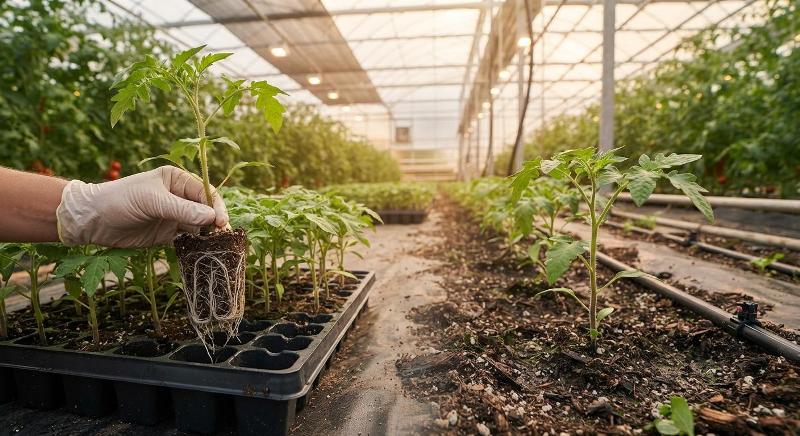
For commercial nursery operators in Iraq and across the Middle East, growing healthy tomato seedlings in hot climates is a constant battle against abiotic stress. During peak production cycles, summer temperatures inside propagation greenhouses frequently surpass 42°C (107°F). Under these punishing conditions, young embryonic tissues suffer severe transpiration stress, thermal root scorch, and stunted growth.
When these fragile young plants are moved to the field or production greenhouse, the sudden environmental change often triggers severe transplant shock. Stunted root systems fail to establish, leading to a 20% to 35% crop mortality rate within the first week after transplanting. Furthermore, weak seedlings become immediate targets for disease vectors like Whiteflies, which transmit the devastating Tomato Yellow Leaf Curl Virus (TYLCV).
Achieving zero-transplant shock requires a fundamental shift in nursery management. By utilizing engineered 105-cell UV-stabilized seed trays, balanced coir substrates, and mechanical pest barriers, commercial growers can consistently produce robust tomato plants that thrive immediately after field setting.
Why Tomato Seedlings Face Severe Stress in Arid Greenhouses
The tomato plant (Solanum lycopersicum) possesses a deeply branching taproot system that demands precise moisture-to-oxygen ratios during early developmental stages. In high-heat propagation rooms, three distinct physical stress factors compromise root health:
-
Cell Volume Imbalance: Trays with tiny cells (such as 200-cell formats) dry out within hours under intense desert heat, leading to root tip necrosis. Conversely, overly large cells hold excess water, causing root suffocation.
-
Root Spiraling and Binding: Smooth-walled plastic containers cause primary roots to circle the bottom of the cell. These root-bound plants fail to anchor properly after transplanting.
-
Substrate Compaction: Traditional soil mixtures bake into hard plugs when heat drives off moisture, preventing lateral root penetration.
According to agricultural management guidelines published by the Food and Agriculture Organization (FAO), managing root-zone temperature and aeration is the single most important factor in reducing transplant shock in arid regions.
The Engineering Behind 105-Cell Trays for Tomato Propagation
Selecting the correct cell density is a strategic decision that directly impacts nursery throughput and plant survival. For commercial tomato propagation, the 105-cell tray format represents the ideal biological and economic sweet spot.
| Tray Format | Cell Volume (cc) | Heat Buffer Capacity | Recommended Tomato Application |
|---|---|---|---|
| 128-Cell Tray | 15 – 18 cc | Low (Dries rapidly in heat) | Short-cycle winter propagation |
| 105-Cell Tray | 25 – 30 cc | Optimal (High thermal protection) | Commercial summer & autumn crops |
| 72-Cell Tray | 45 – 55 cc | Very High (High substrate cost) | Grafted or long-season specialty tomatoes |
Key Mechanical Features of Mayadasht 105-Cell Trays
-
Vertical Root-Guiding Ribs: Internal molded ridges direct root tips straight downward, eliminating spiral root formation and ensuring immediate lateral outward growth upon field planting.
-
Tapered Inverted-Pyramid Shape: The tapered cell wall allows seamless plug ejection during manual or automated transplanting without tearing fine root hairs.
-
Large Bottom Air-Pruning Drainage: Generous drainage openings promote natural air-pruning at the base of the cell, triggering dense secondary root branching inside the plug.
-
Virgin UV-Stabilized Polypropylene: High-density UV protection prevents plastic degradation, structural cracking, and chemical leaching under harsh solar radiation.
To explore technical specifications and bulk ordering options, view our full range of Mayadasht Seed Trays.
Substrate Strategy: Building a Thermal Buffer Matrix
Even the best engineered tray requires a high-performance substrate to protect young tomato seedlings in hot climates. Standard field soil or unblended peat moss compacts and repels water under summer heat.
A professional propagation matrix requires a pre-washed Cocopeat and Horticultural Perlite blend:
-
Low-EC Cocopeat (70%): Acts as a thermal sponge, retaining water up to 8 times its weight while maintaining a low Electrical Conductivity (EC < 0.5 mS/cm) to protect delicate root tips from salt burn.
-
Expanded Perlite 3-5mm (30%): Creates permanent macro-pores that prevent matrix compaction, guaranteeing root zone oxygenation even under frequent irrigation schedules.
Nursery Tip: Keep substrate moisture levels at approximately 60% capacity before tray filling. Never compress the substrate tightly into the cells; light filling ensures optimal air-filled porosity.
Protecting Young Tomato Seedlings from TYLCV Vectors
In hot regions, the Sweetpotato Whitefly (Bemisia tabaci) presents an existential threat to young tomato crops. Infecting seedlings with Tomato Yellow Leaf Curl Virus (TYLCV) during the nursery stage causes total crop loss. Because delicate cotyledons are vulnerable to chemical burning from synthetic sprays, physical control measures are mandatory.
Installing high-tack Yellow & Blue Sticky Cards 10 to 15 cm directly above the tray bench intercepts adult whiteflies before they feed on emerging foliage.
Step-by-Step Protocol to Achieve Zero-Transplant Shock
To consistently achieve a 95%+ survival rate when transplanting tomato seedlings in hot climates, implement this protocol:
-
Tray Preparation: Sanitize reusable trays or unpack fresh Mayadasht 105-Cell Seed Trays.
-
Substrate Pre-Hydration: Mix 70% low-EC Cocopeat with 30% Perlite. Pre-wet the mix to 60% moisture content.
-
Dibbling & Seeding: Fill cells loosely, dibble seeds to a depth of 0.5 cm, and cover lightly with coarse perlite to reflect excess radiant heat.
-
Bench Elevation: Place trays on raised benches (minimum 40 cm off the floor) to enable bottom air-pruning.
-
Physical Vector Control: Position yellow sticky traps along the entire length of the propagation benches to trap whiteflies and aphids.
-
Hardening Off: Three days prior to field setting, reduce watering frequency slightly to allow root plugs to firm up, enabling effortless extraction.
Frequently Asked Questions (FAQ)
Why are 105-cell trays preferred over 200-cell trays for summer tomato propagation?
In high ambient temperatures, the 15cc cell volume of a 200-cell tray dries out too quickly, causing heat shock to root tips. The 25–30cc volume of a 105-cell tray provides sufficient moisture buffering while maintaining space efficiency on nursery benches.
How do vertical cell ribs prevent transplant shock?
Vertical ribs guide root growth downward instead of allowing roots to circle around the cell walls. When transplanted, guided roots immediately grow outward into the surrounding soil, establishing the plant within 24 to 48 hours.
Can Mayadasht 105-cell seed trays be reused across multiple seasons?
Yes. Manufactured from virgin UV-stabilized polymers, Mayadasht seed trays resist sunlight degradation and can be disinfected and reused for multiple growing cycles without cracking or warping.
Upgrade Your Nursery Output with Mayadasht
Eliminating transplant shock and maximizing seedling survival rates requires reliable, professional inputs built for tough climates. Mayadasht manufactures and exports premium agricultural equipment designed specifically for commercial nurseries across Iraq and the Middle East:
-
Heavy-Duty 105-Cell & 72-Cell Seed Trays
-
Low-EC Horticultural Cocopeat & Expanded Perlite
-
High-Tack Yellow & Blue Insect Trap Cards
-
Greenhouse Trellising Twine, Hooks, and Plant Clips
📩 Preparing for your upcoming tomato crop cycle?
Contact the Mayadasht Export Team today to request product samples, technical datasheets, and direct commercial delivery quotes.