
 Persian
 Arabic
 Russian


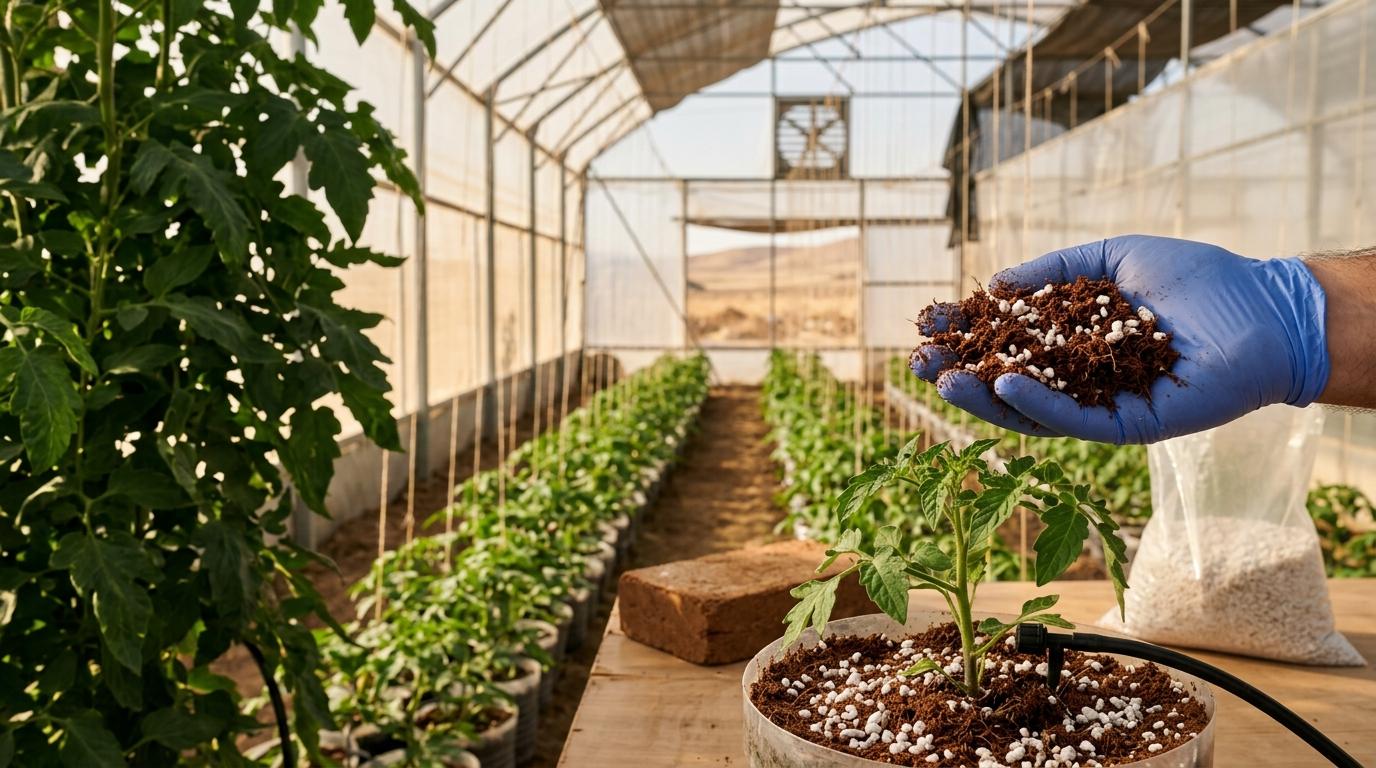
A substrate that supports healthy seedlings in early autumn can become difficult to manage a few weeks later. The material has not necessarily deteriorated. More often, the crop’s water demand has changed while irrigation continues on the same schedule.
This is a critical purchasing issue in autumn greenhouse farming in Iraq. Growers may begin the season managing residual heat, then move into shorter days and cooler nights. Meanwhile, roots expand, leaf area increases, and fruit development changes the crop’s needs.
Consequently, choosing cocopeat or perlite is not simply a comparison between water retention and drainage.
The real question is whether a substrate can be managed reliably with your water supply, irrigation equipment, crop, and seasonal conditions.
For Iraqi growers, nurseries, and agricultural importers, that question connects substrate quality directly to production risk and operating cost.
Why Autumn Greenhouse Farming in Iraq Requires a Regional Approach
Iraq does not have a single autumn growing environment.
A greenhouse in a warm southern location may still face substantial daytime heat during establishment. A project in a cooler northern or elevated location may encounter low night temperatures much earlier.
Water quality adds another layer of variation. Two farms in the same district can have different irrigation constraints because they use different water sources.
Therefore, a product described only as “suitable for Iraq” provides too little information for a technical buying decision.
| Project conditions | Main production risk | What to assess before choosing a substrate |
|---|---|---|
| Warm days and strong solar radiation | Rapid drying and uneven moisture between plants | Usable substrate volume, water retention, and emitter uniformity |
| Irrigation water with elevated sodium or chloride | Salt accumulation around roots | Water analysis, drainage management, and treatment or blending options |
| Cooler nights and declining radiation | Prolonged wetness and reduced root-zone aeration | Irrigation timing, container geometry, and air-filled porosity |
| Limited greenhouse ventilation | Changes in humidity and crop transpiration | Climate management alongside substrate selection |
| Uneven irrigation delivery | Some plants remain wet while others experience water stress | Emitter performance, pressure variation, and filtration |
These conditions should shape the specification before a supplier recommends a cocopeat grade or a cocopeat–perlite blend.
Which Autumn Crops Actually Justify Substrate Investment?
There is an important distinction between fruit harvested in autumn and crops established during autumn.
Dates, pomegranates, and some citrus varieties may enter Iraqi markets during this period, depending on location and cultivar. However, their seasonal availability does not automatically create a commercial case for using cocopeat in established orchards.
For substrate suppliers, the more relevant opportunities are usually:
- Protected cucumber, tomato, and pepper production.
- Vegetable seedling nurseries.
- Selected protected strawberry projects.
- Container and soilless systems with a clear technical or commercial purpose.
Greenhouse Cucumbers
Cucumbers can develop quickly under suitable conditions. This makes irrigation uniformity and root-zone stability particularly important.
However, substrate demand changes as the canopy develops. A system that is adequate immediately after transplanting may require different irrigation management once plants carry a larger leaf area and fruit load.
The purchasing question is not simply whether cocopeat holds enough water. It is whether the chosen substrate volume and irrigation system can support the crop without creating persistent wetness as conditions cool.
Tomatoes and Peppers
For longer production cycles, growers need to consider more than early establishment.
Substrate structure, root volume, drainage, and fertigation management must remain suitable through flowering and fruit development.
Planting dates also need to account for later conditions. Successful transplant establishment does not guarantee good fruit set if subsequent temperatures or light levels become limiting.
Strawberries
Protected strawberry production can justify carefully specified substrates, but it also requires close attention to irrigation water quality.
Strawberries are relatively sensitive to salinity. A low-EC cocopeat product may provide a better starting point, but it cannot compensate indefinitely for unsuitable irrigation water.
Cultivar, transplant type, temperature management, and access to a market for fresh fruit remain central to the investment decision.
Seedling Nurseries
For nurseries, uniformity is often more valuable than maximum water retention.
Differences in particle size, wetting, or cell filling can produce uneven seedlings even when the seed lot and irrigation schedule are identical.
A suitable nursery medium should therefore be assessed in the actual tray size, not only as loose material in a sample bag.
No single planting calendar fits all these projects. Local temperature patterns, greenhouse equipment, cultivar requirements, and the intended harvest window must guide scheduling.
The Hidden Autumn Risk: Keeping a Summer Irrigation Schedule
During the transition into cooler weather, growers sometimes continue frequent irrigation because the crop responded well to it earlier.
That can become a problem when substrate drying slows.
However, automatically reducing irrigation is not the answer either. A developing crop may use more water as its leaf area increases, even while daily radiation declines.
The correct response is to monitor the crop and root zone rather than follow the calendar alone.
What Should Be Monitored?
Useful observations include:
- Moisture before the first irrigation event.
- Moisture distribution through the container.
- Actual emitter discharge.
- Drainage volume and timing.
- Feed and drainage electrical conductivity.
- Root condition.
- Daily radiation and greenhouse temperature, where monitoring equipment is available.
Drainage EC is useful for tracking trends, but it does not describe every part of the root zone. Interpret it alongside moisture, irrigation volume, and plant condition.
Why Wilting Does Not Always Mean the Substrate Is Dry
Plants can wilt in a wet substrate if roots are damaged, oxygen availability is restricted, or salinity is excessive.
Increasing irrigation without checking the root zone may make the problem worse.
Before changing the watering schedule, inspect the substrate, drainage outlets, irrigation delivery, and roots. If root disease is suspected, appropriate diagnosis is necessary.
A good substrate improves controllability. It does not replace diagnosis or irrigation management.
Test the Water Before Selecting Cocopeat or Perlite
For many projects, water quality is a more important starting point than the substrate mixing ratio.
Neither cocopeat nor perlite removes the salts continuously introduced through irrigation.
A low-salinity substrate reduces the initial salt load. It does not make saline water suitable for every crop.
Why EC Alone Is Not Enough
Electrical conductivity, or EC, indicates the overall concentration of dissolved salts. It does not identify which ions are present.
Two water samples can have similar EC readings but different concentrations of sodium, chloride, calcium, and bicarbonate. Their implications for crop management may therefore differ.
A useful irrigation-water assessment commonly includes:
- EC and pH.
- Sodium and chloride.
- Calcium and magnesium.
- Bicarbonate and alkalinity.
- Additional elements, such as boron, where relevant.
Water pH also does not tell you how much acid is required for adjustment. Alkalinity strongly influences that requirement.
Can Extra Drainage Solve Salinity?
Managed drainage can help limit salt accumulation. However, it also increases water and nutrient losses and requires responsible handling of the discharged solution.
If source-water quality is unsuitable, blending or treatment may need to be assessed first.
There is no universal drainage percentage for all Iraqi greenhouses. The appropriate strategy depends on the crop, water composition, substrate, climate, and whether drainage is discarded or recirculated.
Cocopeat Specifications That Matter More Than the Country of Origin
Country of origin can help identify a supply chain, but it does not replace product testing.
For a commercial buyer, clear specifications and consistency between batches are more useful than a broad claim of “premium quality.”
Washed Cocopeat Is Not Necessarily Buffered
These terms describe different processes.
Washing reduces soluble salts.
Buffering adjusts the exchangeable cations associated with cocopeat, commonly using calcium and sometimes magnesium. This matters because cocopeat can interact with potassium, calcium, and magnesium in the root-zone solution.
Therefore, do not assume that a product is buffered because it is described as washed.
Ask the supplier to confirm each treatment separately and explain how the product should be prepared for its intended application.
Compare EC Results Only When the Test Methods Match
An EC value without a measurement method is incomplete information.
Before comparing suppliers, ask:
- How was the extract prepared?
- What water-to-substrate ratio was used?
- What was the quality of the test water?
- Which batch does the result represent?
- When was the sample tested?
Different extraction methods can produce different readings from the same material.
A lower reported number does not automatically prove that one product is better.
Particle Distribution Influences Performance
Fine cocopeat, longer fibres, and coconut husk chips do not behave identically.
Their proportions influence water retention, air space, wetting, and drainage. Nevertheless, performance also depends on container height and packing.
A material that works in a grow bag may behave differently in a shallow seed tray.
For this reason, request information about particle distribution and test the product in the intended container.
Batch Consistency Reduces Management Problems
An excellent sample is useful only if the delivered shipment is reasonably consistent with it.
When receiving a commercial order, inspect multiple blocks from different parts of the shipment.
Check expansion, wetting, particle composition, and EC using the same procedures. Record the batch details so that unexpected differences can be investigated.
When Does Perlite Add Real Value?
Perlite is a physical substrate component, not a fertilizer or a treatment for saline irrigation water.
Depending on its grade and the mixture, it can modify water retention and air-filled porosity. However, adding perlite does not automatically improve every cocopeat system.
| Observed problem | Possible role of perlite | What to check first |
|---|---|---|
| The medium stays wet for too long | An appropriate grade and proportion may improve the physical balance | Irrigation frequency, container height, and drainage openings |
| Irrigation water is saline | It does not remove the source of salinity | Water analysis and management options |
| Growth varies across the greenhouse | It may not address the cause | Irrigation uniformity, filling consistency, and root health |
| A fine mixture has insufficient air space | A blend trial may be justified | Particle distribution and measured physical properties |
| Roots show disease symptoms | It is not a disease treatment | Diagnosis and crop hygiene |
Why a Fixed Cocopeat–Perlite Ratio Can Be Misleading
Two mixtures with the same volume ratio may perform differently because of:
- Cocopeat particle composition.
- Perlite particle-size distribution.
- Packing density.
- Container shape and height.
- Substrate volume per plant.
- Irrigation pulse frequency and duration.
A more freely draining mixture may also need a different irrigation schedule.
The mixing ratio should be the outcome of an assessment, not a universal sales recommendation.
How Substrate Management Affects Fruit Quality
Substrates affect fruit production indirectly through water availability, nutrient management, and root health.
They do not independently guarantee sweeter fruit, larger harvests, or fewer physiological disorders.
In tomatoes and peppers, irregular water supply and disrupted calcium transport can contribute to blossom-end rot. Adding calcium alone does not resolve every case.
In cucumbers, root stress may affect growth and production uniformity, although temperature, nutrition, and fruit load also matter.
For strawberries, salinity and unstable root-zone conditions can limit establishment and performance.
Measure Marketable Yield, Not Just Total Harvest
When assessing a substrate, record:
- Weight of marketable fruit.
- Rejected fruit and reasons for rejection.
- Size uniformity.
- Differences between plants.
- Production cost per kilogram sold.
A heavier total harvest does not necessarily produce a better financial result if rejection rates or operating costs increase.
The Economics: Compare Delivered Cost per Usable Litre
The cheapest five-kilogram block is not necessarily the cheapest growing medium.
Expansion, transport, preparation, and usable volume all affect the final cost.
Use this comparison:
Cost per usable litre = Total purchasing, transport, clearance, preparation, and loss costs ÷ Actual usable substrate volume
Measure expanded volume using a consistent method. Differences in compression during measurement can distort the comparison.
Include These Costs in the Purchasing Decision
- Labour for hydration and preparation.
- Water required for preparation.
- Any additional treatment indicated by testing.
- Packaging and handling.
- Storage requirements.
- Delivery lead time.
- Variability between blocks.
- The cost of managing inconsistent crop performance.
For perlite, transport deserves particular attention. Its low weight does not necessarily mean low freight cost: vehicle space can become the limiting factor.
When Is a Soilless System Economically Justified?
A transition may be worth evaluating where soil-related problems constrain production and the grower can operate the alternative system effectively.
That requires:
- Manageable irrigation water.
- Reliable fertigation.
- Suitable drainage.
- Monitoring and trained staff.
- A sales market capable of supporting production costs.
Replacing soil with cocopeat while keeping poor water quality and uneven irrigation may simply move the problem into a different root zone.
A Practical Trial Before Ordering a Full Shipment
A block that expands quickly is not automatically the best commercial choice.
A useful evaluation combines product testing with a crop trial where appropriate.
Step 1: Check the Material
Compare several samples under consistent conditions:
- Expanded usable volume.
- Wetting uniformity.
- Particle distribution.
- EC and pH using a defined method.
- Variation between blocks.
Step 2: Test It in the Intended System
Use the same cultivar and comparable seedlings. Include replicated groups across representative greenhouse locations where practical.
Avoid placing one substrate entirely on one side of the greenhouse and another on the opposite side. Temperature, light, or irrigation differences could otherwise be mistaken for a substrate effect.
Step 3: Define What You Are Comparing
There are two different questions:
Can the material replace the current substrate without changing management?
Test it under the existing operating conditions, while recognizing that the result reflects that specific management system.
What is its best practical commercial performance?
Adjust irrigation appropriately for each material and record the additional management and costs.
Step 4: Follow the Trial Through Fruiting
An establishment trial can reveal wetting and early growth problems. It cannot establish final yield or profitability.
For a meaningful commercial comparison, continue through fruit production and record marketable yield, rejects, water use, fertilizer inputs, and labour where measurable.
Purchasing Checklist for Iraqi Growers and Importers
Before confirming a substrate order, check the following:
- [ ] Farm location, crop, and intended planting window are defined.
- [ ] A recent irrigation-water analysis is available.
- [ ] Container type and substrate volume per plant are specified.
- [ ] Washing and buffering status are confirmed separately.
- [ ] EC and pH results include the test method.
- [ ] Expansion and particle distribution have been evaluated.
- [ ] Perlite grade is specified where a blend is required.
- [ ] The sample is representative of the proposed shipment.
- [ ] Packaging, delivery responsibilities, and transport terms are clear.
- [ ] Enough time is available for inspection and preparation before transplanting.
Frequently Asked Questions
Can cocopeat be used without perlite?
Yes, in suitable systems. Whether perlite is needed depends on cocopeat structure, container geometry, irrigation management, and crop requirements. It is not a compulsory ingredient.
Should irrigation be reduced as soon as autumn begins?
Not automatically. Assess radiation, plant development, substrate moisture, and drainage. Water demand may remain high during warm weather or increase as the canopy develops.
Does low-EC cocopeat solve irrigation-water salinity?
No. It reduces the substrate’s initial salt contribution but does not stop salts entering through irrigation.
Is cocopeat necessary for every Iraqi greenhouse?
No. Its value depends on the production problem being addressed. Compare improvements to the existing soil system against the full cost of establishing and operating a soilless system.
What information should a substrate supplier request?
At minimum: location, crop, water analysis, container type, irrigation setup, intended quantity, and planting schedule. These details support a more useful recommendation than a price enquiry alone.
Conclusion: Buy for the Whole Crop Cycle
Successful autumn greenhouse farming in Iraq depends on managing a changing environment, not simply choosing a popular substrate.
Cocopeat should have clear, verifiable specifications. Perlite should be added when its physical contribution is useful. Both must fit the irrigation water, container, crop, and management capacity.
Before purchasing, test the water, inspect the material, and compare the delivered cost per usable litre. Then assess performance through marketable production—not just seedling appearance.
A professional supplier helps reduce uncertainty before the order, rather than promising that one product will solve every growing problem.
Discuss Cocopeat Supply to Iraq with Mayadasht
Mayadasht supplies washed cocopeat in compressed five-kilogram blocks, with grades that differ in EC, and provides transit services to Iraq. Overseas customers can request product samples and analysis before confirming an order.
Washing should not be taken as confirmation of buffering. Ask for the treatment status and specifications of the offered grade.
Send your destination city, crop, required quantity, growing system, and available water analysis to discuss suitable supply options. Before ordering, confirm the product specifications, packaging, transport terms, and preparation requirements.