
 Persian
 Arabic
 Russian


1. Modern agriculture in Arab countries: more than just buying products
Across many Arab countries – from Iraq and Syria to Saudi Arabia, UAE, Oman, Qatar and beyond – farmers and investors are under the same pressure:
- Water is limited and expensive
- Climate is harsh, with high temperatures and strong sunlight
- Land must produce more yield per square meter
- Markets demand consistent quality for export
Because of this, agricultural inputs such as cocopeat, peat moss, coco chips, greenhouse plastic films, seedling trays, insect nets, and shading nets are no longer “optional extras”. They have become strategic tools for survival and growth.
But here is the key point:
Having access to good products is not enough.
Using the right product, in the right way, for the right crop and climate – with expert guidance – is what creates success.
This is exactly where a professional, experienced partner like Maya Dasht can change the game.
2. Growing media: cocopeat, peat moss, and coco chips as the foundation
Cocopeat
Cocopeat is widely used in Arab countries for:
- Greenhouse vegetables (tomato, cucumber, pepper, strawberry)
- Nurseries and seedling production
- Soilless and hydroponic systems
Its high water-holding capacity and good aeration help plants handle heat and irregular irrigation, which are very common challenges in hot, dry regions.
Peat moss
Peat moss is still popular for:
- Mixing with local soils to improve structure
- High-value ornamentals and nursery plants
- Seedling trays for sensitive crops
It is light, clean, and has stable properties – but it can be expensive and not always sustainable.
Coco chips
Coco chips are especially useful for:
- Crops that need more aeration around the roots
- Long-term crops in bags or containers
- Mixing with cocopeat or peat moss to create a custom substrate
They help prevent over-compaction and improve oxygen availability, which is critical in hot conditions where root diseases can develop quickly.
The real question is not “which is better?” but:
- What is your crop?
- What is your climate and water quality?
- What irrigation system do you use?
- What is your budget and target market?
Only then can a professional advisor decide whether to recommend pure cocopeat, peat moss, a cocopeat–perlite mix, coco chips blends, or another solution.
3. Greenhouse plastics: films that protect every drop of water
In hot and arid Arab regions, the type of greenhouse film you choose can be the difference between profit and loss.
Modern greenhouse plastics can offer:
- UV stabilization – longer film life under strong sun
- IR (infrared) blocking – lower temperature at night, more stable climate
- Anti-fog and anti-drip – less condensation, fewer diseases, more light for plants
- Light diffusion – better light distribution, reduced leaf burn
However, not every farm needs the most expensive film.
Some farms need high-diffusion film for tomatoes, others may need simpler film for seasonal crops.
An expert consultant looks at:
- Region and temperature profile
- Type of crop and growing season
- Expected lifetime of the project
- Investment capacity
and then suggests the right combination of thickness, additives, and lifespan.
This is the kind of tailored advice that Maya Dasht provides – not just “selling plastic”, but designing the right cover for your climate and budget.
4. Seedling trays, pots, and nursery systems: where success starts
Many failures in greenhouses and open-field projects in Arab countries start before plants even reach the field – in the nursery phase.
Using the right seedling trays and nursery systems helps to:
- Create uniform seedlings with strong roots
- Reduce transplant shock
- Save seeds and inputs
- Shorten the production cycle
But tray design matters:
- Number of cells and volume per cell
- Plastic quality and durability
- Compatibility with cocopeat, peat moss, or other substrates
Without proper guidance, a farmer may buy cheap trays that:
- Break easily
- Do not drain well
- Produce weak seedlings
A professional advisor helps choose the correct tray type and substrate mix for each crop and climate – again, turning simple “products” into a real production system.
5. Insect nets, shading nets, and climate control: protecting the investment
In many Arab countries, pests and extreme sunlight are constant threats.
- Insect-proof nets reduce the need for chemical pesticides and protect sensitive crops from whiteflies, thrips, and aphids.
- Shading nets help control temperature and light intensity, especially in summer months.
But here too, details matter:
- Mesh size for insect nets (e.g., 40 mesh, 50 mesh)
- Shade percentage for shading nets (30%, 50%, 70%…)
- Placement and installation design
Choosing the wrong mesh or shade level can lead to:
- Too much heat inside the greenhouse
- Poor ventilation
- Insufficient light for proper photosynthesis
This is why having an integrated design – instead of random product purchases – is crucial.
6. Products are tools. Strategy and expertise create results.
If we look at all these items together:
- Cocopeat, peat moss, coco chips
- Greenhouse plastic films
- Seedling trays and nursery systems
- Insect nets and shading solutions
we see that they are tools. On their own, they do not guarantee success.
What really makes a difference in Arab agriculture is:
- Understanding local climate, water, soil, and market conditions
- Designing a complete solution: from substrate to greenhouse cover to nursery and pest protection
- Calculating cost vs. return on investment (ROI) for each decision
This is exactly the role of a professional consultant and technical partner – not only a seller.
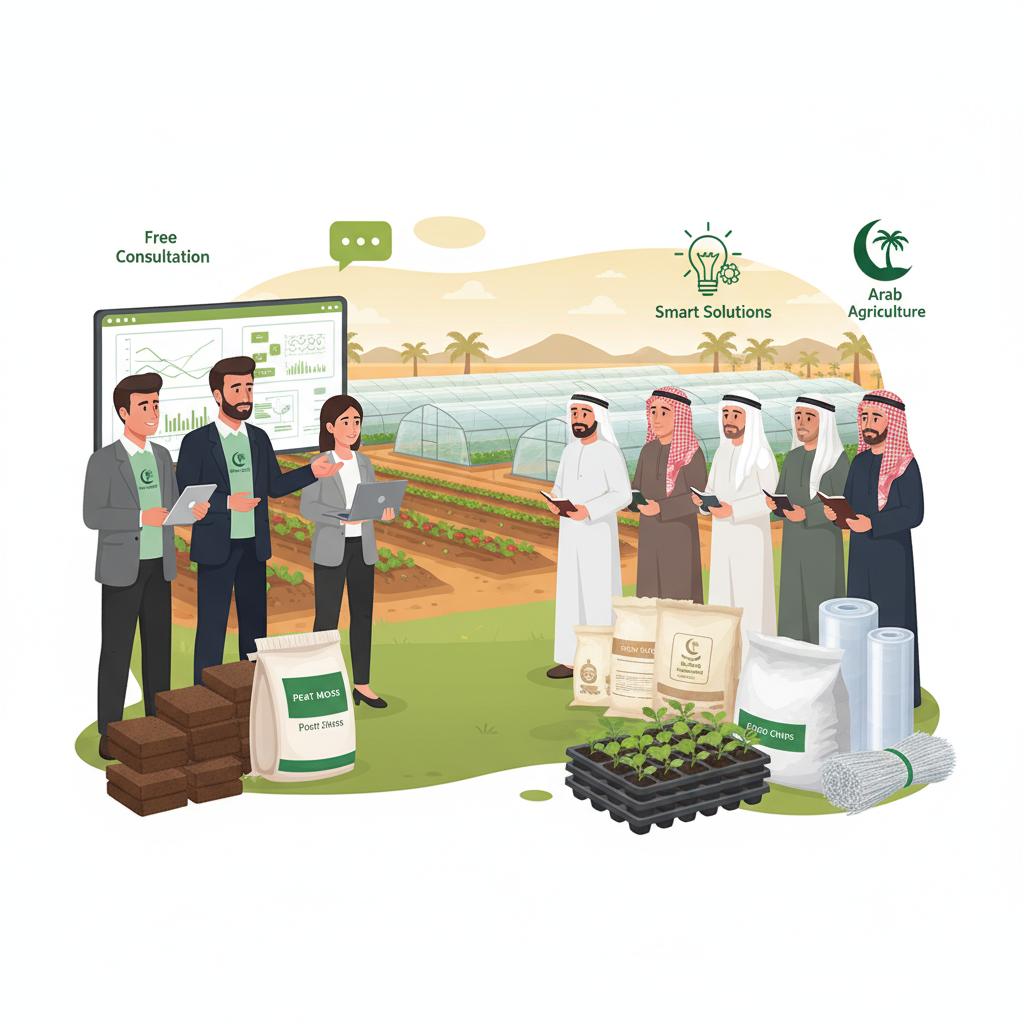
7. How Maya Dasht supports Arab farmers and traders
At Maya Dasht, we do not look at cocopeat, greenhouse films, or trays as separate products.
We see them as parts of a full agricultural strategy.
For Arab farmers, investors, and traders, we offer:
- Free initial consultation to understand your project, climate, and goals
- Technical advice on choosing between cocopeat, peat moss, or mixed substrates
- Recommendations on the right greenhouse plastic type, thickness, and additives for your region
- Guidance on seedling tray selection, nursery setup, and substrate filling
- Suggestions for insect nets, shading nets, and other protection tools that match your climate
Our role is to act as your long-term technical partner, helping you:
- Reduce risk
- Increase yield and quality
- Use water and inputs more efficiently
- Build projects that are profitable and sustainable
8. Conclusion: The right partner is as important as the right product
Modern agriculture in Arab countries will not succeed with “one product fits all” thinking.
The same cocopeat block or plastic film can fail in one project and succeed in another –
the difference is design, adaptation, and expert guidance.
By working with a team that understands both the products and the realities of Arab climates and markets, you can turn these inputs into real, measurable results.
If you are a farmer, trader, or investor in any Arab country and you are planning or expanding projects with:
- Greenhouses
- Soilless or hydroponic systems
- Nurseries and seedling production
you do not need to make these decisions alone.
📩 Contact Maya Dasht for a free, no‑obligation consultation.
Together, we can analyze your conditions and design the most efficient combination of cocopeat, substrates, greenhouse films, and protection systems – so that your investment turns into sustainable success.