
 Persian
 Arabic
 Russian


Agriculture in Iraq operates under permanent pressure.
Heat arrives early, water availability is unpredictable, and corrective actions are often taken too late to fully protect crops.
In such conditions, success is rarely about pushing maximum yield.
It is about controlling risk.
This is where perlite’s real value emerges—not as a growing medium, but as a structural tool that reduces the impact of stress, error, and environmental volatility.
Why Iraqi Agriculture Is Structurally Vulnerable
Most agricultural systems in Iraq face a combination of challenges:
- rapid temperature increases
- inconsistent irrigation schedules
- variable soil structures
- limited tolerance for mid‑season correction
These factors create a fragile root environment.
Once roots are stressed, recovery is slow, expensive, and often incomplete.
Crop Failures Begin as Physical Problems, Not Nutritional Ones
When crops struggle, the immediate response is often to adjust fertilizers.
However, in many Iraqi production systems, early crop failure begins with physical root‑zone stress.
Common issues include:
- oxygen depletion due to compaction
- waterlogging after increased irrigation
- uneven moisture distribution during heat transitions
Nutrients cannot compensate for a dysfunctional root environment.
What Perlite Actually Does Under Pressure
Perlite’s function is mechanical, not chemical.
Its contribution becomes visible only under stress.
In Iraqi conditions, perlite:
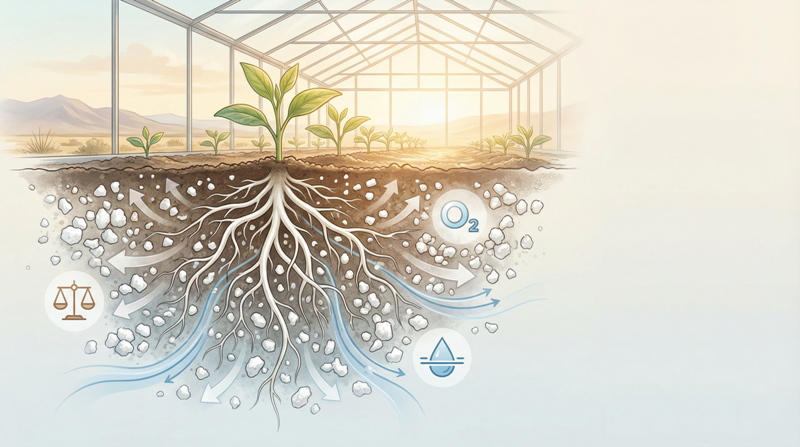
- preserves oxygen channels as irrigation frequency increases
- prevents structural collapse during heat‑driven root expansion
- improves water movement without drying the root zone
This stabilizing effect reduces the likelihood of sudden system failure.
Perlite as a Risk‑Management Layer
Professional growers rarely rely on a single input to guarantee performance.
Instead, they build layers of protection.
Perlite acts as one of these layers by:
- absorbing irrigation variability
- reducing sensitivity to temperature spikes
- maintaining consistency across the root zone
Rather than increasing yield directly, it protects yield potential from being lost.
The Cost of Ignoring Structural Inputs in Spring
As Iraq transitions from winter to spring, irrigation patterns change rapidly.
Without structural support in the growing medium:
- root stress accumulates quietly
- disease pressure increases
- corrective actions become reactive and costly
These costs rarely appear immediately but surface later as reduced uniformity, delayed growth, or partial crop loss.
How Professional Growers Evaluate Perlite
Experienced agricultural decision‑makers do not evaluate perlite by price alone.
They focus on:
- particle size consistency
- expansion quality
- long‑term structural stability
- performance under repeated irrigation cycles
Cheap perlite that collapses under pressure increases risk rather than reducing it.
Why Perlite Matters More in Iraq Than in Many Regions
In climates with gradual seasons and stable water supply, growing media have time to recover.
Iraq’s environment offers no such margin.
Here, perlite’s role is amplified because it:
- buffers environmental extremes
- extends the system’s tolerance to error
- increases predictability under pressure
Predictability, in this context, is more valuable than incremental yield gains.
Final Insight: Stability Is the New Yield
In Iraq, agricultural success is not defined by the highest theoretical output.
It is defined by what survives stress.
Perlite does not promise miracles.
It offers structure, oxygen, and resilience—three elements that allow crops to endure heat, water fluctuation, and human error.
In a high‑risk agricultural environment, stability is not a luxury.
It is the foundation of profitability.