
 Persian
 Arabic
 Russian



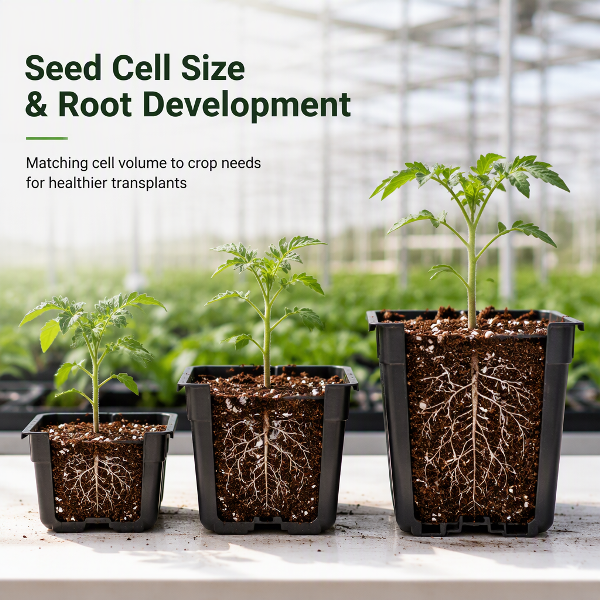
A seedling tray is more than a container for germination. It defines the volume of substrate available to each plant, influences irrigation management, and limits how long a seedling can remain in the nursery before root restriction becomes a production concern.
Yet trays are frequently purchased by cell count alone.
A 105-cell tray, for example, describes the number of planting positions—not the root-zone volume, cell depth, drainage performance, or suitable holding period.
The practical question is not simply “How many cells should this tray have?” It is “Will this cell support the crop until the actual transplanting date, under our irrigation and nursery conditions?”
This guide explains how to evaluate that question without relying on universal tray recommendations.
1. Cell Count Is a Layout Specification, Not a Complete Growing Specification
Cell count indicates how many seedlings a tray can accommodate. It becomes a useful indicator of growing space only when tray dimensions and cell geometry are also known.
Within a similar tray footprint, a higher cell count generally means smaller individual cells. Across different tray designs, however, that relationship is not reliable enough for technical purchasing.
Two trays with the same number of cells can differ in:
- Usable substrate volume per cell.
- Cell depth and taper.
- Opening dimensions.
- Drainage-hole design.
- Spacing between seedlings.
- Rigidity and compatibility with handling equipment.
A tray comparison should therefore start with dimensions, not catalogue labels.
What to Request from a Supplier
| Specification | Why it matters |
|---|---|
| Cell count | Determines planting positions per tray |
| External tray dimensions | Determines bench fit and production density |
| Usable cell volume | Indicates substrate capacity per seedling |
| Cell depth and shape | Influences root-zone geometry and water distribution |
| Drainage configuration | Affects water discharge; must be assessed with the substrate |
| Material and thickness | Influences rigidity, handling, and potential reuse |
| Equipment compatibility | Matters for filling, sowing, and transplanting operations |
Nominal cell volume and actual filled substrate volume may differ, depending on fill height, compaction, and the manufacturer’s measurement method.
2. Cell Volume Affects the Margin for Irrigation Error
Smaller cells usually contain less substrate and, under otherwise comparable conditions, a smaller absolute water reserve.
This does not automatically make them unsuitable. It means their performance depends more heavily on timely, uniform irrigation.
A useful conceptual relationship is:
Approximate irrigation interval = usable water reserve per cell ÷ water loss per cell over time
This is a management concept, not a validated scheduling formula. Actual irrigation decisions also depend on substrate properties, plant size, weather, drainage, and the acceptable degree of drying.
The important distinction is between total water held and water available within a suitable root-zone moisture range.
A substrate can retain considerable water while still providing inadequate aeration when wet. Conversely, a well-aerated mix may dry quickly in a small cell.
Why This Matters in Hot Nurseries
High temperature, radiation, airflow, and low relative humidity can increase water loss. As seedlings develop, increasing leaf area can further accelerate water use.
Under these conditions, a small cell may leave little room for:
- A missed irrigation cycle.
- Uneven sprinkler coverage.
- Edge-tray drying.
- Delays in responding to changing weather.
Tray selection and irrigation capability should be evaluated together. A tray suitable for a closely monitored nursery may be less forgiving in a facility with irregular watering.
3. Cell Depth Changes Water Distribution—not Just Rooting Space
Depth is often treated as a simple measure of how far roots can grow. It also affects the distribution of water and air within the substrate.
For a given substrate under comparable drainage conditions, a taller container generally has a lower average water content after drainage than a shallower one. The lower portion can remain wetter while the upper portion becomes better aerated.
This means two cells with similar volumes but different shapes may not provide the same root environment.
However, “deeper is better” is not a universal rule. Performance also depends on:
- Substrate particle-size distribution.
- Filling and compaction.
- Drainage outlets.
- Irrigation frequency.
- Root development.
- How readily the plug can be extracted.
Depth, volume, and substrate must be assessed as a system.
4. The Real Transplanting Date Matters More Than the Planned Date
Tray selection often assumes seedlings will leave the nursery on schedule. Commercial production does not always follow that schedule.
Field preparation, weather, labour shortages, transport, or customer requirements can delay transplanting.
During that delay, seedlings continue developing inside a fixed substrate volume. Depending on the crop and conditions, consequences can include:
- More frequent irrigation requirements.
- Increasing root restriction.
- Reduced spacing between expanding canopies.
- Greater variation in plant water status.
- More difficult management of seedling size and nutrition.
A useful planning principle is:
Design for the expected nursery period plus a realistic delay allowance.
The allowance should come from actual production history—not an arbitrary number of extra days.
A larger cell may provide more flexibility, but it also increases substrate demand and may reduce the number of seedlings produced per unit of bench area.
The objective is not maximum cell size. It is enough capacity for the production schedule at an acceptable cost.
5. Tomato, Pepper, and Cucumber Should Not Share an Automatic Tray Recommendation
Crop names alone are not sufficient for specifying a cell count.
Cultivar, nursery climate, grafting, transplant age, substrate, and irrigation all influence the decision.
| Crop | Important selection consideration |
|---|---|
| Tomato | Match cell capacity to growth rate, nursery duration, and the risk of excessive canopy crowding |
| Pepper | Account for the planned nursery period and how moisture will be managed throughout it |
| Cucumber | Prioritize timely transplanting, careful handling, and adequate space during rapid seedling development |
For cucumber in particular, avoiding unnecessary disturbance during transplanting is important. But neither a specific cell count nor a larger tray can guarantee “zero transplant shock.”
Establishment also depends on root condition, hardening, field moisture, temperature, and handling.
6. Evaluate Root Plug Quality Before Making a Purchasing Decision
A seedling that looks vigorous above the substrate is not necessarily ready for efficient transplanting.
Inspect representative plugs from both central and edge positions.
Look for a Functional Root Plug
A suitable plug should:
- Hold together adequately during extraction.
- Show roots distributed through the substrate.
- Release without excessive pulling or stem damage.
- Be moist enough for handling without being saturated.
- Avoid severe root congestion or extensive circling.
Some roots visible at the cell wall are normal. Their presence alone does not establish that a seedling is root-bound.
Likewise, a loose plug may reflect an early extraction date or unsuitable filling conditions—not necessarily a defective tray.
Assess the tray, substrate, crop stage, and extraction method together.
7. Run a Small Trial Before Changing Tray Specifications
The most useful recommendation is often the one tested under your nursery conditions.
Compare two or three candidate tray designs using the same cultivar and comparable growing conditions.
Record:
- Cell volume and depth.
- Substrate composition.
- Filling method.
- Sowing and transplanting dates.
- Irrigation frequency.
- Seedling uniformity.
- Plug integrity during extraction.
- Handling losses.
- Establishment after transplanting.
Use replicated trays and distribute them across the nursery to reduce positional bias.
Be clear about the trial objective. Giving every tray identical irrigation tests performance under one fixed schedule. Adjusting irrigation to each design tests its performance under appropriate management. Those are different questions.
Compare Cost per Usable Seedling
A practical financial measure is:
Cost per usable seedling = relevant nursery production costs ÷ number of seedlings meeting transplant specifications
Relevant costs can include substrate, tray allocation or depreciation, bench occupancy, labour, and rejected seedlings.
This is more informative than tray purchase price alone.
Frequently Asked Questions
Is a higher-cell-count tray always more economical?
No. It may increase seedlings per tray, but the benefit can be offset by irrigation demands, quality losses, or a holding period that is too long for the cell capacity.
Does a larger cell always produce a better seedling?
No. Larger cells provide more substrate capacity, but suitable quality depends on crop timing, growing conditions, and management. Additional volume may be unnecessary for a short nursery cycle.
Can two trays with the same cell count perform differently?
Yes. Differences in cell volume, depth, shape, drainage, and spacing can change growing and handling performance.
What is the best cell count for tomato, pepper, or cucumber?
There is no universally best count. Select from the actual cell specifications, planned nursery period, irrigation capability, and acceptable transplant quality.
Conclusion: Purchase Root-Zone Capacity, Not Just Planting Positions
Cell count is a useful starting point, but an incomplete selection criterion.
A technically sound tray decision connects cell volume, depth, substrate behaviour, irrigation capacity, and actual transplant timing.
Before ordering, ask:
Can this tray produce a uniform, extractable, adequately rooted seedling—and maintain that quality if transplanting is delayed?
That question is more valuable than choosing a tray solely because it offers more cells or a lower purchase price.