
 Persian
 Arabic
 Russian


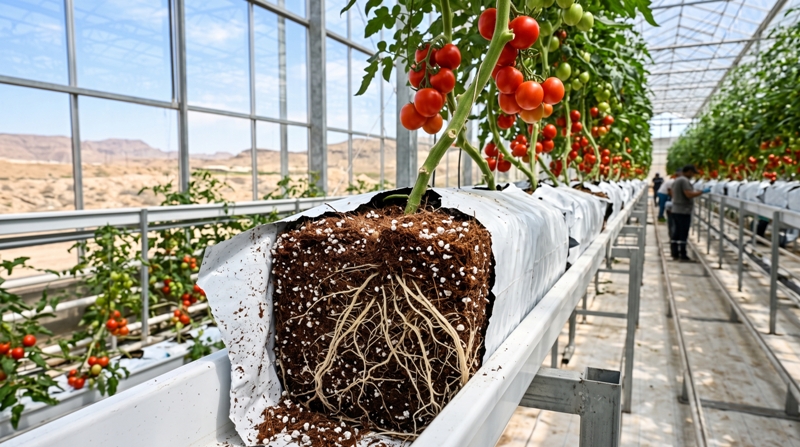
In commercial greenhouse farming across Iraq—particularly in central and southern provinces such as Basra, Najaf, Karbala, and Babil—salinity presents an existential threat to crop productivity. Decades of intensive irrigation, reduced river inflows, high water evaporation rates, and brackish groundwater have degraded traditional agricultural soils.
When soil Electrical Conductivity (EC) levels spike, vegetable crops like tomatoes, cucumbers, and peppers experience extreme osmotic stress. Plants struggle to draw water, toxic sodium () and chloride () ions accumulate in leaf margins, and essential nutrients like calcium and potassium become biologically locked out.
To maintain profitability, leading commercial growers are transitioning away from degraded field beds toward soilless hydroponic systems. Utilizing triple-washed low EC cocopeat for saline soil environments allows growers to isolate plant root zones from contaminated field ground, establish a clean nutritional slate, and achieve high yields even with moderate water salinity.
The Salinity Crisis in Iraqi Protected Horticulture
In traditional soil-based farming, high salinity causes severe physiological damage before visual symptoms appear:
-
Osmotic Drought: High salt concentration in soil water creates high osmotic pressure outside root cells. Even if the soil is visually wet, the root system cannot absorb water, causing severe midday wilting.
-
Sodium and Chloride Toxicity: Excessive sodium ions destroy soil structure, reducing aeration. Within the plant, high sodium displaces potassium and calcium, leading to blossom-end rot in tomatoes and marginal leaf necrosis in cucumbers.
-
Soil-Borne Disease Proliferation: Salt-stressed root systems become highly susceptible to opportunistic fungal pathogens such as Pythium, Phytophthora, and root-knot nematodes.
According to soil degradation reports published by the Food and Agriculture Organization (FAO), soil salinization affects vast agricultural areas in arid regions, making controlled soilless substrates the primary pathway for sustainable food production.
Why Low-EC Cocopeat Outperforms Raw Substrates
Cocopeat (coir pith) is a natural byproduct of coconut husk processing. However, raw or unwashed cocopeat naturally contains high levels of sodium and potassium salts from coastal growing environments. Placing raw cocopeat into an already saline environment compounds root stress.
Triple-washed, buffered low EC cocopeat for saline soil applications undergoes rigorous industrial washing with fresh water and calcium treatment to flush out residual salts, lowering the EC to under 0.5 mS/cm.
| Substrate Type | Electrical Conductivity (EC) | Water Retention Capacity | Root Zone Isolation | Suitability for Saline Regions |
|---|---|---|---|---|
| Saline Iraqi Field Soil | High to Extreme (> 4.0 mS/cm) | Poor (Compacts and crusts) | None (Direct contact with soil pathogens) | Unsuitable without reclamation |
| Raw / Unwashed Cocopeat | High (1.5 – 3.0 mS/cm) | High (8x – 10x weight) | High (Soilless medium) | Risky (Burns young feeder roots) |
| Mayadasht Low-EC Cocopeat | Very Low (< 0.5 mS/cm) | Optimal (High capillary retention) | Complete (Sterile root zone) | Ideal for Saline & Arid Environments |
Explore our complete technical range of professional growing media at Mayadasht Substrates.
Integrating Low-EC Cocopeat and Perlite in High-Heat Climates
To maximize the performance of low EC cocopeat for saline soil zones, the substrate matrix must maintain high air-filled porosity. Under intense summer temperatures exceeding 40°C, frequent irrigation with moderately saline water can cause salt buildup in the substrate if drainage is insufficient.
Blending 70% Low-EC Cocopeat with 30% Horticultural Perlite (3–5mm) creates structural macro-pores that deliver three vital agronomic advantages:
-
Effortless Salt Flushing: The porous matrix allows excess irrigation water to flush residual sodium and chloride salts through drainage channels smoothly.
-
Root Zone Oxygenation: Maintains 15% to 20% air space even immediately after heavy drip irrigation, preventing root suffocation.
-
Thermal Protection: The spongy cellular structure of coir fibers buffers root temperatures against extreme ambient greenhouse heat.
Agronomic Protocol for Managing Saline Water Hydroponics
When operating in areas where irrigation water has moderate background salinity, follow this standard operating procedure:
-
Substrate EC Verification: Before planting, hydrate cocopeat blocks and measure drain water EC. Ensure initial substrate EC remains below 0.8 mS/cm.
-
Maintain a 20% Leaching Fraction: Apply 20% more irrigation volume than plant uptake requirements. This intentional excess flushes accumulated salts out of the growbag or container bottom.
-
Elevate Growbags off Field Soil: Never place growbags directly on saline field ground. Use elevated gutters or raised plastic walkways to prevent saline groundwater from wicking into the substrate.
-
Fortify Calcium & Magnesium: Calcium ions ($Ca^{2+}$) compete directly with sodium ions ($Na^+$) at root binding sites. Maintaining higher calcium ratios in nutrient solutions protects roots against sodium toxicity.
Troubleshooting Substrate and Salinity Issues
| Observed Crop Symptom | Underlying Cause | Corrective Action |
|---|---|---|
| Leaf margin burning & tip necrosis | High substrate EC caused by unwashed coir or insufficient flushing | Flush growbags with clean low-EC water until drain EC drops below 1.8 mS/cm. |
| Blossom-end rot in tomato fruit | Sodium toxicity blocking calcium uptake in root tips | Switch to Mayadasht triple-washed low-EC cocopeat and increase Calcium Nitrate fertigation. |
| Root dieback and yellowing foliage | Compacted substrate lacking perlite aeration under heavy irrigation | Blend 30% coarse perlite with low-EC cocopeat to restore root oxygenation. |
Frequently Asked Questions (FAQ)
What is the difference between raw cocopeat and low-EC washed cocopeat?
Raw cocopeat contains high levels of naturally occurring sodium and chloride salts from coconut husk processing, with EC levels reaching 2.0 to 3.0 mS/cm. Low-EC cocopeat is triple-washed with fresh water, lowering EC levels to below 0.5 mS/cm, making it completely safe for tender seedling and greenhouse crop roots.
Can low-EC cocopeat be used if greenhouse irrigation water is brackish?
Yes. Using low EC cocopeat for saline soil zones provides a clean, inert root medium that does not contribute extra salts. When paired with a 20% leaching fraction, it allows growers to produce successful crops even with moderately brackish water.
What is the ideal EC target for greenhouse tomatoes in cocopeat growbags?
For tomato crops grown in cocopeat growbags, maintain a substrate drain EC between 2.0 and 3.5 mS/cm during peak fruiting. Initial planting should always occur in fresh substrate below 0.8 mS/cm.
Overcome Salinity Challenges with Mayadasht Solutions
Eliminating salinity bottlenecks and achieving high commercial yields in tough climate conditions requires reliable, export-grade growing media. Mayadasht supplies commercial greenhouse operations across Iraq and the Middle East with high-performance agricultural inputs:
-
Triple-Washed Low-EC Cocopeat Blocks & Growbag Slabs
-
Horticultural Grade Expanded Perlite (3–5mm)
-
UV-Stabilized Seed Trays & Flexible Plant Pots
-
Greenhouse Trellising Twine, Hooks & Plant Clips
📩 Planning your next greenhouse production cycle?
Contact the Mayadasht Export Team today to request technical datasheets, custom substrate blends, and wholesale export delivery quotes.