
 Persian
 Arabic
 Russian

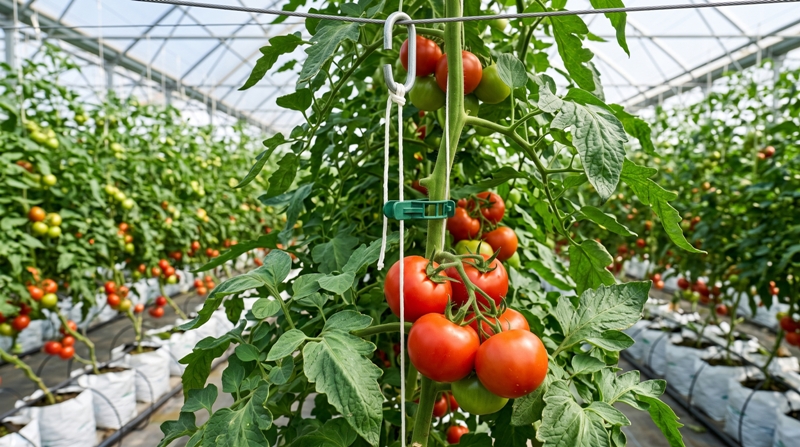
In commercial greenhouse production across Iraq and the Middle East, high-yield indeterminate crops like cucumbers and tomatoes represent significant capital investments. However, as plants reach peak load—carrying anywhere from 8 to 15 kilograms of fruit per vine—the structural integrity of the crop canopy is put under extreme physical strain.
Properly trellising heavy greenhouse crops is not merely a routine maintenance task; it is a critical engineering requirement for high-density production. Under extreme summer heat, plant stems become more succulent and pliable. Without adequate vertical support, a single heavy cluster can cause severe stem kinking, vascular constriction, or catastrophic stem collapse.
When a main stem snaps or kinks, water and nutrient transport through the xylem and phloem ceases immediately, causing fruit drop, leaf wilting, and complete loss of the affected vine. Implementing an integrated support system using UV-stabilized twine, roller hooks, and stem clips guarantees structural stability, optimizes canopy light interception, and streamlines daily labor operations.
The Physics of Stem Collapse in High-Density Greenhouses
As indeterminate vines grow vertically toward the support wire, static and dynamic loads accumulate simultaneously:
-
Static Cumulative Load: The combined weight of vegetative biomass, expanding foliage, heavy fruit clusters, and absorbed water after overhead misting or high humidity events.
-
Dynamic Operational Load: The physical stress placed on plant stems during routine pruning, leaf removal, harvesting, and lowering/leaning operations.
-
Vascular Constriction Risk: Manually wrapping twine tightly around expanding stems creates severe pressure points. As stem diameter increases, the twine acts like a tourniquet, restricting carbohydrate transport to developing roots and fruit.
According to greenhouse production guidelines published by the Food and Agriculture Organization (FAO), establishing proper vertical support systems reduces mechanical plant injury by up to 40% and significantly lowers susceptibility to fungal pathogens like Botrytis cinerea.
The Three Pillar Support System for Heavy Crops
Relying on a single line of twine tied around the base of a plant is a recipe for failure in high-output commercial operations. Effective trellising heavy greenhouse crops requires a synchronized three-component infrastructure:
| Component | Technical Specifications | Primary Function | Risk if Omitted |
|---|---|---|---|
| Greenhouse Twine | 100% Virgin Polypropylene, UV-Stabilized, 1000–1200 m/kg | Vertical weight bearing from overhead wire to substrate | Line snapping under high fruit load under sun exposure |
| Roller / Trellis Hooks | Galvanized steel wire or heavy-duty PP with free-fall spooling | Facilitates controlled lowering & leaning of long-cycle vines | Stem bending and apical meristem crowding against roof glass/film |
| Plant Clips (23mm) | Ventilated, quick-locking virgin PP with anti-slip twine grip | Transfers plant weight to twine without strangling the stem | Stem girdling, restricted sap flow, and increased disease entry |
1. High-Tensile UV-Stabilized Greenhouse Twine
In high-radiation climates, standard agricultural string degrades within months. Premium Mayadasht Greenhouse Twine is extruded from 100% virgin polypropylene blended with specialized UV-stabilizing additives. This ensures high breaking strength (minimum 35–40 kg linear tension) and soft surface fibrillation that prevents stem abrasion while resisting solar degradation across multi-month crop cycles.
2. Roller Hooks and Trellis Hooks for Controlled Lowering
When long-cycle cucumbers or tomatoes reach the main overhead cable (usually at 2.5 to 3 meters height), vertical growth must transition into a “lowering and leaning” system.
Using Roller Hooks pre-wound with 25 to 32 meters of twine allows workers to release precise lengths of string with a single motion. This shifts the plant horizontally down the row while maintaining ideal canopy height, keeping workers operating comfortably at ground level without using ladders or elevated platforms.
3. Stem-Safe Plant Clips
Manually twisting stems around twine is labor-intensive and poses constant risk of micro-fractures in plant tissue. Ergonomically designed Plant Clips lock securely onto the vertical twine directly beneath a sturdy leaf node. The broad, smooth inner ring holds the stem loosely, leaving ample space for stem thickening while transferring 100% of the crop’s vertical load directly to the twine.
Step-by-Step Protocol for Trellising Heavy Greenhouse Crops
To establish a fail-safe support infrastructure in commercial greenhouse units, follow this standard operating procedure:
-
Overhead Cable Calibration: Ensure main overhead support wires (galvanized steel cable, 3–4mm) are anchored securely and tensioned correctly to prevent line sagging under full crop weight.
-
Hook Pre-hanging: Hang steel trellis hooks or roller hooks onto the support cable directly above each plant station prior to transplanting.
-
Initial Clip Attachment: When seedlings reach 25–30 cm in height, attach the first plant clip onto the twine approximately 5 cm below the lowest true leaf node.
-
Regular Interval Clipping: Attach a new plant clip every 30 to 40 cm of vertical growth, positioning clips directly underneath strong leaf petioles or heavy fruit trusses.
-
Lowering & Leaning Executions: Once the vine tip approaches 20 cm from the overhead wire, release 30–50 cm of twine from the hook, shift the base of the vine down the row, and strip old lower leaves to maintain air movement.
Troubleshooting Common Trellising Failures
| Observed Issue | Root Cause | Immediate Corrective Action |
|---|---|---|
| Fruit Cluster Kinking (Peduncle Bending) | Excessive fruit weight bending the main truss stem | Install flexible plastic Truss Support Archs (Truss Clips) at the cluster joint. |
| Twine Slipping or Sagging | Low-grade clip without anti-slip twine teeth | Upgrade to Mayadasht ventilated plant clips featuring engineered twine-locking grooves. |
| Premature Twine Snapping | Non-UV stabilized twine degrading under solar radiation | Replace with virgin polypropylene UV-treated twine with a minimum 35 kg tensile rating. |
Frequently Asked Questions (FAQ)
Why are plant clips superior to wrapping twine directly around tomato stems?
Wrapping twine directly around stems creates friction and stem constriction as the vine expands. Plant clips grip the twine tightly while leaving an open 23mm chamber for the stem to swell naturally, eliminating stem girdling and reducing labor time by up to 30%.
How much weight can UV-stabilized polypropylene greenhouse twine hold?
Commercial-grade UV polypropylene twine manufactured by Mayadasht offers a linear breaking strength between 35 kg and 45 kg, providing a generous safety factor for heavy indeterminate tomato and cucumber crops even during peak fruit load.
When should lowering and leaning begin in commercial cucumber crops?
Lowering should commence as soon as the active apical growth tip comes within 20 to 30 cm of the overhead wire. Delaying lowering causes apical crowding, reduces light penetration, and risks snapping the main stem against the support line.
Secure Your Greenhouse Crop Yield with Mayadasht
Preventing stem damage and maximizing harvest volume requires reliable crop support hardware engineered for demanding climates. Mayadasht manufactures and exports high-performance agricultural accessories tailored for commercial growers across Iraq and the Middle East:
-
UV-Stabilized Polypropylene Greenhouse & Baler Twine
-
Galvanized Steel Trellis Hooks & Roller Hooks
-
23mm Ventilated Plant Clips & Truss Support Arches
-
UV Seed Trays & Sticky Insect Traps
📩 Optimizing your crop support system for the upcoming season?
Contact the Mayadasht Export Team today to request product samples, technical specification sheets, and bulk wholesale quotes.