
 Persian
 Arabic
 Russian


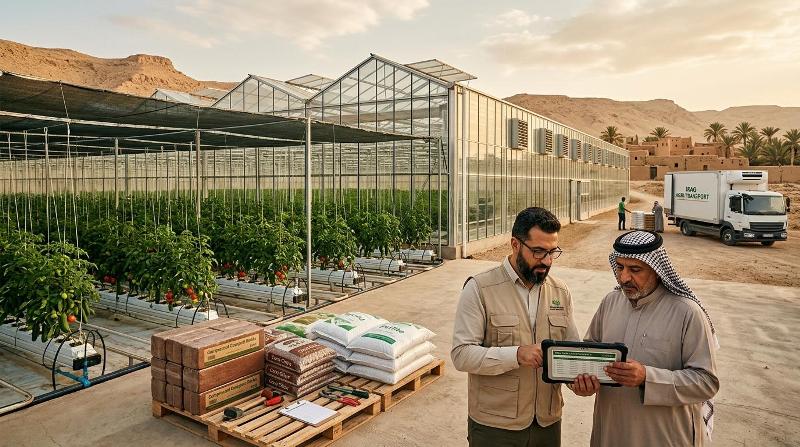
Agriculture in Iraq faces several operational challenges, particularly during the hot season:
- High temperatures and rapid evaporation
- Increasing pressure on irrigation water
- Variable water and soil quality
- Salinity risks in certain agricultural areas
- Root-zone temperature stress
- Higher production and transportation costs
- The need for more controlled greenhouse cultivation
Under these conditions, the growing medium is not a minor detail. It directly affects the root system, irrigation efficiency, crop stability and production costs.
Poor-quality growing media may lead to:
- Weak root development
- Excessive water consumption
- Poor drainage
- Salt accumulation around the roots
- Uneven crop growth
- Low-quality seedlings
- Increased disease risk
- Additional replacement and labor costs
High-quality cocopeat, when selected and managed correctly, can help create a lighter, more manageable and better-aerated growing environment for many greenhouse and container-grown crops.
However, not all cocopeat products deliver the same performance.
The Real Price of Cocopeat Is More Than the Purchase Price
One of the biggest mistakes in bulk purchasing is comparing only the price of one bale or compressed block.
For an Iraqi trader, the real cost should include:
Final Cost = Product Price + Loading + Transportation + Handling + Border and Delivery Costs + Potential Delay Costs
A product with a lower initial price may become more expensive if it has:
- Lower usable volume after expansion
- Unclear salinity levels
- Inconsistent quality
- Weak packaging
- Unreliable delivery
- Excessive moisture
- Poor compression
- No technical support
This is why professional buyers should compare the cost per usable liter of growing media, not simply the price per block.
Important questions before placing an order
Before purchasing cocopeat, ask the supplier:
- What is the net weight of each block or bale?
- What is the expected volume after hydration?
- Is the product washed or buffered?
- What are the EC and pH levels?
- What is the ratio of peat, fiber and chips?
- How long does order preparation take?
- What is the delivery location and transport plan?
- Is the packaging suitable for long-distance transportation?
- Can the same product be supplied for future orders?
- Is technical guidance available for proper use?
These questions help transform a cheap purchase into a truly economical one.
What Should High-Quality Cocopeat for Iraq Offer?
1. Controlled Salinity
The electrical conductivity, or EC, of cocopeat is a critical factor for professional cultivation.
If the growing medium contains excessive soluble salts, sensitive crops and young seedlings may experience stress. This can affect germination, root development and nutrient absorption.
For greenhouse and nursery applications, buyers should request clear information about:
- EC level
- pH range
- Washing process
- Buffering process, if applicable
- Product analysis
- Recommended applications
A supplier that cannot clearly explain these points may create unnecessary risk for the buyer.
2. A Balanced Physical Structure
Cocopeat is not a single uniform material. Its performance depends on the balance between fine particles, fibers and chips.
Coco Peat
Coco peat generally provides greater moisture retention and helps maintain water availability around the root zone.
Coco Fiber
Coco fiber improves structure and helps create air spaces within the growing medium.
Coco Chips
Coco chips can improve drainage, increase air porosity and create a more open structure.
The ideal composition depends on:
- Crop type
- Irrigation method
- Container size
- Greenhouse temperature
- Water quality
- Required drainage
- Production cycle
For this reason, one universal cocopeat formula cannot be suitable for every agricultural project.
3. Reliable Expansion Volume
The weight of a compressed block is not enough to evaluate its value.
Buyers should also know the expected output after hydration. Expansion volume is influenced by:
- Compression level
- Moisture content
- Particle size
- Fiber ratio
- Raw material quality
- Net weight
A reliable supplier should be able to explain the expected volume and the correct hydration method.
4. Good Aeration After Irrigation
Cocopeat should retain moisture without becoming excessively compacted.
If the growing medium remains too dense after irrigation, oxygen availability around the roots may decrease. This can become especially problematic in hot conditions, where plants require efficient water management and healthy root activity.
5. Strong Packaging for Transportation
Cocopeat is lightweight but bulky. Its packaging must be designed to withstand:
- Long-distance transportation
- Loading and unloading
- Pressure from stacked products
- Temporary storage
- Moisture exposure
- Repeated handling
Weak packaging may cause product loss, contamination or additional handling costs before the product reaches the farm or warehouse.
Cocopeat in Iraq’s Hot Climate: Managing Water More Efficiently
During the hot season, water evaporates rapidly and plants can experience frequent moisture stress.
When selected and used correctly, cocopeat can help:
- Retain moisture around the root zone
- Improve root development
- Support more controlled irrigation
- Reduce sudden moisture fluctuations
- Create a lighter growing environment
- Improve the management of container and greenhouse crops
However, cocopeat is not a standalone solution for heat stress.
Its performance depends on a complete growing system that may include:
- Greenhouse ventilation
- Shade systems
- Drip irrigation
- Proper drainage
- Water quality management
- Root-zone monitoring
- Correct nutrient management
- Suitable cocopeat and perlite ratios
The right supplier should not only sell the material. The supplier should help the buyer understand how the material fits into the production system.
Cocopeat and Perlite: A More Balanced Growing Medium
Many greenhouse projects use cocopeat together with perlite to create a balance between moisture retention and aeration.
Cocopeat helps retain water, while perlite improves air porosity and drainage. This combination can be useful for crops that require both stable moisture and a well-aerated root zone.
Common starting ratios
| Growing Medium Mix | Possible Application |
|---|---|
| 70% cocopeat + 30% perlite | Balanced moisture retention and drainage |
| 60% cocopeat + 40% perlite | Hotter conditions or crops requiring more aeration |
| 50% cocopeat + 50% perlite | Crops that are highly sensitive to excess moisture |
These ratios are starting points, not fixed rules. The final mix should be adjusted according to:
- Crop requirements
- Irrigation frequency
- Container size
- Water quality
- Greenhouse temperature
- Drainage conditions
- Production goals
Mayadasht can assist buyers in selecting cocopeat, coco chips and perlite according to the specific needs of their project.
What Iraqi Agricultural Traders Really Need from a Cocopeat Supplier
For many traders, the main challenge is not finding a product. The real challenge is coordinating the entire supply chain.
Common purchasing problems include:
- Unclear technical specifications
- Different prices from different suppliers
- Uncertain preparation times
- Unexpected transportation costs
- Inconsistent product quality
- Poor communication during delivery
- Lack of technical advice
- Difficulty arranging repeat orders
A professional supplier should make the process easier from the first inquiry to final delivery.
This includes:
- Understanding the buyer’s requirements
- Confirming the required quantity
- Recommending the right product
- Providing technical information
- Preparing a clear quotation
- Reviewing transportation options
- Coordinating order preparation
- Tracking the delivery process
- Supporting the buyer with usage guidance
For a serious trader, this level of coordination can save time, reduce uncertainty and protect profit margins.
Why Choose Mayadasht for Cocopeat Supply to Iraq?
The Right Product for the Right Application
A greenhouse, nursery and agricultural distributor may not need the same type of cocopeat.
Some projects may require higher moisture retention. Others may need a more open structure with additional perlite or coco chips.
Mayadasht focuses on understanding the application before recommending a product.
Competitive Pricing Based on Real Delivery Costs
A professional quotation should consider more than the product price.
Mayadasht evaluates the order based on:
- Product type
- Quantity
- Destination
- Packaging
- Delivery requirements
- Transportation conditions
- Order schedule
This helps buyers understand the expected final cost more accurately.
Experienced Agricultural and Commercial Team
The value of a growing medium depends on how it is selected and used.
Mayadasht is supported by experienced specialists and commercial professionals who can help buyers make better decisions regarding:
- Cocopeat selection
- Coco chips and fiber
- Perlite combinations
- Greenhouse applications
- Bulk purchasing
- Repeat supply
- Transportation coordination
Reliable Logistics Coordination
A high-quality product is not enough if it arrives late or in poor condition.
Mayadasht pays attention to order preparation, packaging, transportation coordination and communication throughout the delivery process.
The aim is to provide Iraqi buyers with a supply process that is faster, clearer and easier to manage.
Long-Term Commercial Cooperation
A reliable supplier should not disappear after the first shipment.
For distributors, greenhouse operators and agricultural companies, consistent quality and repeat availability are essential. Mayadasht aims to build long-term cooperation rather than one-time transactions.
How to Calculate the Real Cost of Cocopeat
A useful method for comparing suppliers is to calculate the final cost per usable liter:
Cost per Usable Liter = Total Delivered Cost ÷ Actual Expanded Volume
The total delivered cost may include:
- Product price
- Loading
- Transportation
- Handling
- Delivery-related expenses
- Additional processing or washing, if required
The actual expanded volume should be calculated after proper hydration.
Two blocks with similar weight may provide different usable volumes. Likewise, a product that requires extensive washing may consume additional water, time and labor.
Before purchasing, request details about:
- Net weight
- Number of blocks
- Expansion volume
- Delivered price
- Delivery location
- Preparation time
- Product specifications
This calculation allows traders to compare suppliers based on business value rather than advertising price.
Who Can Benefit from Cocopeat in Iraq?
Cocopeat can be suitable for:
- Commercial greenhouse operators
- Seedling producers
- Agricultural companies
- Nurseries
- Plant distributors
- Ornamental plant growers
- Fruit and vegetable producers
- Agricultural input traders
- Container farming projects
- Companies supplying greenhouse materials
The required product type, packaging and quantity may differ for each customer. A professional consultation can prevent the purchase of unsuitable material.
What Information Should You Send to Receive an Accurate Quotation?
To receive a faster and more precise offer for cocopeat in Iraq, provide the following information:
- Required quantity
- Delivery city
- Type of application
- Crop or plant type
- Greenhouse, nursery or container use
- Required delivery time
- Preference for cocopeat, coco chips or a cocopeat-perlite mix
- Preferred packaging
- Whether the order is for personal use or distribution
The more complete the information, the more accurately the supplier can calculate the product, price and logistics plan.
Cocopeat Buying Checklist for Iraqi Businesses
Before confirming an order, make sure the supplier can provide:
- Clear product specifications
- EC and pH information
- Expected expansion volume
- Reliable packaging
- Transparent pricing
- Bulk supply capacity
- Clear preparation time
- Transportation experience
- Technical support
- Communication during delivery
- Repeat-order capability
- A practical solution based on your project
If these details remain unclear, a low initial price may not represent a low final cost.
Conclusion: Cocopeat Should Be a Complete Agricultural Solution
For Iraq’s greenhouse and controlled agriculture sector, cocopeat is more than a growing medium. It is part of a larger system for managing water, roots, heat, drainage and production costs.
The right cocopeat can support:
- Better moisture management
- Improved root-zone structure
- More efficient irrigation
- Healthier plant development
- Better control of greenhouse production
- More predictable operating costs
But these advantages depend on choosing the correct product and working with a supplier that understands both agriculture and logistics.
Mayadasht supplies cocopeat, coco chips and perlite for Iraqi traders, greenhouse operators and agricultural companies. With experienced agricultural consultants, commercial specialists and logistics support behind the process, Mayadasht helps buyers move from product selection to delivery with greater confidence.
If you are looking for competitive pricing, reliable quality, fast supply and professional agricultural support, send the following information:
Required quantity + destination city in Iraq + application + preferred delivery time
The Mayadasht team can review your requirements and recommend a practical supply solution for your project.