
 Persian
 Arabic
 Russian


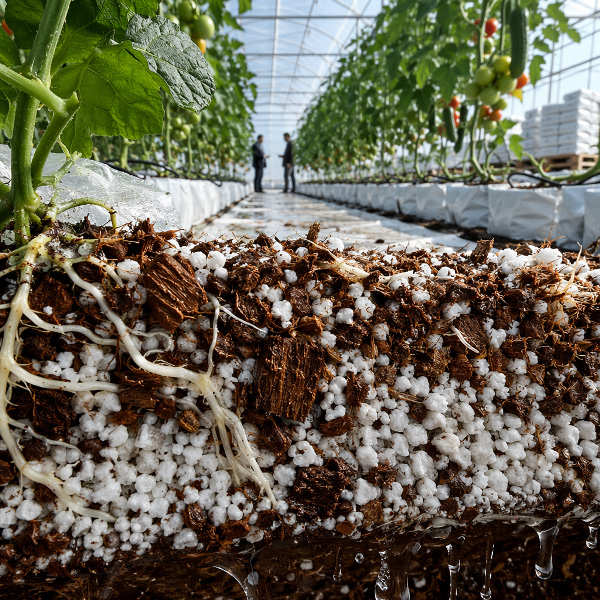
Uzbekistan’s agriculture is entering a more professional and competitive stage.
For many years, agricultural success was mainly connected to land, labor, water access, local experience, and seasonal timing. These factors are still important. But today, the market is changing. Greenhouse farming is expanding. Nurseries and seedling producers are becoming more technical. Farmers are paying more attention to water efficiency. Agricultural traders are looking for products that can create repeat demand, not only one-time sales.
In this new environment, perlite deserves serious attention.
Not as a simple white mineral.
Not as a cheap filler.
Not as a decorative material for pots.
For Uzbekistan, perlite can become a strategic growing media component — a material that helps improve root aeration, drainage, substrate stability, water movement, and crop management.
However, the strongest opportunity is not only in selling perlite alone.
The real value appears when perlite is offered together with cocopeat, coco chips, peat moss, or professional substrate consultation. In this way, perlite becomes part of a complete growing media solution for greenhouses, nurseries, seedling production, horticulture, and agricultural trading.
For Uzbek traders, importers, greenhouse companies, and agricultural experts, perlite is more than a product.
It is an opportunity to build a more reliable and professional business around root-zone management, product quality, and trusted supply.
Why Uzbekistan Needs Better Growing Media Solutions
Uzbekistan is one of the important agricultural markets in Central Asia. The country has strong production potential, active farming regions, and growing interest in modern cultivation systems.
Several changes make the market suitable for perlite and professional growing media products:
- expansion of greenhouse farming;
- increasing demand for vegetables, fruits, and high-value crops;
- development of nurseries and seedling production;
- interest in soilless cultivation and controlled growing systems;
- need for better water management;
- soil structure challenges in some areas;
- salinity concerns in certain regions;
- demand for more reliable agricultural inputs;
- increasing need for technical advice, not only product supply.
This last point is very important.
Uzbekistan’s agricultural market does not only need materials. It needs experience, product knowledge, logistics reliability, and practical consultation.
A trader does not want to buy a product that only looks good on paper.
A greenhouse owner does not want a substrate that creates problems after planting.
A nursery does not want inconsistent materials that affect plant uniformity.
An agricultural company does not want delayed delivery or uncertain quality.
This is where perlite can create value — if it is selected, supplied, and used correctly.
The Hidden Problem: Roots Are Often Managed Too Late
In many agricultural projects, the first attention goes to seeds, fertilizers, greenhouse structures, irrigation systems, plastic covers, and machinery. All of these are important. But one of the most critical parts of crop performance is often underestimated:
the root zone.
The root zone decides how efficiently the plant can absorb water, oxygen, and nutrients.
If roots cannot breathe, the plant becomes weak.
If water stays too long, disease risk increases.
If water drains too quickly, the plant enters drought stress.
If the substrate becomes compacted, root growth slows down.
If salts accumulate around the roots, nutrient uptake becomes difficult.
If the growing medium loses structure during the season, irrigation behavior becomes unstable.
In Uzbekistan, where greenhouse farming and efficient water use are becoming more important, root-zone management should not be treated as a secondary issue.
It should be treated as a technical priority.
Perlite is one of the most practical materials for improving the physical structure of growing media.
Perlite does not directly feed the plant like fertilizer.
It does not replace irrigation management.
It does not work like a chemical treatment.
Instead, perlite improves the physical architecture of the root environment.
It helps create a substrate where roots can breathe, water can move properly, and the crop can perform more consistently.
What Makes Perlite Valuable for Uzbekistan?
Perlite is a natural volcanic mineral that expands when exposed to high temperature. After expansion, it becomes lightweight, porous, and highly useful in agriculture and horticulture.
For Uzbekistan’s greenhouse and nursery sector, agricultural perlite can offer several important advantages.
1. Better Root Aeration
Roots need oxygen to function properly. In dense soil or compact growing media, oxygen availability decreases after irrigation. This can lead to weak roots, poor nutrient uptake, slow growth, and higher disease risk.
Perlite helps create air spaces inside the substrate. These spaces allow the growing medium to remain more breathable after irrigation.
For crops such as tomato, cucumber, pepper, strawberry, herbs, flowers, and seedlings, better root aeration can directly improve plant strength and uniformity.
In simple words:
Perlite helps the substrate breathe.
This is one of the most important reasons why perlite is widely used in professional greenhouse and nursery systems.
2. Improved Drainage Without Losing Control
Many growers believe that more water always means better plant growth. In reality, too much water in the root zone can be as dangerous as drought.
When water remains in the substrate for too long, oxygen disappears. Roots become stressed. Pathogens become more active. Nutrient uptake becomes weaker.
Perlite improves drainage and reduces the risk of waterlogging. This is especially useful in greenhouses where irrigation is frequent and root-zone control is essential.
For Uzbekistan, where modern greenhouse growers increasingly focus on precision irrigation, perlite can help make substrate behavior more predictable.
A good substrate should not be too dry.
It should not be too wet.
It should keep a balance between water and oxygen.
Perlite helps create that balance.
3. Reduced Compaction in Growing Media
Some organic substrates settle and compact over time. When this happens, water movement changes, air space decreases, and root development becomes limited.
Perlite is an inorganic mineral. It does not decompose like organic matter. When used correctly, it helps maintain the physical structure of the growing medium during the crop cycle.
This is especially important for:
- long-cycle greenhouse crops;
- nursery plants;
- container production;
- ornamental plants;
- substrate blends used for repeated or extended growth periods.
In professional agriculture, substrate stability matters.
A growing medium that performs well in the first week but collapses after several weeks can create serious problems. Perlite helps reduce this risk.
4. Cleaner and More Controlled Root Environment
Agricultural-grade expanded perlite is generally clean and stable when processed, packed, and handled properly. It does not introduce weed seeds like some unprocessed organic materials may do.
This makes it useful for seedling production, nurseries, and controlled greenhouse systems.
For professional growers, a clean starting medium can help reduce uncertainty.
Perlite supports a more controlled root environment — and control is one of the main goals of modern agriculture.
5. Lightweight Handling and Practical Trade Value
Perlite is lightweight. For growers, this makes handling easier. For traders, it creates both an advantage and a responsibility.
The advantage is that perlite is easier to carry, distribute, and use compared with many heavy mineral materials.
The responsibility is that perlite is bulky. This means logistics must be planned carefully. Packaging size, loading method, transport route, storage space, and delivery timing all affect the final cost.
For Uzbekistan, a supplier must understand not only the product itself, but also the commercial side of moving the product efficiently.
This is one of the areas where experience matters.
A good product with poor logistics can become expensive.
A quality product with professional logistics becomes a stronger business opportunity.
Perlite Is Not a Fertilizer — and That Is Exactly Why It Matters
One of the common misunderstandings about perlite is expecting it to behave like a fertilizer.
Perlite is not a fertilizer.
It does not provide a full nutrient program.
It does not replace crop nutrition.
It does not replace irrigation knowledge.
But perlite does something very important:
It improves the physical condition of the root zone.
Many crop problems are not caused only by lack of fertilizer. Sometimes the problem is that the root system cannot absorb nutrients properly because the substrate is poorly structured.
A grower may increase fertilizer, but if the root zone is compacted, waterlogged, low in oxygen, or unstable, the plant will not respond efficiently.
In this sense, perlite helps protect the value of other investments:
- seeds;
- fertilizers;
- irrigation systems;
- greenhouse structures;
- labor;
- crop protection products;
- technical management;
- seasonal planning.
A better root environment allows these investments to work more effectively.
That is why perlite should not be positioned in Uzbekistan as a cheap additive.
It should be presented as a root-zone engineering material.
The Strongest Strategy: Perlite with Cocopeat and Coco Chips
Perlite can be sold and used alone in some applications. But in Uzbekistan, the stronger commercial and technical strategy is to offer perlite as part of a complete growing media solution.
This is where cocopeat and coco chips become important.
Together, these materials can help create professional substrate blends for different crops and systems.
Perlite + Cocopeat: Balance Between Air and Water
Cocopeat is known for its high water-holding capacity, light structure, and usefulness in soilless growing systems. It can hold moisture around roots and help prevent rapid drying.
However, cocopeat alone may hold too much water in certain conditions, especially if the particle structure is too fine or irrigation is not managed properly.
Perlite balances cocopeat by improving aeration and drainage.
A well-designed perlite and cocopeat blend can help provide:
- better moisture distribution;
- improved oxygen availability;
- reduced risk of compaction;
- more stable irrigation behavior;
- better root development;
- lower risk of waterlogging;
- more predictable substrate performance.
For Uzbekistan’s greenhouse crops such as tomato, cucumber, pepper, strawberry, herbs, and flowers, this combination can be very practical.
Cocopeat holds moisture.
Perlite keeps the substrate open and breathable.
Together, they create balance.
Perlite + Coco Chips: Structure for Longer Crop Cycles
Coco chips are larger pieces of coconut husk. They create larger pore spaces and improve the physical structure of the substrate.
When coco chips are combined with perlite and cocopeat, the result can be a more open, durable, and stable growing medium.
This type of blend can be useful for:
- long-cycle greenhouse crops;
- fruiting vegetables;
- nurseries;
- ornamental plants;
- container crops;
- systems where substrate structure must remain stable for a longer time.
In this blend:
- coco chips act like the structural frame;
- cocopeat acts as the moisture reservoir;
- perlite improves aeration and drainage.
This approach gives growers more control over the root environment and gives traders a stronger product story.
Instead of selling one material, they can offer a complete substrate direction.
Perlite + Peat Moss: A Professional Mix for Nurseries and Potting Media
Peat moss is widely used in professional horticulture because of its moisture behavior, structure, and suitability for many crops. When combined with perlite, it can create high-quality potting media for nurseries, flowers, ornamentals, and seedling production.
For Uzbek traders and agricultural companies, offering perlite together with peat moss can open additional opportunities in:
- nursery production;
- flower production;
- potting soil blends;
- seedling trays;
- professional horticultural mixes.
This is another reason perlite is commercially attractive. It can connect to several product lines and customer groups.
Practical Substrate Directions for Uzbekistan
A professional growing medium should not be designed by guesswork. It should be selected based on crop type, water quality, irrigation method, temperature, production system, and market needs.
For Uzbekistan, different applications may require different substrate directions.
Perlite for Greenhouse Tomato and Cucumber
Tomato and cucumber are among the most important greenhouse crops in many regional markets. These crops need a root zone that can hold enough moisture but also drain properly and maintain oxygen.
A blend of cocopeat and perlite can help balance these needs.
In warmer greenhouse conditions or systems with frequent irrigation, a higher share of perlite may help reduce waterlogging and improve root aeration.
If the crop cycle is long, coco chips may be added to increase structural stability.
The goal is not simply to create a soft substrate.
The goal is to create a substrate that behaves predictably throughout the crop cycle.
Perlite for Seedling Production
Seedling production requires uniformity.
A weak or inconsistent seedling can affect the entire crop. For this reason, the growing medium used in trays must be light, clean, stable, and easy to manage.
Fine to medium agricultural perlite can be blended with cocopeat or peat moss to improve aeration and reduce compaction in seedling trays.
For this application, quality is critical.
Low dust, suitable particle size, clean materials, and low-EC components are very important.
A small mistake at the seedling stage can create problems later in the greenhouse or field.
Perlite for Nurseries and Ornamental Plants
Nurseries need substrates that are practical, stable, and suitable for container production. Perlite can improve drainage, reduce weight, and support better root-zone oxygen.
When used with cocopeat, coco chips, or peat moss, perlite can help create container media for:
- ornamental plants;
- young trees;
- shrubs;
- flowers;
- vegetable seedlings;
- horticultural plants.
For nurseries, long-term structure is important. A substrate that compacts too quickly can reduce plant quality and customer satisfaction.
Perlite helps improve this structure.
Perlite for Hydroponic and Soilless Systems
In some soilless and hydroponic systems, perlite can be used either alone or as part of a substrate blend. Its lightweight structure, porosity, and drainage behavior make it useful in controlled cultivation.
However, particle size and consistency are very important.
For professional systems, not every perlite is suitable. The grade must match the irrigation method, container design, crop type, and drainage strategy.
This is why technical consultation matters.
The right perlite grade can support system performance.
The wrong grade can create management problems.
Perlite for Soil Improvement
In some cases, perlite can be used to improve heavy soils, especially where compaction and poor aeration limit root growth.
However, this use must be evaluated carefully. Soil improvement usually requires larger volumes, and economic feasibility should be considered.
For high-value crops, greenhouse beds, nursery beds, and specialized planting areas, perlite may be more practical than for broad open-field use.
The decision should depend on crop value, soil condition, and expected return.
Why One Fixed Formula Does Not Work for Every Buyer
It may be tempting to offer one simple formula, such as:
50% cocopeat + 50% perlite
This can work in some situations, but professional agriculture does not operate with one universal recipe.
The best blend depends on many factors:
- crop type;
- greenhouse temperature;
- irrigation frequency;
- water EC;
- container or grow bag size;
- crop duration;
- drainage requirements;
- grower experience;
- substrate cost;
- market expectations.
A professional approach should focus on blend direction, not only a fixed recipe.
More cocopeat means more water retention.
More perlite means more aeration and drainage.
More coco chips means more structure and larger pores.
More peat moss changes moisture behavior and organic structure.
The correct blend is the one that matches the grower’s real conditions.
This is why professional consultation is valuable.
A trader may know the product.
A specialist knows how the product behaves in the root zone.
When both work together, the final result becomes stronger.
Water Management in Uzbekistan: Why Substrate Efficiency Matters
Water management is one of the most important issues in Central Asian agriculture. Uzbekistan has made significant efforts to improve agricultural efficiency, and growers are becoming more aware of the importance of irrigation control.
Perlite and cocopeat cannot solve water challenges alone. But they can help growers manage irrigation more effectively when used correctly.
Cocopeat helps hold moisture.
Perlite helps prevent waterlogging and improves drainage.
Together, they make moisture behavior more balanced.
In professional greenhouse systems, the goal is not only to use less water. The goal is to deliver water at the right time, in the right amount, while keeping enough oxygen in the root zone.
A poorly designed substrate may force growers to over-irrigate because some areas dry too quickly while others stay too wet.
A well-designed perlite-cocopeat blend can reduce this imbalance.
For Uzbekistan, where efficient water use is increasingly important, this is a strong technical advantage.
Salinity and Substrate Quality: A Risk That Should Not Be Ignored
In some regions, irrigation water quality and salinity can affect crop performance. When water contains salts, the growing medium becomes even more important.
If drainage is weak, salts can accumulate around roots.
If the substrate dries unevenly, salt concentration can increase in certain zones.
If the medium has poor structure, flushing becomes difficult.
If the cocopeat has high EC, the problem can become worse from the beginning.
Perlite helps improve drainage and reduce compaction. Cocopeat helps retain moisture, but its quality must be controlled.
For Uzbekistan, buyers should pay attention to:
- cocopeat EC;
- washing quality;
- buffering;
- expansion volume;
- fiber and pith ratio;
- consistency between batches;
- packaging strength;
- compatibility with perlite.
A low-quality cocopeat can damage the reputation of a trader and create problems for the grower.
This is why product selection should not be based only on price.
Price matters, but in agricultural trade, wrong quality can become far more expensive than a slightly higher purchase cost.
Why Serious Buyers in Uzbekistan Need More Than a Product
In Uzbekistan’s agricultural trade, trust, experience, and reliability still carry real weight. A professional buyer does not choose a supplier only by comparing numbers. He looks for stable quality, correct product selection, clear communication, fast delivery, and a partner who understands both agriculture and trade.
This is especially true for perlite, cocopeat, and coco chips.
These materials may look simple from the outside, but small differences in quality can create large differences in performance.
The wrong perlite particle size, excessive dust, weak packaging, high-EC cocopeat, poor expansion, or delayed delivery can turn a profitable order into a difficult business experience.
For a trader, a bad shipment does not only mean one failed order. It can damage reputation in the local market.
For a greenhouse operator, the wrong substrate can affect an entire crop cycle.
For a nursery, inconsistent material can reduce plant uniformity and customer trust.
That is why serious buyers in Uzbekistan need more than a seller.
They need a partner who understands the product technically, understands the market commercially, and can manage logistics professionally.
This is where Mayadasht can be different.
Mayadasht: A Reliable Trade Partner, Not Just a Supplier
For Uzbekistan, the value of perlite is not only in the product itself. The value is also in how the product is selected, prepared, priced, shipped, and supported.
Mayadasht understands that buyers need more than a quotation.
They need confidence.
Confidence that the product is suitable.
Confidence that the quality is stable.
Confidence that the shipment will be coordinated correctly.
Confidence that the final cost makes sense.
Confidence that if they need technical advice, experienced people are available.
This is why Mayadasht focuses on a complete supply experience.
Not aggressive selling.
Not empty promises.
Not offering whatever is available.
But experience, product knowledge, quality selection, reliable supply, logistics coordination, and professional consultation.
Product Quality That Supports Professional Agriculture
Mayadasht focuses on supplying high-quality perlite and complementary growing media products such as cocopeat and coco chips.
The goal is to provide materials that can be used confidently in:
- greenhouse production;
- nurseries;
- seedling systems;
- substrate blending;
- horticultural applications;
- agricultural trading;
- professional growing media preparation.
In products like perlite and cocopeat, quality is not only about appearance.
For perlite, important quality factors include:
- particle size;
- dust level;
- volume consistency;
- packaging strength;
- suitability for the intended application.
For cocopeat, important quality factors include:
- EC level;
- washing and buffering;
- expansion volume;
- fiber-to-pith ratio;
- uniformity;
- packaging;
- consistency between shipments.
Mayadasht’s approach is to help buyers select products that make sense for their real use, not only for the first purchase.
Professional Consultation Before the Buyer Makes a Mistake
Many buyers know they need perlite, but they may not know which type is best for their application.
A greenhouse grower may need one grade.
A seedling producer may need another.
A nursery may need a different blend.
A trader may need a product that is easier to sell across several customer groups.
This is why consultation matters.
Mayadasht can help buyers evaluate:
- whether perlite should be used alone or blended;
- whether cocopeat or coco chips should be added;
- which substrate direction is more suitable;
- what type of customer the trader wants to target;
- how logistics may affect final cost;
- how to avoid low-quality materials that create complaints.
Professional advice before purchase can prevent expensive problems after delivery.
For traditional traders and experienced agricultural buyers, this is a real value.
They do not want pressure.
They want clarity.
They do not want exaggerated claims.
They want reliable guidance.
Logistics and Fast Delivery: A Real Competitive Advantage
In regional agricultural trade, logistics can decide whether a deal is profitable or difficult.
Perlite and cocopeat are not products where only the unit price matters. They are bulky, sensitive to packaging quality, and strongly affected by transport planning.
The final cost depends on:
- product price;
- packaging type;
- loaded volume;
- transport route;
- delivery time;
- storage conditions;
- shipment coordination;
- handling quality;
- repeat supply stability.
Mayadasht’s experience in logistics and regional trade helps buyers reduce uncertainty.
For Uzbek traders and importers, this can be a major advantage. A reliable product with weak logistics can create stress. A reliable product with professional delivery planning creates confidence.
In many cases, the best supplier is not simply the one who gives the lowest price.
It is the supplier who can deliver the right product, in the right condition, at the right time, with clear communication.
The Real Competitive Advantage: Experience, Quality, Logistics, and Trust
Many companies can offer a product. Fewer companies can offer the right product, at the right time, with the right advice and the right delivery plan.
This is the difference that matters in Uzbekistan.
Perlite, cocopeat, and coco chips are part of the root-zone system. Their quality can influence water movement, aeration, drainage, crop uniformity, and final customer satisfaction.
Mayadasht’s competitive advantage is based on four pillars:
1. Specialized Product Knowledge
Understanding the difference between grades, applications, particle sizes, substrate behavior, and blending directions.
2. High-Quality Materials
Supplying products that meet the needs of serious agricultural buyers, professional growers, and traders who care about reputation.
3. Logistics Capability
Managing transport, timing, packaging, and delivery with practical regional experience.
4. Expert Consultation
Helping buyers make better decisions before the purchase, not after a problem appears.
This is the kind of support that traditional and professional buyers respect.
Because it speaks the language of trade:
quality, timing, trust, and profit protection.
The Commercial Opportunity for Uzbek Traders
For Uzbek traders and importers, perlite has strong commercial potential because it can serve multiple market segments.
Potential customers include:
- greenhouse farms;
- seedling producers;
- nurseries;
- ornamental plant growers;
- hydroponic projects;
- substrate blending companies;
- agricultural input shops;
- agro-clusters;
- professional farmers;
- horticultural producers.
This makes perlite different from many agricultural inputs.
It is not limited to one crop.
It is not limited to one season.
It is not limited to one customer group.
When positioned correctly, perlite can become a repeat-demand product.
The strongest approach is to sell perlite by application:
- perlite for greenhouses;
- perlite for seedlings;
- perlite for nurseries;
- perlite for cocopeat blends;
- perlite for coco chips blends;
- perlite for hydroponics;
- perlite for soil improvement;
- perlite for professional growing media production.
This helps traders move away from simple price comparison and toward technical value.
A trader who can explain the use of perlite professionally has a stronger position than a trader who only gives a price.
What Uzbek Buyers Should Ask Before Purchasing Perlite
Professional buyers should not buy perlite only based on price. They should ask practical questions that protect the business.
Important questions include:
- Is it agricultural-grade expanded perlite?
- What is the particle size distribution?
- Is the dust level controlled?
- Is it suitable for greenhouse substrates or soil improvement?
- Is the packaging strong enough for transport and storage?
- Is the volume consistent between shipments?
- Can it be blended with cocopeat, coco chips, or peat moss?
- Does the supplier provide technical guidance?
- What is the final delivered cost?
- Is the quality stable for repeat orders?
These questions help buyers avoid cheap products that become expensive later because of dust, inconsistency, weak packaging, or poor performance.
In agricultural trade, consistency is often more valuable than a small price difference.
What Buyers Should Ask Before Purchasing Cocopeat or Coco Chips
If Uzbek buyers want to offer cocopeat or coco chips together with perlite, they should evaluate quality carefully.
For cocopeat, important questions include:
- What is the EC level?
- Is it washed?
- Is it buffered?
- What is the expansion volume?
- What is the fiber-to-pith ratio?
- Is it suitable for greenhouse crops or nurseries?
- Is the product uniform between batches?
- Is the packaging suitable for transport?
- Can it be blended with perlite and coco chips?
- Is technical support available?
For coco chips, buyers should ask:
- What is the chip size?
- Is the product clean and consistent?
- Is it suitable for long-cycle crops?
- Can it improve substrate structure?
- How does it behave when mixed with cocopeat and perlite?
Cocopeat and coco chips can be powerful partners for perlite, but only when quality is controlled.
A Practical Market Scenario: When Perlite Changes the Sales Model
A greenhouse supplier in the region was originally selling irrigation equipment, greenhouse plastic, and basic agricultural inputs. Perlite was added to the product list as a small item for customers who asked for lightweight growing media components.
At first, sales were limited.
The product was presented simply as “perlite for plants.” Buyers compared it only by price and did not understand why particle size, dust level, or quality mattered.
The strategy changed when the supplier began offering perlite as part of a substrate improvement package.
Instead of saying:
“We sell perlite.”
The message became:
“We help greenhouse growers improve root aeration, drainage, and substrate stability by choosing the right perlite and combining it with cocopeat or coco chips.”
The customers were divided into three groups:
- seedling producers;
- greenhouse vegetable growers;
- nurseries and ornamental plant producers.
Each group received a different explanation.
Seedling producers learned how perlite could reduce compaction in trays.
Greenhouse growers learned how perlite could balance moisture in cocopeat blends.
Nursery producers learned how perlite and coco chips could help maintain container structure over time.
Within one season, perlite stopped being a secondary product. It became a starting point for selling cocopeat, coco chips, grow bags, trays, irrigation accessories, and technical consultation.
The main change was not the product itself.
The main change was positioning.
Perlite moved from being “a cheap white additive” to being “a technical root-zone solution.”
This is exactly the kind of shift Uzbek traders can use.
How to Present Perlite to the Uzbek Market
To enter the Uzbek market successfully, the message should not be:
“Cheap perlite available.”
That is too weak.
A stronger message is:
Perlite for professional root-zone management in Uzbekistan’s greenhouses, nurseries, and substrate production.
This message speaks to serious buyers, agricultural experts, and professional traders.
A good market approach should include:
Clear Product Explanation
Buyers should understand what perlite does, where it is used, and why quality matters.
Application-Based Selling
Different customers need different explanations. A greenhouse owner, nursery producer, seedling grower, and wholesale trader do not all buy for the same reason.
Practical Product Combinations
Perlite should be presented with possible complementary products:
- perlite + cocopeat for moisture and aeration balance;
- perlite + coco chips for structure and long-cycle crops;
- perlite + peat moss for nursery and potting mixes;
- perlite for seedling trays;
- perlite for substrate blending.
Technical Support
Buyers feel more confident when they know the supplier can guide them before and after the purchase.
Reliable Delivery Planning
For traders, fast and predictable supply can be as important as the product itself.
This approach does not pressure the buyer.
It helps the buyer make a better decision.
Perlite as a Platform Product for Agricultural Trade
Perlite should not be seen as only one product in a catalogue.
For Uzbekistan, perlite can become a platform product.
A platform product opens the door to other sales and deeper customer relationships.
Once a trader sells perlite to a greenhouse customer, the conversation can expand to:
- cocopeat;
- coco chips;
- peat moss;
- grow bags;
- seedling trays;
- irrigation accessories;
- greenhouse supplies;
- substrate consulting;
- logistics support;
- seasonal supply planning.
This is why perlite has strong business potential.
It may start with a small order, but it can become the foundation of a long-term customer relationship.
For traders, repeat customers are more valuable than one-time sales.
For growers, stable substrate quality can affect the entire crop cycle.
For Mayadasht, this is where product supply and technical partnership meet.
Conclusion: Uzbekistan Needs Smarter Root-Zone Solutions
Uzbekistan’s agriculture is moving toward higher efficiency, better control, and more professional production systems. In this environment, perlite can play a serious role.
But only if it is positioned correctly.
Perlite is not only a lightweight mineral.
It is not only a soil additive.
It is not only a greenhouse substrate component.
For Uzbekistan, perlite can be a strategic material for:
- improving root aeration;
- balancing drainage and moisture;
- reducing substrate compaction;
- supporting seedling production;
- improving nursery media;
- building better cocopeat and coco chips blends;
- improving greenhouse substrate performance;
- creating new trade opportunities for agricultural suppliers.
When combined with cocopeat, coco chips, high-quality selection, logistics support, and professional consultation, perlite becomes more than a product.
It becomes a complete growing media strategy.
For Uzbek traders, importers, greenhouse companies, and agricultural experts, the opportunity is clear:
Do not compete only on price.
Compete on knowledge, product quality, reliable supply, fast logistics, and technical value.
Mayadasht is ready to support this opportunity with high-quality perlite, complementary growing media products, competitive pricing, logistics coordination, and expert consultation.
Because the future of modern agriculture is not built only above the soil.
It is built in the root zone.
Looking for perlite, cocopeat, or coco chips for Uzbekistan?
Mayadasht can help traders, importers, greenhouse companies, nurseries, and agricultural experts choose the right growing media solution for their market.
Contact Mayadasht for:
- high-quality agricultural perlite;
- cocopeat and coco chips supply;
- professional substrate consultation;
- product selection guidance;
- competitive pricing;
- logistics and fast delivery support;
- long-term trade cooperation.
Perlite is lightweight. But for Uzbekistan’s modern agriculture, its business potential is serious.