
 Persian
 Arabic
 Russian


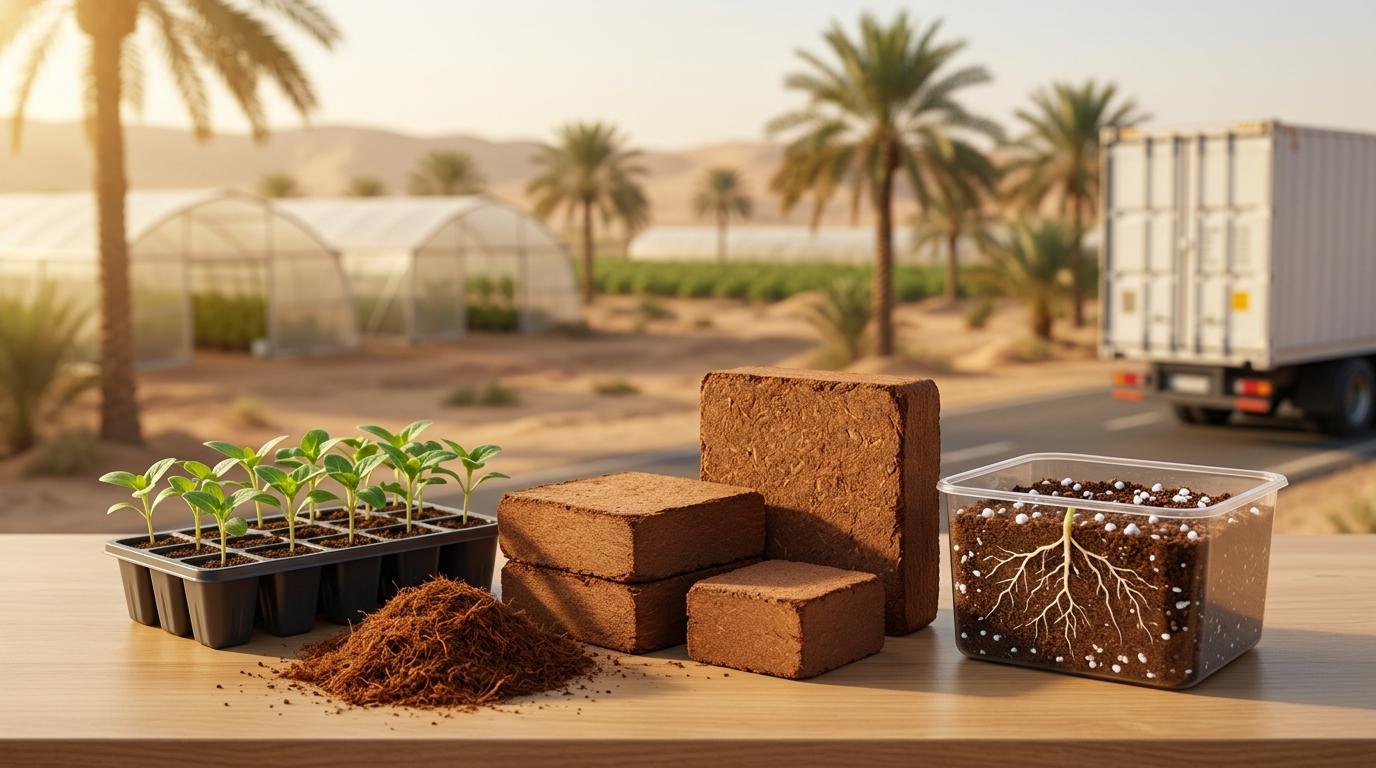
Iraq’s agricultural market is changing.
For years, many growers depended heavily on traditional soil-based cultivation. But rising temperatures, water pressure, greenhouse expansion, seedling production, nurseries, and the need for more controlled root-zone management are pushing the market toward better growing media.
This is where cocopeat becomes more than a product.
For an Iraqi trader, cocopeat can become a repeat-demand business line — if it is selected correctly, priced properly, delivered efficiently, and introduced to the right customers with the right message.
The opportunity is not simply “buy cocopeat and sell it.”
The real opportunity is to help Iraqi growers, greenhouse owners, nurseries, seedling producers, and agricultural input shops solve a serious problem:
How can they create a lighter, cleaner, more moisture-friendly and controllable growing environment for roots in a hot and demanding climate?
When a product answers that question, it becomes easier to sell.
When it creates repeat customers, it becomes a business.
And when the sourcing, consultation, and logistics are handled by an experienced partner, it becomes a more comfortable and profitable trade for the importer.
That is exactly where Mayadasht can support Iraqi agricultural traders.
Iraq Is Not Just a Market; It Is a Climate Challenge
Selling agricultural inputs in Iraq is different from selling them in many other countries.
The climate itself creates demand.
High temperatures, long hot seasons, intense evaporation, variable soil conditions, and the need for better irrigation efficiency all affect how growers think about production.
In such conditions, the root zone becomes one of the most important parts of the entire cultivation system.
A weak growing medium can make irrigation harder to manage.
A heavy or poorly aerated medium can stress roots.
A substrate with poor moisture behavior can increase production problems.
And in warm periods, these problems appear faster.
For this reason, more growers are becoming interested in growing media that can support better moisture management, lighter structure, and more predictable root development.
Cocopeat fits naturally into this conversation.
It is not a fertilizer.
It is not a magic solution.
But it is a practical growing media component that can help create a better environment around the roots — especially when used correctly and, in many cases, combined with materials such as perlite.
For Iraqi agriculture, this is not a small detail.
It is a serious business opportunity.
Why Cocopeat Makes Economic Sense for Iraqi Traders
A trader does not buy a product only because it sounds useful.
A trader wants to know:
- Is there real demand?
- Can it be sold to different customer groups?
- Is it easy to explain?
- Can it generate repeat orders?
- Is the final cost reasonable?
- Can logistics be managed?
- Will the customer come back after using it?
- Does the supplier help reduce risk?
Cocopeat can answer many of these questions positively when it is handled properly.
First, it has multiple customer groups in Iraq:
- greenhouse growers;
- nursery owners;
- seedling producers;
- agricultural input shops;
- landscaping and ornamental plant producers;
- substrate mixers;
- distributors of growing media and greenhouse supplies.
Second, cocopeat is not a one-time seasonal novelty.
It is a consumable growing media product. Once growers use it in seedling production, potting mixes, greenhouse substrates, or nursery applications, demand can repeat.
Third, cocopeat can be sold as part of a solution, not only as a standalone material.
For example:
Cocopeat for moisture management + perlite for aeration and drainage
This combination is much easier to explain to professional growers than simply saying, “Here is cocopeat.”
Fourth, cocopeat can create better sales conversations.
Instead of competing only on price, the trader can talk about:
- root-zone quality;
- water retention;
- lighter substrate structure;
- seedling performance;
- greenhouse productivity;
- reduced dependence on heavy soil;
- better substrate control in hot weather.
That is how a basic product becomes a value-added trade.
The Most Expensive Mistake: Buying Cocopeat Only by Price
In the Iraqi market, price matters.
There is no doubt about that.
But in cocopeat trade, the lowest price can become the most expensive decision.
Why?
Because cocopeat quality is not only about appearance.
A professional buyer should consider:
- EC level;
- pH range;
- moisture content;
- expansion capacity;
- fiber-to-pith ratio;
- texture uniformity;
- compression quality;
- packaging strength;
- consistency between shipments;
- suitability for the target application.
A low-quality cocopeat shipment may look attractive at first, but it can create problems later:
- poor expansion;
- high salinity complaints;
- inconsistent texture;
- difficult customer feedback;
- lower trust in the trader;
- slower repeat sales;
- pressure to discount remaining stock.
For a trader, the real question is not:
“What is the cheapest cocopeat?”
The better question is:
“Which cocopeat can I sell confidently, repeatably, and profitably in my market?”
This is where Mayadasht’s role becomes important.
Mayadasht does not approach cocopeat only as a commodity.
The team helps buyers think about application, customer type, quality level, shipment conditions, packaging, final cost, and long-term trade potential.
That is a very different conversation from simply sending a price list.
The Iraqi Buyer Needs Confidence, Not Complication
One of the biggest concerns for importers is operational stress.
Many traders are interested in agricultural products, but they hesitate because of the hidden workload:
- choosing the right grade;
- checking quality;
- negotiating price;
- calculating final cost;
- planning transport;
- managing timing;
- understanding customer applications;
- explaining the product to the market;
- dealing with uncertainty after purchase.
This is exactly why a supportive supplier matters.
A trader does not always need another seller.
He needs someone who can make the buying process easier.
Mayadasht can help Iraqi traders by supporting key decisions before the shipment happens:
- What type of cocopeat is suitable for the target customers?
- Is the product intended for nurseries, seedlings, greenhouses, potting mixes, or resale?
- Should cocopeat be sold alone or together with perlite?
- What volume makes sense for the first shipment?
- How should the product be positioned in the Iraqi market?
- How can logistics be coordinated more smoothly?
- How can the trader avoid buying the wrong product for the wrong market?
This support gives the importer something very valuable:
peace of mind.
And in cross-border agricultural trade, peace of mind has real economic value.
A Realistic Trade Story: How One Importer Turned Cocopeat into a Repeat Business Line
A Baghdad-based agricultural trader had been selling different farm inputs for years. Some products moved quickly but had low margins. Others offered better margins but were difficult to explain or hard to sell repeatedly.
His customers included input shops, small greenhouse owners, nursery operators, and seedling producers around Baghdad and nearby provinces.
For a long time, he heard growers asking for better growing media. Some complained that traditional soil was too heavy. Some wanted a cleaner material for seedlings. Others were looking for a substrate that could hold moisture better during hot days while still working well with irrigation programs.
At first, cocopeat looked like a simple product to import.
He asked several suppliers for prices.
Some gave very low offers.
Some gave no technical explanation.
Some only said, “Good quality,” without discussing application, EC, texture, expansion, or suitable customers.
The trader almost chose the cheapest option.
But before confirming the purchase, he discussed the project with Mayadasht.
The conversation changed the direction of the deal.
Instead of only asking how many tons he wanted, Mayadasht asked:
- Who are your main buyers?
- Are you selling to greenhouses or nurseries?
- Will your customers use cocopeat alone or in blends?
- Are they familiar with perlite?
- Is the market more price-sensitive or quality-sensitive?
- Do you need a product for resale or direct agricultural use?
- What city will receive the shipment?
- What final cost do you need to stay competitive?
These questions helped the trader see cocopeat differently.
It was not only a product to store and resell.
It could become a growing media solution for different customer groups.
With Mayadasht’s support, he selected a product that matched his first target market: seedling producers, nurseries, and greenhouse growers.
The first shipment was planned carefully.
The product positioning was clear.
The trader did not introduce cocopeat as “cheap coconut dust.”
He introduced it as a professional growing media component for lighter root-zone management, seedling production, potting mixes, and greenhouse substrates.
For more advanced customers, he also presented the idea of combining cocopeat with perlite:
- cocopeat to support moisture retention;
- perlite to improve aeration and drainage.
This made the offer more professional.
The result was not instant magic.
It was better than that: it was realistic.
Some customers tested the product.
Seedling producers understood the value quickly.
Nurseries liked the lightweight structure.
Input shops found it easier to sell when the product was explained by application, not just by price.
By the second order, the trader was no longer experimenting blindly.
He knew which customers responded better.
He knew which explanation worked.
He knew that quality consistency mattered more than chasing the lowest price.
Cocopeat became a repeatable business line — not because it was the cheapest product, but because it was introduced correctly, supported properly, and supplied with a clear trade strategy.
This is the difference Mayadasht wants to create for Iraqi traders.
Why Cocopeat and Perlite Together Can Sell Better in Iraq
In many professional markets, cocopeat is rarely discussed alone.
It is often part of a growing media system.
For Iraq, this is especially important because heat and irrigation conditions can make the root zone more sensitive.
Cocopeat helps with moisture retention and substrate lightness.
Perlite helps improve aeration, drainage, and root oxygen availability.
Together, they can create a more balanced growing environment.
This gives the Iraqi trader a smarter commercial angle.
Instead of offering only one product, he can offer a solution:
“A growing media combination for hot-climate cultivation, seedlings, nurseries, and greenhouse production.”
That kind of positioning can increase trust, improve average order value, and make the trader look more professional in front of agricultural customers.
Mayadasht can support this approach because it understands the relationship between different growing media products and how they can be positioned for regional agricultural markets.
How Iraqi Traders Can Sell Cocopeat More Effectively
A common mistake is to sell cocopeat with one sentence:
“Cocopeat is available.”
That is not enough.
In a developing market, the product must be explained clearly.
A trader should position cocopeat based on use:
For greenhouse growers
A lightweight growing media component that can help support root-zone moisture management and substrate control.
For seedling producers
A cleaner, lighter component for seedling trays and propagation mixes.
For nurseries
A practical material for potting mixes and young plant development.
For input shops
A product with repeat demand that can be explained to multiple customer types.
For substrate mixers
A base material that can be blended with perlite, peat moss, coco chips, and other components.
For ornamental plants and landscaping
A useful growing media component for pots, containers, and plant care.
The more clearly the product is positioned, the easier it becomes to sell.
This is why Mayadasht’s consultation can be valuable before importing.
The goal is not only to move goods from one place to another.
The goal is to help the buyer understand how the goods can move inside his market.
Logistics: The Hidden Factor Behind Profit
Many traders focus on product price and forget logistics.
But in cross-border agricultural trade, logistics can make or break the deal.
A good price at origin does not always mean a good final cost.
The trader must think about:
- loading efficiency;
- packaging strength;
- shipment volume;
- delivery timing;
- border and transport coordination;
- damage reduction;
- unloading conditions;
- final landed cost;
- market delivery schedule.
If logistics are poorly managed, even a good product can become less competitive.
This is one of the reasons Iraqi traders prefer working with suppliers who understand regional movement, documentation, coordination, and practical shipment concerns.
Mayadasht’s advantage is not only product availability.
It is the ability to support the buyer through the sourcing and delivery process, helping reduce confusion and unnecessary delays.
For the Iraqi importer, this means less stress and better control over the business.
What Makes Mayadasht Different for Iraqi Buyers?
Mayadasht is not trying to be just another supplier in a crowded market.
The real value is in combining product supply with trade support.
For Iraqi agricultural traders, Mayadasht can offer:
1. Product consultation before purchase
So the buyer chooses according to application, not only price.
2. Quality-focused sourcing
Helping avoid products that may be difficult to sell or create customer complaints.
3. Competitive pricing
Important for a price-sensitive market like Iraq.
4. Logistics support
Helping make the supply process smoother and easier to manage.
5. Multi-product strategy
Cocopeat can be positioned with perlite, peat moss, or other growing media products for a stronger offer.
6. Market-oriented thinking
Mayadasht helps the trader think about how to sell the product after import.
7. Long-term cooperation
The aim is not only one shipment. The aim is repeat business and market trust.
This is why an Iraqi trader who wants comfort, clarity, and a better trade experience should talk to Mayadasht before buying.
The Real Opportunity: Become a Growing Media Supplier, Not Just a Product Seller
The future of agricultural input trade in Iraq will not belong only to sellers who offer the lowest price.
It will belong to those who help growers make better decisions.
A trader who imports cocopeat properly can build a stronger position in the market by becoming known as a supplier of growing media solutions.
That is a bigger opportunity than selling one shipment.
Because once a trader becomes trusted for growing media, he can expand into:
- cocopeat;
- perlite;
- peat moss;
- coco chips;
- substrate blends;
- greenhouse supplies;
- seedling production materials;
- nursery inputs.
This is how one product can open the door to a broader agricultural business.
Cocopeat can be the entry point.
Mayadasht can help make that entry easier, smarter, and more reliable.
Final Message for Iraqi Agricultural Traders
Cocopeat is not just a product to import.
For Iraq, it can be a practical response to hot climate cultivation, greenhouse development, seedling production, nursery growth, and the need for better root-zone management.
For traders, it can be a repeat-demand product with multiple customer groups and strong commercial potential.
But the difference between a successful cocopeat business and a difficult shipment often comes down to four things:
quality, price, logistics, and guidance.
Mayadasht brings these four elements together.
If you are an Iraqi trader, greenhouse supplier, agricultural input distributor, nursery supplier, or seedling production partner, do not choose cocopeat blindly.
Talk to Mayadasht first.
Let the team help you understand the right product, the right volume, the right pricing logic, and the easiest supply route for your market.
Because in agricultural trade, the best deal is not always the cheapest one.
The best deal is the one that arrives correctly, sells confidently, creates repeat orders, and lets you sleep easier at night.
Looking for high-quality cocopeat for the Iraqi market?
Mayadasht can help you with product selection, competitive pricing, supply planning, logistics support, and professional consultation before purchase.
Contact Mayadasht today and build a smarter, easier, and more profitable cocopeat trade for Iraq.