
 Persian
 Arabic
 Russian


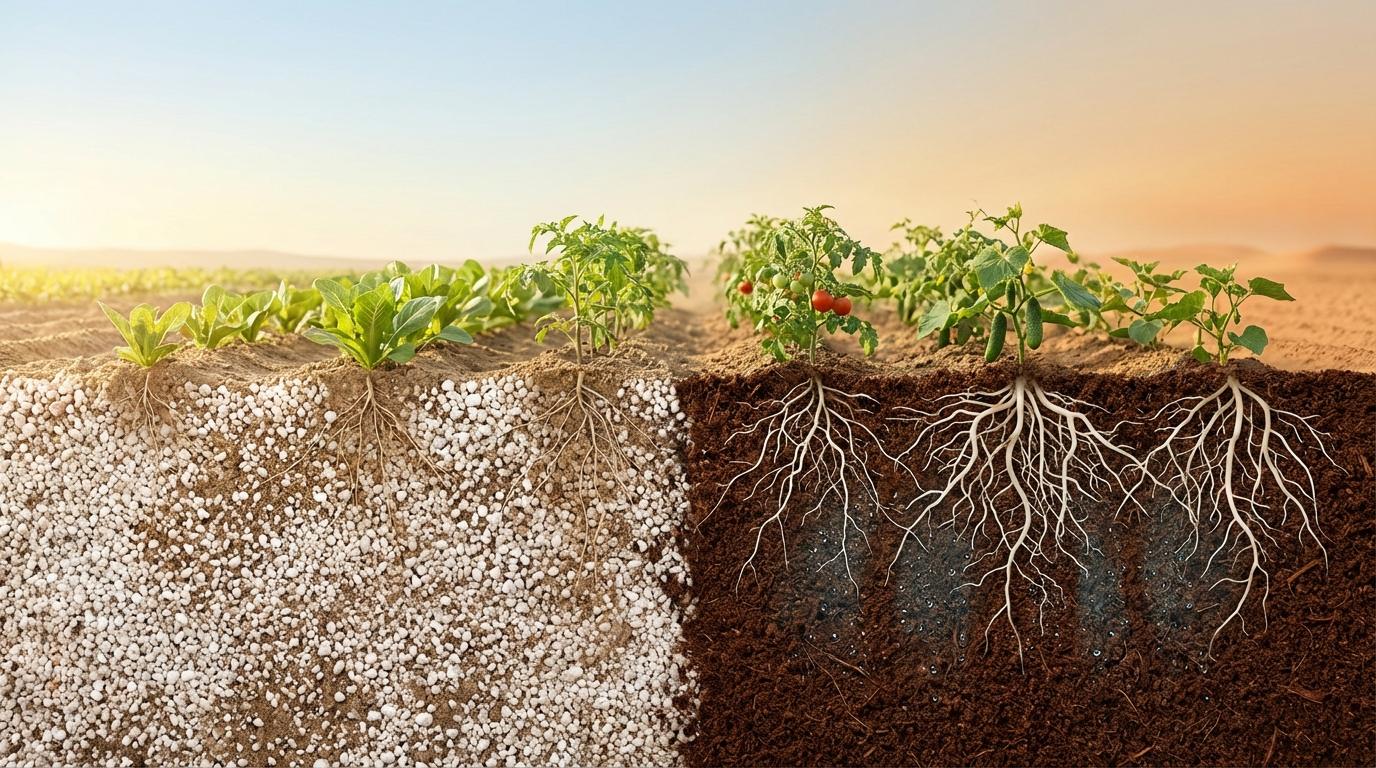
Across much of the Arab world, the agricultural calendar is deceptive. March feels forgiving. Temperatures are still moderate, crops establish quickly, and irrigation systems seem under control. Yet experienced greenhouse growers know that this period is not about comfort—it is about preparation. What happens below the surface during these weeks determines whether crops will endure July and August or collapse under stress.
In hot and arid regions, crop failure rarely begins with heat alone. It begins earlier, in the root zone, when the growing medium teaches roots how to expect water, oxygen, and stability. Once summer arrives, there is no time to retrain the plant.
This is why the choice between perlite and cocopeat is not a matter of preference or price. It is a strategic decision.
Spring Is When Root Behavior Is Set
Roots do not simply grow; they adapt. In early growth stages, they learn how frequently water arrives, how long moisture remains available, and how quickly oxygen disappears after irrigation. These learned patterns shape root architecture and stress tolerance.
In many greenhouses across the Gulf, Levant, and North Africa, spring irrigation is generous. Water is available, evaporation is still manageable, and plants appear vigorous. But this apparent success can be misleading. Roots that experience rapid wet–dry cycles or unstable moisture during this phase often become highly sensitive to stress later.
Once summer heat intensifies, the system reveals its weaknesses.
The Real Challenge of Arab Greenhouse Climates
Greenhouse production in Arab countries faces a unique combination of pressures. High solar radiation, prolonged heat waves, saline or limited water resources, and high evapotranspiration rates all converge during summer. Under these conditions, the growing medium must perform two opposing tasks simultaneously: retain water long enough to buffer irrigation gaps, and maintain sufficient air space to avoid root suffocation.
Most problems attributed to nutrition or irrigation scheduling are, in reality, physical failures of the root environment.
This is where the comparison between perlite and cocopeat becomes meaningful.
Perlite: Precision and Oxygen Under Pressure
Perlite has long been favored in controlled greenhouse systems, particularly where fertigation is frequent and precise. Its structure provides excellent aeration and rapid drainage, allowing roots to access oxygen even under high irrigation frequency. In climates where water quality is poor or salinity is a concern, this fast drainage can be an advantage, reducing salt accumulation around roots.
However, in extreme heat, perlite shows its limitation. It does not store water. When temperatures spike and irrigation intervals are extended—even slightly—the root zone can shift rapidly from optimal to stressful. In regions where water supply is not perfectly stable, this sensitivity can become a risk factor rather than a benefit.
Perlite performs best in systems where irrigation control is absolute and uninterrupted. In the real conditions of many Arab greenhouses, this assumption does not always hold.
Cocopeat: Moisture Buffering as a Survival Strategy
Cocopeat behaves differently. Its value lies not in maximum aeration, but in moderation. Cocopeat absorbs and holds water, then releases it gradually, creating a more stable moisture environment around the roots. This buffering effect becomes critical during hot periods when evapotranspiration accelerates and irrigation timing is challenged.
In early spring, cocopeat allows roots to develop in a consistently moist yet breathable environment. This consistency encourages deeper, more branched root systems that tolerate short-term stress far better than roots trained in highly fluctuating conditions.
Critically, cocopeat does not eliminate the need for good irrigation management. Instead, it reduces the consequences of imperfection. In hot climates, this margin of error often determines success.
The Hidden Risk of Oversimplified Choices
The question is often framed incorrectly: perlite or cocopeat. In reality, the more important question is what role the growing medium must play in the system.
In greenhouses targeting high-frequency fertigation and maximum vegetative control, perlite can be highly effective. In systems facing water instability, extreme heat, or operational variability, cocopeat provides resilience rather than speed.
What matters most is not growth rate in March, but plant behavior in July.
Summer Failures Are Usually Root Failures
When crops decline in summer, symptoms appear above ground: leaf burn, fruit drop, reduced size, or sudden yield collapse. But the cause is almost always below ground. Roots exposed to repeated moisture shock, oxygen stress, or dehydration lose their ability to recover.
By the time these symptoms appear, no nutritional adjustment can reverse the damage.
This is why experienced growers increasingly treat the growing medium as a risk-management tool, not a commodity.
A Strategic Perspective for the Coming Season
As Arab greenhouse producers move from late winter into spring, this is the final window to shape root-zone behavior. Decisions made now—often quietly and without visible impact—will determine how plants respond to the coming heat.
Perlite offers control and oxygen, but demands precision. Cocopeat offers stability and buffering, but requires understanding. Neither is universally superior. The correct choice depends on climate intensity, water reliability, and management capacity.
In hot regions, resilience is often more valuable than speed.
Final Thought
Summer in the Arab world is not forgiving. The question is not whether stress will occur, but whether the production system is designed to absorb it. The growing medium is the first and most fundamental line of defense.
Choose it not for how plants look in spring, but for how they survive in summer.