
 Persian
 Arabic
 Russian


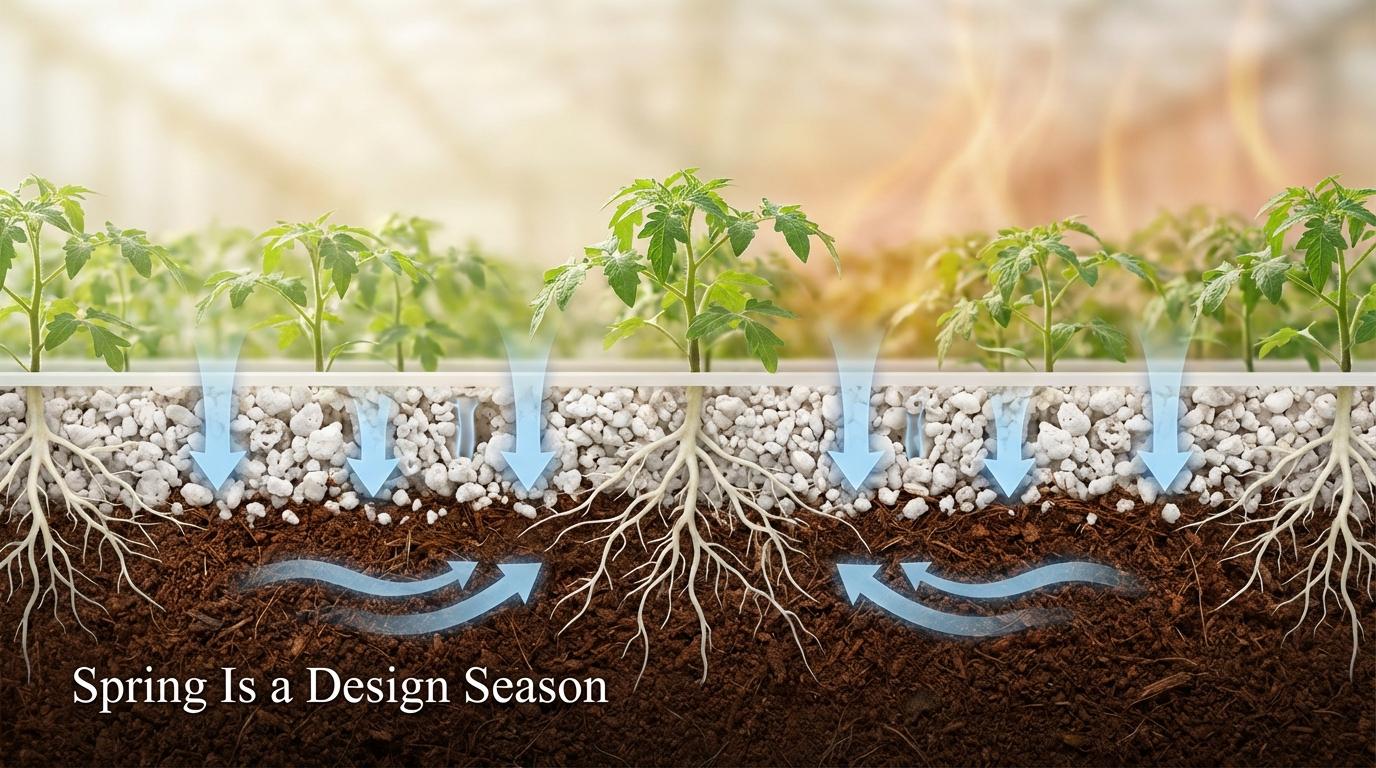
In Iraqi agriculture, spring is often misunderstood.
It looks calm.
Temperatures are moderate.
Plants grow fast.
Irrigation seems forgiving.
But for experienced growers, spring is not a season of comfort—it is a season of irreversible decisions.
What happens below the surface in spring defines whether a system survives summer or collapses under heat stress.
1️⃣ Spring in Iraq: The Season Where Mistakes Are Made Quietly
Spring creates a false sense of safety.
Compared to summer:
- evaporation is lower
- plants show visible growth
- stress symptoms are minimal
This is exactly why errors go unnoticed.
Root damage rarely announces itself immediately.
It appears weeks later—when correction is no longer possible.
2️⃣ Spring Climate Dynamics: Why Conditions Change Faster Than Growers Expect
Spring in Iraq brings:
- increasing solar radiation
- longer days
- rapidly rising root‑zone temperatures
What looks like stable weather above ground hides accelerating stress below ground.
As temperatures rise:
- oxygen availability in wet substrates decreases
- microbial activity increases
- roots consume oxygen faster
Systems that are not physically prepared begin to destabilize.
3️⃣ Spring Crops in Iraq: Two Very Different Objectives
Spring supports two crop categories, each with different risks.
Crops Harvested in Spring
- leafy greens (lettuce, spinach)
- herbs
- early cucumbers
- strawberries in protected systems
These crops rely on:
- fast root respiration
- high oxygen availability
- precise irrigation
Even short oxygen deficits reduce quality and shelf life.
Crops Established in Spring for Summer Production
- tomatoes
- peppers
- eggplants
- melons and watermelons
For these crops, spring is not about yield.
It is about root architecture.
Weak roots formed in spring cannot be repaired in summer.
4️⃣ Greenhouse Spring Strategy: Production vs. Preparation
Less experienced growers use spring to push growth.
Professional systems use spring to:
- rebuild substrate structure
- correct compaction
- stabilize irrigation behavior
- prepare roots for thermal stress
Greenhouses that focus only on visible growth often fail first in summer.
5️⃣ Root‑Zone Reality: Why Nutrition Cannot Fix Physical Instability
Many spring problems are mistakenly treated with:
- more fertilizer
- different nutrient ratios
- additives and stimulants
But root stress caused by:
- poor oxygen diffusion
- unstable moisture distribution
- structural collapse
cannot be fixed chemically.
Spring is when physical root‑zone design matters most.
6️⃣ Spring Irrigation: The Most Misleading Management Factor
Spring irrigation feels easy.
Plants respond well.
Runoff looks manageable.
Media feels “comfortable.”
This leads to:
- higher irrigation frequency
- longer wet periods
- gradual oxygen loss
By the time heat increases, roots are already compromised.
7️⃣ Perlite in Spring: Its Real Value Appears Before Problems Start
Perlite is often associated with emergency drainage.
In reality, its most strategic role in Iraq appears before stress becomes visible.
In spring systems, perlite:
- preserves air porosity during frequent irrigation
- prevents thermal compaction of the substrate
- stabilizes oxygen diffusion as temperatures rise
This creates roots that are:
- deeper
- more branched
- more heat‑tolerant
8️⃣ Why Systems Without Structural Media Fail First in Summer
Greenhouse systems without physical correction show a pattern:
- strong spring growth
- sudden summer decline
- reduced water uptake despite frequent irrigation
The failure is not climatic—it is structural.
Perlite reduces this risk by maintaining physical integrity.
9️⃣ Open Field vs. Greenhouse: Different Systems, Same Spring Risk
Open Fields
- spring irrigation and rainfall can saturate heavy soils
- compaction increases as temperatures rise
Perlite improves soil structure and oxygen movement.
Greenhouses
- precision irrigation increases hypoxia risk
- closed systems magnify physical mistakes
Perlite stabilizes engineered environments.
🔟 Economic Perspective: Spring Decisions Are the Most Expensive Ones
Most summer yield losses originate in spring.
Costs include:
- reduced fruit size
- uneven maturity
- quality downgrade
- early system exhaustion
Correct substrate design costs less than recovery attempts.
1️⃣1️⃣ Designed Systems vs. Improvised Systems
Improvised systems react to problems.
Designed systems prevent them.
In Iraq’s climate:
- prevention always outperforms correction
- physical stability outperforms chemical intervention
Perlite functions as a risk‑reduction input, not just a growing medium.
1️⃣2️⃣ Expert Checklist: Spring Questions Professionals Ask
Before summer arrives, experts ask:
- Is oxygen stable under frequent irrigation?
- Will the substrate maintain structure at higher temperatures?
- Can roots tolerate irrigation delays during heat spikes?
If the answer is uncertain, spring correction is required.
✅ Final Conclusion: Spring Is the Season That Decides Summer
Spring does not forgive poor preparation.
Crops change.
Markets change.
Weather becomes extreme.
But root‑zone physics does not change.
Perlite, when integrated strategically in spring, supports systems that survive summer stress rather than react to it.
That is why spring is not a planting season.
It is a design season.