
 Persian
 Arabic
 Russian



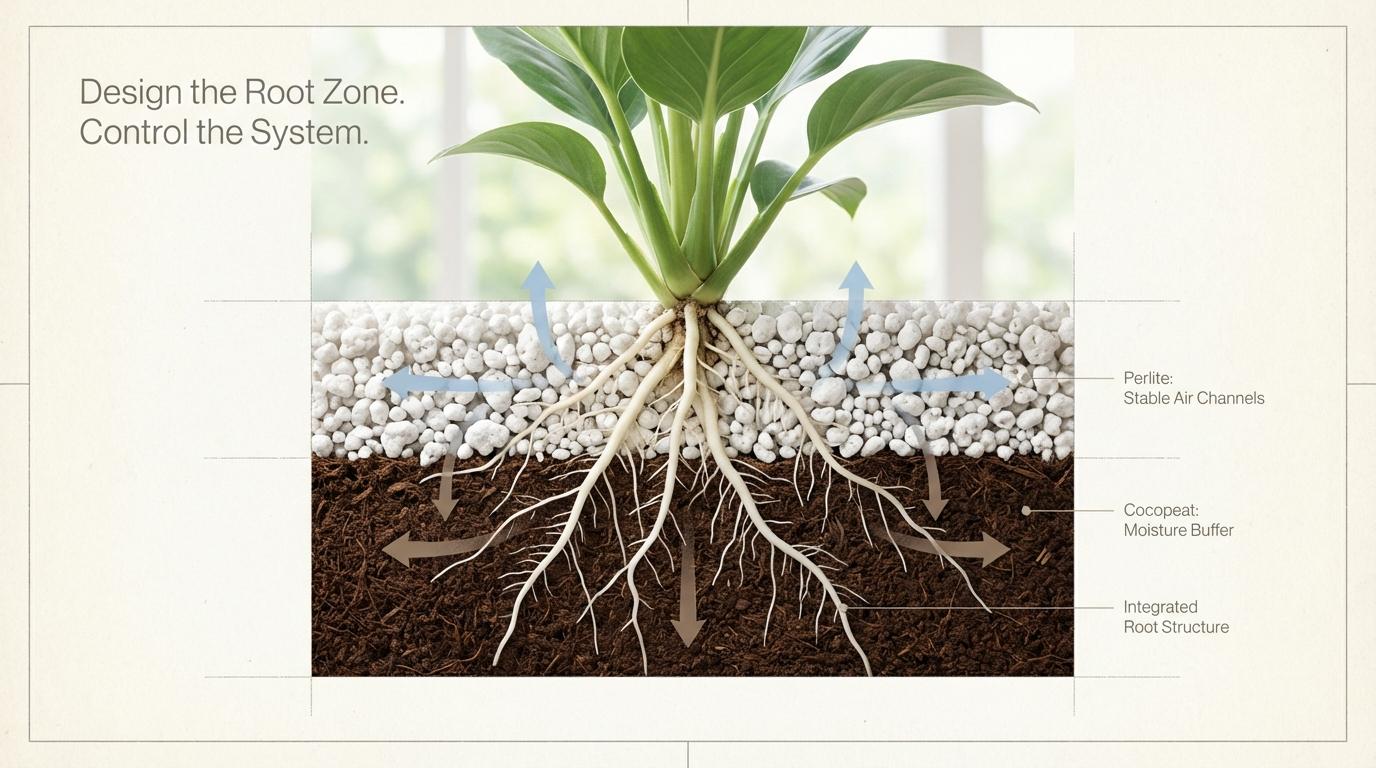
In Iraqi agriculture, crop performance is increasingly determined below the surface.
Rising temperatures, frequent irrigation cycles, and shrinking safety margins have shifted the focus from inputs above ground to root‑zone design.
Perlite and cocopeat are often discussed separately, but in practice, they address different physical challenges within the same system.
Root‑Zone Stress Under Iraqi Climate Conditions
Under prolonged heat:
- soil oxygen declines rapidly
- moisture distribution becomes uneven
- roots experience simultaneous heat and water stress
Without physical correction, nutritional programs cannot compensate for structural instability.
Technical Role of Perlite: Oxygen and Structural Control
Perlite’s primary function is physical.
In Iraqi systems, it contributes by:
- maintaining stable air porosity under frequent irrigation
- preventing compaction caused by thermal expansion
- improving drainage uniformity in intensive cultivation
These properties protect roots from hypoxia, particularly during hot periods.
Technical Role of Cocopeat: Moisture and Thermal Buffering
Cocopeat functions differently.
Its value lies in:
- controlled moisture release
- lateral water redistribution
- moderation of root‑zone temperature
This buffering effect reduces stress during irrigation gaps and temperature spikes.
Why One Material Alone Is Not Enough
Systems relying only on perlite may experience rapid drying.
Systems relying only on cocopeat may risk oxygen limitation.
In hot‑climate agriculture, imbalance increases volatility.
Designed Substrate Systems: Integrating Complementary Functions
High‑performance greenhouse systems integrate both materials:
- perlite provides oxygen stability
- cocopeat regulates water behavior
The interaction creates a root environment that responds predictably under stress.
Irrigation Efficiency as a System Outcome
Water efficiency is not defined by retention alone.
In designed substrates:
- irrigation frequency stabilizes
- runoff decreases
- nutrient availability becomes more consistent
Both materials contribute through different mechanisms.
Long‑Term System Reliability
Under climate pressure, consistency matters more than peak performance.
Perlite extends structural lifespan.
Cocopeat smooths operational variability.
Together, they reduce failure rates and improve planning reliability.
Expert Perspective: Root‑Zone Design Is Strategic
Modern agriculture in Iraq requires intentional physical design.
Perlite and cocopeat should be selected based on function, not preference.
When used strategically, they form the foundation of climate‑resilient production systems.
Final Conclusion
The question is not which material is better.
The question is how to design root environments that remain stable under heat, water stress, and uncertainty.
In Iraqi agriculture, perlite and cocopeat are not alternatives.
They are complementary tools in system design.