
 Persian
 Arabic
 Russian



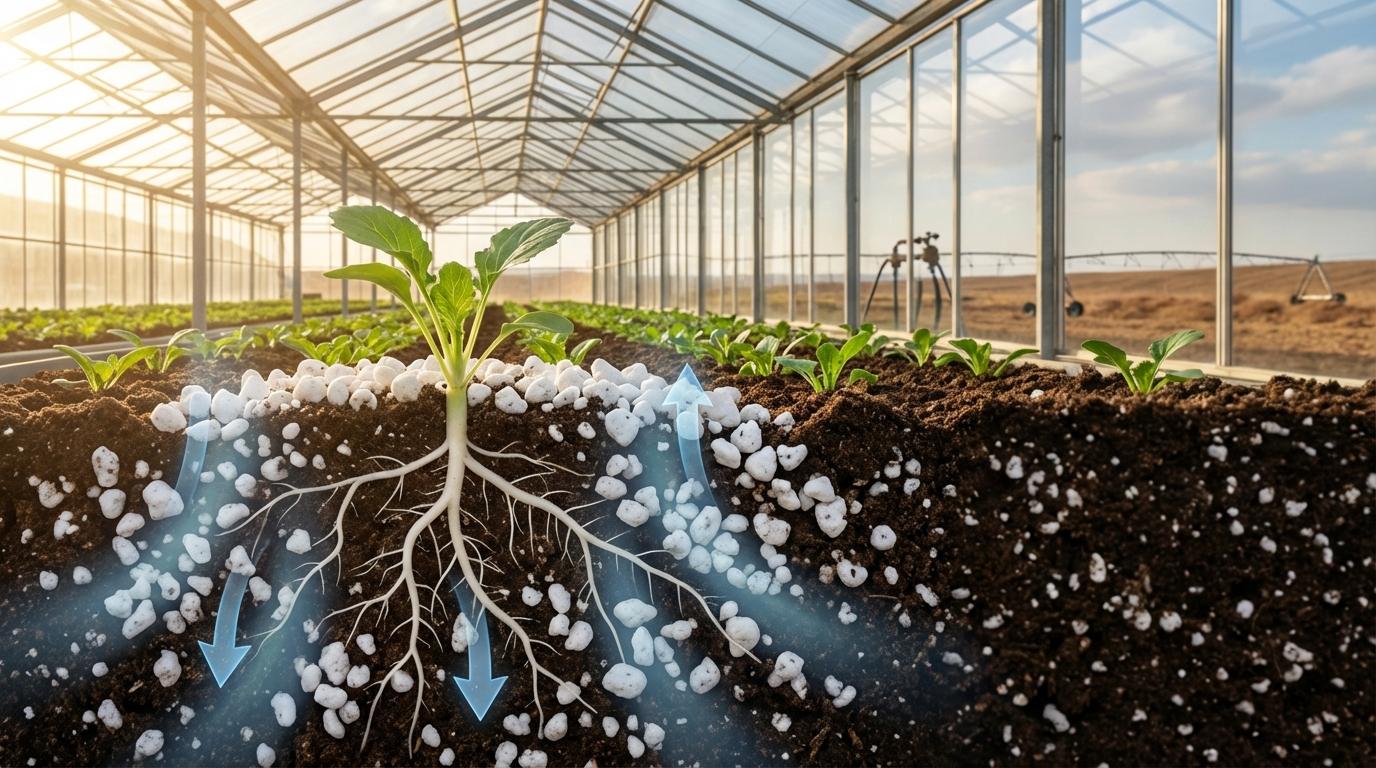
Climate change is no longer a future scenario for Iraqi agriculture.
It is an operational reality shaping every production decision today.
Rising average temperatures, longer heat waves, and increasing water unpredictability are redefining how crops respond—not just in open fields, but inside greenhouses as well.
In this environment, survival depends less on short‑term inputs and more on structural adaptation.
Climate Pressure in Iraq Is Structural, Not Seasonal
Many agricultural strategies still treat heat stress as a seasonal challenge.
In Iraq, it is structural.
Key trends shaping Iraqi agriculture include:
- earlier onset of extreme temperatures
- higher night‑time soil temperatures
- increased evaporation rates
- shrinking error margins in irrigation
These pressures directly target the root zone—the most vulnerable part of the system.
Why Traditional Solutions Are Failing
Fertilizers, growth stimulants, and foliar sprays offer limited relief.
They address symptoms, not causes.
Under rising soil temperatures and irregular water availability:
- root respiration accelerates
- oxygen availability declines
- microbial balance shifts
Without physical correction of the root environment, plant performance deteriorates regardless of nutritional input.
Perlite as a Climate‑Adaptation Material
Perlite’s relevance increases as climates become more extreme.
Unlike organic amendments that degrade over time, perlite maintains its physical structure under prolonged stress.
In hot climates, perlite:
- reflects and dissipates excess heat in the root zone
- maintains oxygen channels under frequent irrigation
- prevents compaction caused by thermal expansion and contraction
These functions directly counter climate‑induced stress patterns.
Greenhouses Under Global Warming: Why Root Stability Matters More Than Technology
Modern greenhouses often focus on climate control systems above ground.
However, as external temperatures rise, energy costs increase and control becomes imperfect.
Root zones that lack structural stability amplify stress:
- irrigation becomes more frequent
- oxygen deprivation intensifies
- disease pressure rises
Perlite acts as a passive stabilizer—working continuously without energy input.
Water Efficiency in a Warming Future
As water scarcity intensifies, efficiency becomes non‑negotiable.
Perlite improves water behavior by:
- enhancing uniform wetting
- reducing localized saturation
- minimizing runoff and nutrient loss
This leads to more predictable water use under variable conditions—a critical advantage in Iraq’s future climate scenario.
Sustainability Beyond Carbon Metrics
Sustainable agriculture is often reduced to carbon calculations.
In reality, sustainability in Iraq depends on system durability.
Perlite contributes by:
- extending substrate lifespan
- reducing crop failure frequency
- lowering dependency on chemical correction
A system that fails less often is inherently more sustainable.
Long‑Term Economics: The Cost of Rebuilding Systems Each Season
As climate stress increases, reactive agriculture becomes expensive.
Repeated replanting, corrective treatments, and yield instability erode profitability.
Perlite does not eliminate risk, but it reduces system volatility, allowing growers to plan, invest, and scale with greater confidence.
Expert Perspective: Adaptation Is a Design Choice
Climate‑resilient agriculture is not achieved through emergency measures.
It is designed into the system.
For Iraqi agriculture, adapting to a warmer future means prioritizing inputs that modify physical reality, not just chemical responses.
Perlite belongs in this category.
Final Insight: The Future Belongs to Stable Systems
Global warming will not ask for permission.
It will simply apply pressure.
Agricultural systems that rely on fragile root environments will struggle.
Those built with structural resilience will endure.
In Iraq, perlite is not a convenience.
It is a material aligned with the future climate reality.