
 Persian
 Arabic
 Russian



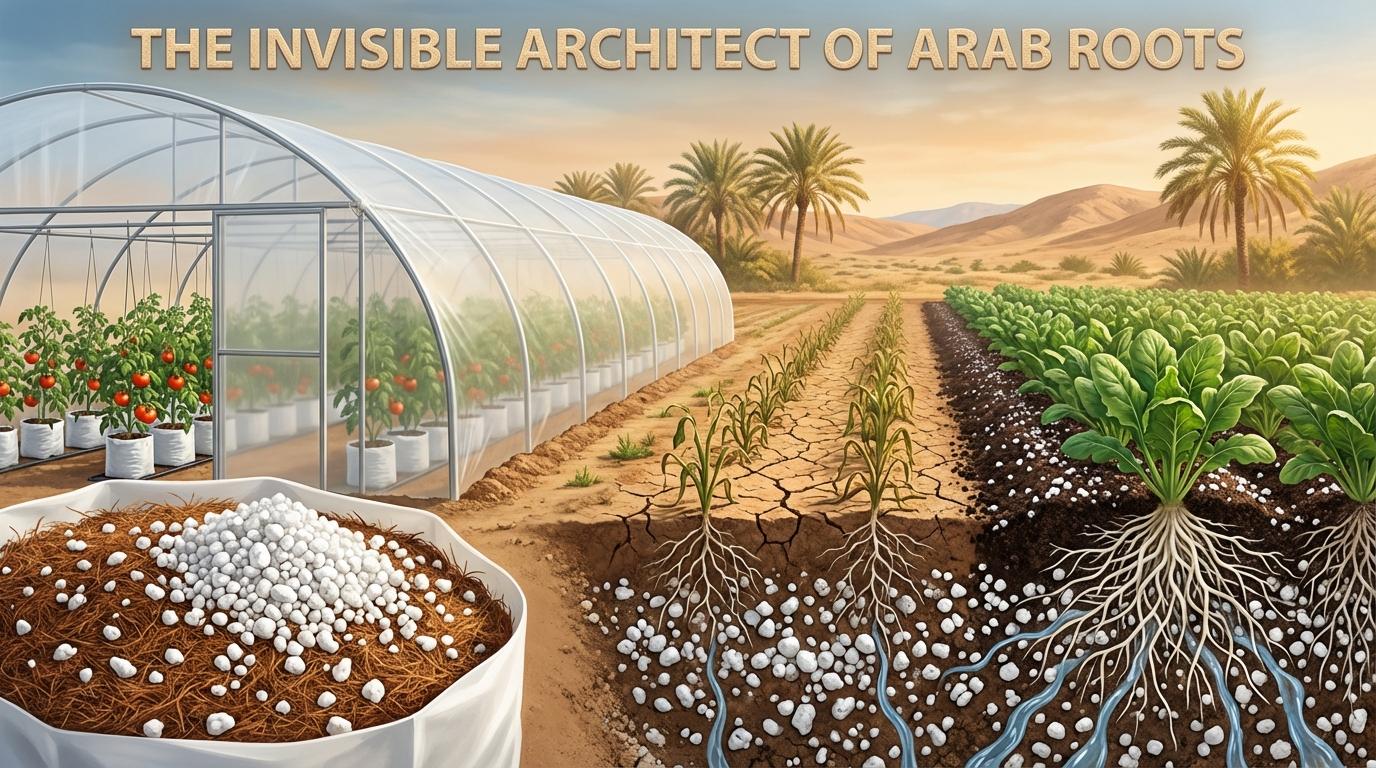
Ask most people in Arab countries what perlite is, and you’ll hear:
“That white, lightweight stone we sometimes mix into potting soil.”
Technically, that’s correct.
But for farmers, greenhouse owners and investors in Arab countries such as Iraq, Kuwait, Qatar, Oman, Bahrain and the UAE, perlite can become something much more powerful:
The invisible architect of the root zone – a material that quietly decides whether roots can breathe, drink and survive in hot, salty and compacted conditions.
This article does not repeat the classic “perlite improves aeration and drainage” message.
Instead, it shows how perlite can be used as a strategic design tool in Arab agriculture – to protect high‑value crops, stabilize yields and support modern systems based on cocopeat, substrates and controlled irrigation.
1. The real problem: not just water, but where the water sits
In many Arab countries, including Iraq and its neighbors, the main problem is often described as:
- “We don’t have enough water.”
But on a technical level, the problem is more specific:
- Sometimes there is too little water in the root zone (drought stress).
- Sometimes there is too much water in the wrong place (waterlogging, low oxygen).
- Often, there is salt accumulation exactly where the roots should be active.
In heavy clays, compacted soils, or poorly designed substrates, water:
- Stagnates around the roots, pushing oxygen out.
- Dries unevenly, causing stress between irrigations.
- Leaves behind concentrated salts when it evaporates.
Perlite does not create water.
What it does is rearrange water and air inside the root zone – like an architect redesigning a crowded city so that people (roots) can actually live and move.
2. What perlite really does: architecture, not just “white dots”
2.1. Perlite as a structural skeleton
Perlite is an expanded volcanic rock with a unique internal structure:
- When heated, it “pops” like popcorn and becomes full of tiny, sealed air cells.
- These particles are rigid but light, and do not break down quickly.
When you mix perlite into soil or cocopeat:
- You are building a permanent skeleton inside the substrate.
- This skeleton forces spaces for air and water pathways, even under pressure.
In practical terms for Arab agriculture:
- Under heavy irrigation or heavy soil, where everything tends to compact, perlite keeps the root zone open and breathable.
- In long seasons or multi‑cycle greenhouse crops, perlite prevents the substrate from collapsing over time.
2.2. Perlite as a traffic engineer for water and salts
Because perlite particles are rigid and water‑tolerant:
- They slow down water in fast‑draining soils.
- They speed up drainage in heavy or compacted soils.
- They create micro‑channels that help move excess salts away from the root surface.
In hot, saline environments, this is critical:
- Water stays where roots can reach it, but
- Excess water and salts still have a path to escape before they suffocate or burn the roots.
This is why perlite is particularly interesting in Iraq’s clay zones, coastal desert edges and greenhouse systems with high irrigation frequency.
3. Why perlite matters specifically in Arab countries
Many technical articles on perlite were written for mild, temperate climates.
Arab countries are completely different:
- Temperatures are higher.
- Evaporation is stronger.
- In some zones, humidity can also spike.
- Water is often limited and sometimes saline.
Under these conditions, perlite plays roles that are much more strategic than in Europe.
3.1. In Iraq’s heavy soils: turning concrete into something roots can live in
Large areas in Iraq have heavy clay soils that:
- Crack when dry.
- Become sticky and suffocating when wet.
- Are difficult to manage with modern drip irrigation.
Mixing perlite into such soils (in planting rows, beds or pits):
- Increases porosity and air content.
- Reduces the risk of standing water around roots.
- Helps roots explore deeper and wider, instead of staying close to the surface.
This is particularly important for:
- Vegetables in open fields or simple tunnels.
- Fruit trees and date palms established in heavy ground.
- Any high‑value crop where root health equals income.
3.2. In sandy and coastal areas: giving water a reason to stay
On the other side of the spectrum, many coastal or desert‑edge soils in Arab countries are:
- Very sandy, with almost no organic matter.
- Poor at holding water or nutrients.
Here, perlite does something different:
- It creates micro‑reservoirs and structure in otherwise loose sand.
- It slows down water enough so that roots have time to absorb it.
- Combined with organic matter or cocopeat, it transforms “dead sand” into functional growing media.
In many coastal projects, a mix of:
- Sand + cocopeat + perlite
can turn non‑productive land into a reliable base for vegetables or ornamentals.
3.3. In greenhouses: protecting expensive plants and data
Modern Arab greenhouses – especially in wealthier states and advanced Iraqi projects – are using:
- Climate control
- Drip irrigation and fertigation
- Sometimes sensors and software
Perlite here acts like:
- A safety layer for expensive plants (tomato, cucumber, strawberry, capsicum, etc.)
- A stabilizer for data: because moisture and air are more uniform, sensor readings are more trustworthy.
If you design a cocopeat‑based substrate system without perlite, small mistakes or local compaction can cause big problems.
With a carefully chosen percentage of perlite (often 20–40%), you give the root zone:
- A stable structure
- Better oxygen supply
- Faster recovery from irrigation errors
4. Perlite and cocopeat: not enemies, but a powerful team
Many farmers in the region ask:
“Should I use cocopeat or perlite?”
That is the wrong question.
In most successful systems in Arab countries, the real answer is:
“Use cocopeat with perlite – but in the right proportion for your climate, water and crop.”
4.1. What cocopeat brings – and where it can fail
Cocopeat is excellent at:
- Holding water
- Providing a soft, uniform substrate
- Buffering nutrients
But in hot, humid or poorly ventilated situations, pure cocopeat can:
- Stay too wet for too long.
- Lose some structure over long seasons.
- Increase the risk of root diseases if irrigation is not perfectly managed.
4.2. What perlite adds to the mix
When you blend perlite into cocopeat:
- You create extra air spaces and “escape routes” for excess water.
- You limit overall water‑holding capacity to something safer in humid times.
- You maintain structure through multiple crop cycles.
Typical mixes in Arab greenhouses might be:
- 70% cocopeat / 30% perlite – balanced water and air.
- 60% cocopeat / 40% perlite – for more humid climates or disease‑sensitive crops.
- 50% cocopeat / 50% perlite – in nurseries and very intensive rooting systems.
The art lies in adapting the ratio to:
- Local climate (very hot and dry vs hot and humid)
- Water quality (fresh vs moderately saline)
- Crop type and planting density
- Technical level of the farm team
5. Perlite as a risk‑management tool, not just a cost line
When you read farm budgets in Arab countries, perlite often appears as a small line:
- “Perlite: X USD per cubic meter or per bag.”
But the real financial picture is different. Perlite influences:
- Root diseases (less waterlogging = fewer problems)
- Yield stability (fewer extreme ups and downs)
- Crop lifespan (substrate can last longer in multi‑season systems)
- Labor and management stress (systems more tolerant to small mistakes)
If a few extra bags of perlite:
- Save you even 5–10% of potential yield losses
- Or allow you to push one more profitable crop cycle in the same substrate
…then perlite is not a cost – it is a low‑cost insurance policy.
For investors and traders working with Arab greenhouse projects, this is a key message:
the value of perlite is not in the “bag price”; it is in the risk it removes from the system.
6. Designing perlite use for Arab conditions
To use perlite intelligently in Arab agriculture, you do not start by asking:
“How many bags can I sell?”
You start by asking:
“Where are the root‑zone problems in this project – and how can perlite redesign that space?”
6.1. Key questions to ask
For each project, consider:
- Is the soil too heavy or too sandy?
- Is water scarce, saline, or both?
- Is the system open field, tunnel or full greenhouse?
- How long does each crop stay in the ground or substrate?
- What is the tolerance for risk? (small family farm vs large investor project)
From there, you can design:
- Simple field mixes:
- Clay soil + perlite + organic matter for vegetables.
- Greenhouse substrate recipes:
- Cocopeat + 20–40% perlite in bags or slabs.
- Nursery media:
- Fine cocopeat + 30–50% fine perlite for strong seedlings and cuttings.
6.2. Examples for the region
-
Iraqi greenhouse, tomatoes, heavy outside soil, moderate water quality:
- Cocopeat grow bags with 25–30% perlite to ensure aeration and safer drainage.
- Focus on preventing waterlogging during cooler months and over‑irrigation.
-
High‑tech Arab greenhouse, cucumbers, long cycles:
- Cocopeat + perlite mix designed to keep structure for two or more seasons.
- Use perlite to maintain consistent root‑zone conditions cycle after cycle.
-
Coastal sandy farm, peppers in tunnels:
- Mix of sand + organic matter + perlite in raised beds.
- Aim to hold water a bit longer while still draining salts.
7. What traders and technical partners can offer beyond “perlite bags”
For traders, distributors and technical companies working with Arab farmers, the opportunity is not just to add perlite as another SKU on the shelf.
The real opportunity is to offer:
-
Designed perlite solutions for specific problems:
- Heavy soil? → structured mixes and field protocols.
- Greenhouse disease issues? → substrate redesign with perlite.
- Salinity problems? → drainage and leaching strategies supported by perlite.
-
Training and advisory on:
- How to mix perlite correctly (avoiding dust, ensuring homogeneity).
- How to adjust irrigation when perlite is added.
- How to use perlite to extend substrate life over multiple crops.
In other words, perlite becomes part of a complete technical package – together with cocopeat, greenhouse plastics, nets, seedling trays and irrigation systems.
8. The bottom line: a small white stone with a big impact
Perlite will never be the star of marketing campaigns.
It does not have the glamour of high‑tech gear or the appeal of shiny greenhouses.
But in the demanding conditions of Arab agriculture – from Iraq’s clays to coastal sands and high‑tech greenhouses – perlite is often the quiet difference between:
- Roots that drown or breathe
- Substrates that collapse or stay open
- Projects that fight constant problems or run steadily and profitably
If you design your root zones without perlite, you are building cities without streets or ventilation.
If you use perlite with purpose, you are letting roots live, explore and perform – even in hot, salty, difficult environments.
For Arab farmers, traders and investors looking at the next decade of agriculture, perlite is not just a “white additive”.
It is an invisible architect that can help shape more resilient, more profitable cropping systems across the region.