
 Persian
 Arabic
 Russian



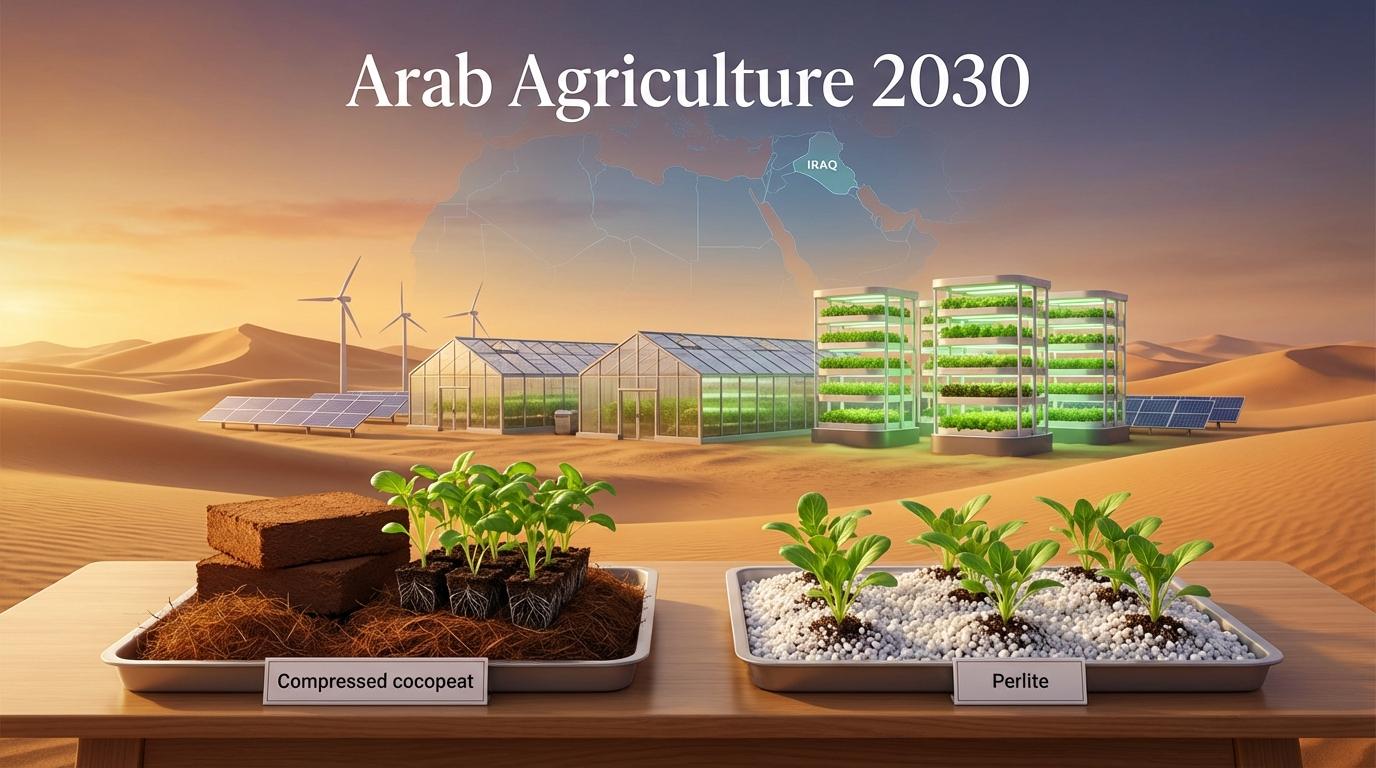
Arab countries are entering a decisive decade in agriculture. By 2030, population growth, climate stress and food‑security concerns will force the region to move from traditional, water‑intensive farming to technology‑driven, resource‑efficient systems.
Within this transformation, three tools will quietly but powerfully shape the future of Arab agriculture:
- Cocopeat – as a water‑saving, sustainable growing medium
- Perlite – as a key soil and substrate improver for aeration and drainage
- Greenhouses and protected cultivation – as the backbone of climate‑smart production
This article looks at how agriculture in Arab countries is expected to change by 2030, using available data and trends, and explains where cocopeat, perlite and greenhouses fit into this new landscape.
2. Where Arab agriculture stands today
Heavy dependence on food imports
According to multiple regional analyses, Arab countries are among the most food‑import‑dependent regions in the world:
- The United Arab Emirates imports around 90% of its food.
- Saudi Arabia imports about 80% of its food needs.
- Many other Gulf countries show similar levels of dependency.
This dependence has become a strategic concern, especially after:
- The COVID‑19 pandemic
- Global supply chain disruptions
- Price volatility in grains, vegetables and animal feed
As a result, countries like the UAE, Saudi Arabia and Qatar have made food security and agricultural innovation central parts of their national strategies toward 2030.
Harsh climate and water scarcity
Most Arab countries face:
- Arid or semi‑arid climates
- High temperatures and intense solar radiation
- Limited renewable water resources
The Middle East and North Africa region holds around 6% of the world’s population but less than 2% of its renewable freshwater resources. In some Gulf countries, over 80–90% of freshwater withdrawals go to agriculture, often with low efficiency.
Under these conditions, traditional open‑field irrigation is no longer sustainable. By 2030, Arab agriculture will have to produce more food with less water, on less land, and under more extreme weather.
3. Key trends shaping Arab agriculture to 2030
Based on policy documents, investment trends and technology roadmaps, several clear directions are emerging:
3.1. Rapid growth of protected cultivation (greenhouses)
Protected cultivation – including plastic greenhouses, net houses and climate‑controlled structures – is expanding across the region:
- The UAE and Saudi Arabia are investing in large‑scale greenhouse complexes and indoor farms to reduce import dependence.
- Governments and private investors are supporting high‑tech greenhouses with climate control, fertigation and integrated pest management.
- North African countries (Morocco, Tunisia, Egypt) are also increasing greenhouse area to supply both local and export markets.
By 2030, the share of vegetables, fruits and leafy greens grown under some form of protected environment in Arab countries is expected to be significantly higher than today.
3.2. Investment in agri‑technology and digital agriculture
Arab countries, particularly in the Gulf, are moving toward:
- Vertical farming and indoor hydroponics
- Smart irrigation with sensors, drip and subsurface systems
- Use of AI, IoT and data platforms to optimize water, fertilizer and climate control
Reports on Gulf food security strategies indicate that by 2030, the region aims to become a global hub for agricultural innovation, not only a buyer of food.
3.3. Shift toward water‑efficient and soilless systems
With water scarcity intensifying, there is a clear push toward:
- Soilless culture (hydroponics, substrate‑based systems)
- Drip irrigation and fertigation
- Drought‑tolerant crops and varieties
These systems rely heavily on engineered substrates like cocopeat and perlite, instead of traditional field soil.
3.4. Cross‑border and overseas farming
Because of limited arable land and water at home, some Arab countries (notably the UAE and Saudi Arabia) are:
- Investing in overseas farming projects in Africa and other regions
- Securing long‑term access to land and water abroad
- Using modern inputs and technologies to produce food that can be exported back to the Gulf
Even in these overseas projects, greenhouses and improved substrates are used to maximize yield and stability.
4. The strategic role of greenhouses by 2030
Greenhouses and protected cultivation will likely be the central platform for many of the region’s agricultural ambitions.
4.1. More food per drop of water
Compared to open‑field production, modern greenhouses can:
- Increase water‑use efficiency by up to 60–90%, depending on the system
- Increase yield per square meter by 2–5 times, especially for high‑value crops like tomato, cucumber, pepper and strawberry
- Reduce exposure to extreme heat and sandstorms
For countries like the UAE, Saudi Arabia, Qatar and Kuwait, where arable land is extremely limited, this productivity gain is critical.
4.2. Stable quality and year‑round supply
Greenhouses allow:
- Better temperature and humidity control
- Season extension or even year‑round production
- More consistent quality and size for export or premium local markets
By 2030, supermarkets and hospitality sectors in Arab cities will depend even more on reliable, locally grown greenhouse products, especially vegetables and herbs.
4.3. Greenhouses as platforms for cocopeat and perlite
Most modern greenhouses in the region are moving away from traditional soil and adopting:
- Substrate grow bags and slabs (mainly cocopeat, often with perlite)
- Container systems for hydroponics and recirculating fertigation
This is where cocopeat and perlite become structural components of the new agricultural model.
5. Cocopeat: a core substrate for Arab agriculture’s future
Cocopeat (coco peat) will likely be one of the most widely used substrates in Arab greenhouses and soilless systems by 2030.
5.1. Why cocopeat fits Arab conditions
Cocopeat offers several advantages that align directly with regional challenges:
- High water‑holding capacity – crucial in arid climates and under limited irrigation.
- Good aeration – even when moist, roots still receive oxygen.
- Buffering capacity for nutrients – cocopeat’s CEC helps stabilize nutrient availability.
- Neutral to slightly acidic pH – suitable for most horticultural crops.
- Renewable and sustainable – important for long‑term strategies and ESG‑focused investments.
For water‑scarce countries, cocopeat acts like a controlled sponge, holding water in the root zone and reducing the risk of drought stress between irrigation cycles.
5.2. Key uses of cocopeat toward 2030
By 2030, cocopeat will be central to:
- Greenhouse vegetable production – tomato, cucumber, pepper, eggplant, strawberry.
- Nursery and seedling production – in trays for vegetables, ornamentals and fruit trees.
- Urban and vertical farming – as a substrate for leafy greens and herbs.
- Rehabilitation of sandy soils – in parts of the Gulf and North Africa.
As investment in modern greenhouses expands, demand for high‑quality, low‑EC cocopeat in Arab countries is expected to grow significantly.
5.3. Quality considerations for the region
For Arab markets, especially in the Gulf and Iraq, it will be crucial to source cocopeat that is:
- Low in EC (salt) and well‑washed
- Properly buffered to avoid issues with potassium and sodium
- Supplied in forms adapted to the market – blocks, grow bags, open‑top bags or loose substrate
Suppliers and technical partners who can provide tailored cocopeat solutions for local water quality and crops will have a strong position in the market.
6. Perlite: the invisible partner for aeration and drainage
While cocopeat often receives more attention, perlite will also play a significant role in Arab agriculture by 2030.
6.1. Perlite’s functions in future systems
Perlite contributes:
- Aeration – it creates air pockets in substrates and soils.
- Drainage – it helps excess water move away from roots.
- Structure stability – it keeps mixes open and reduces compaction over time.
In high‑density, intensive production systems, maintaining healthy root zones is essential, and perlite is a key tool for that.
6.2. Where perlite will be most important
By 2030, perlite will be especially valuable in:
- Cocopeat mixes – improving aeration in slabs, bags and pots (e.g., 70% cocopeat : 30% perlite).
- Heavy soils – such as clay soils in parts of Iraq and the Levant, where perlite can reduce waterlogging.
- Nurseries and propagation – for cuttings, seedlings and ornamentals, where precise control of moisture and air is needed.
- Hydroponic systems – where inert, fast‑draining media are required.
As more farms in Arab countries adopt intensive and multi‑season production, perlite’s role in preventing root diseases and maintaining long‑term substrate structure will become more visible.
7. Cocopeat + Perlite: the standard mix for many Arab greenhouses
Looking toward 2030, many successful greenhouse operations in Arab countries are likely to use blends of cocopeat and perlite rather than either material alone.
7.1. Typical mixes
Common mixes used globally – and increasingly in the region – include:
- 70% cocopeat / 30% perlite – high water retention, good aeration; suitable for tomatoes and cucumbers.
- 60% cocopeat / 40% perlite – faster drainage, more oxygen; suitable for humid climates or sensitive crops.
- 50% cocopeat / 50% perlite – very light and airy; used in some nurseries and special crops.
These mixes can be customized based on:
- Local climate (hot and dry vs coastal and humid)
- Water quality (fresh vs saline)
- Crop type and production cycle length
- Grower’s irrigation and fertigation strategy
7.2. Regional customization by 2030
Technical partners working in Iraq, the Gulf and North Africa will increasingly offer region‑specific substrate recipes, for example:
- For Iraq’s central plains: cocopeat‑perlite mixes optimized for hot summers and sometimes saline water.
- For coastal areas of the Gulf: more perlite in the mix to handle high humidity and reduce disease pressure.
- For desert greenhouses: cocopeat‑rich mixes to hold water, combined with precise drip irrigation.
8. How Arab agriculture could look in 2030
If current trends and investments continue, by 2030 we can expect:
-
More food produced locally
- A higher share of vegetables and fresh produce grown inside the region, especially in the Gulf.
- Reduced vulnerability to global supply chain shocks.
-
Much higher share of protected cultivation
- A large proportion of commercial vegetables in the Gulf, Iraq and parts of North Africa produced in greenhouses or net houses.
- More climate‑controlled, high‑tech facilities for premium crops.
-
Widespread use of cocopeat and perlite
- Cocopeat becoming the standard substrate for greenhouse vegetables and nurseries.
- Perlite widely used in substrate mixes and as a soil amendment for problem soils.
-
Greater water‑use efficiency
- Adoption of drip irrigation, fertigation and moisture monitoring in most commercial farms.
- Soilless systems using cocopeat and perlite enabling more crop per drop.
-
Regional expertise and consultancy
- Local companies and technical teams (like Maya Dasht and similar players) becoming trusted advisors for designing substrate systems, greenhouses and input packages.
- A shift from “selling products” to “delivering integrated solutions” for Arab farmers and investors.
9. What this means for suppliers, traders and farmers
9.1. For suppliers and traders
By 2030, successful input suppliers in Arab countries will be those who:
- Offer high‑quality cocopeat and perlite adapted to local needs.
- Combine substrates with greenhouse films, insect nets, seedling trays and irrigation systems.
- Provide technical support and training, not just products.
Building long‑term relationships with farmers, greenhouse owners and agribusiness investors will be more valuable than one‑time sales.
9.2. For farmers and greenhouse investors
Farmers and investors who want to succeed in the 2030 landscape should:
- Shift from traditional open‑field systems to protected cultivation and soilless culture where feasible.
- Learn how to use cocopeat and perlite mixes effectively.
- Work with technical partners who understand both inputs and regional agronomy.
- Focus on water‑efficient, market‑oriented production.
10. The bottom line: cocopeat, perlite and greenhouses as pillars of Arab agriculture 2030
Arab agriculture by 2030 will be:
- More technological
- More water‑efficient
- More dependent on engineered substrates and protected cultivation
In this future:
- Greenhouses provide the controlled environment.
- Cocopeat supplies water retention, rooting volume and nutrient buffering.
- Perlite ensures aeration, drainage and long‑term root health.
Together, they form a practical toolkit that allows Arab countries – from Iraq to the Gulf and North Africa – to move closer to real food security in a difficult climate.
For farmers, traders and investors who start adapting now, this is not only a necessity, but also a major business opportunity.