
 Persian
 Arabic
 Russian



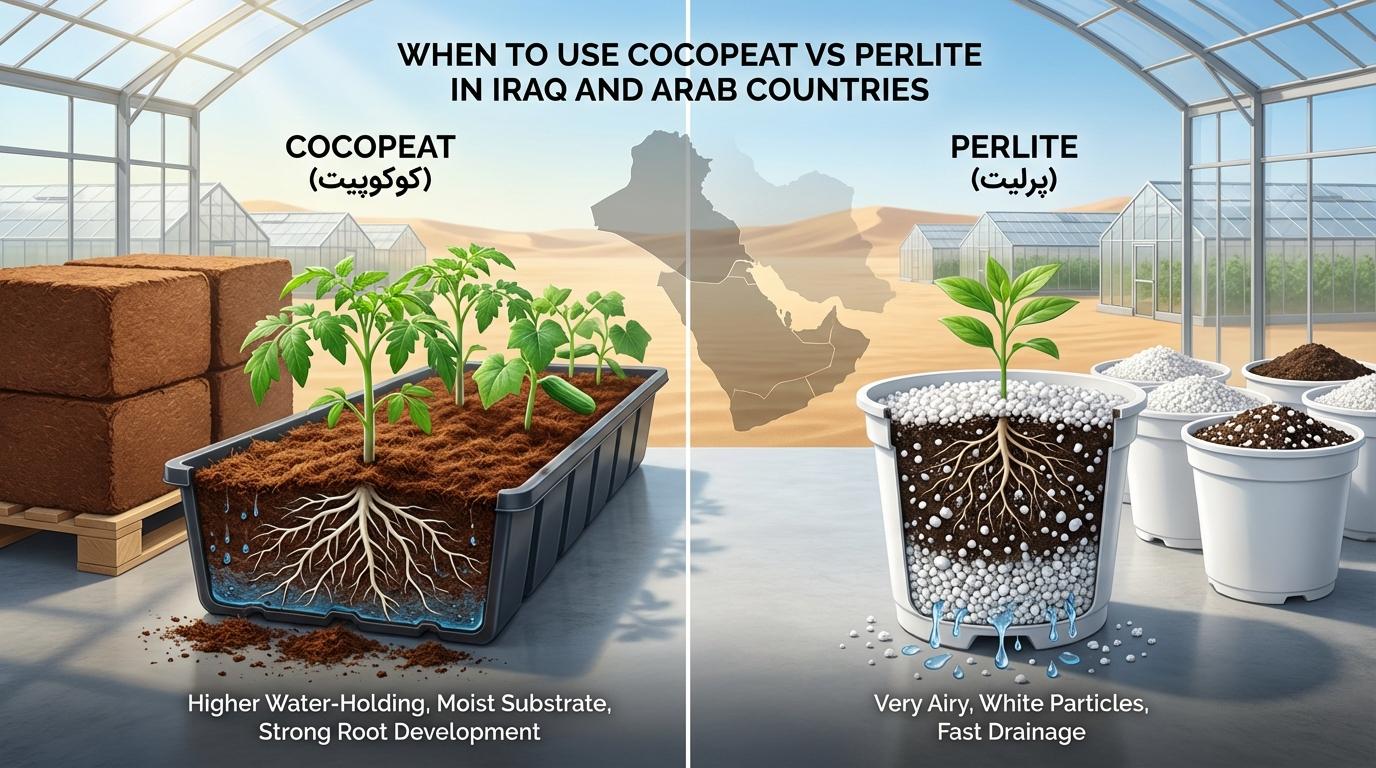
Modern agriculture in Iraq and Arab countries is changing fast. Greenhouses, soilless culture, and intensive vegetable production are expanding from Iraq to the Gulf states and North Africa. With this change, two materials appear again and again in successful projects:
- Cocopeat
- Perlite
Both are excellent growing media, but they do very different jobs. Using the wrong one – or using the right one in the wrong way – can cost you yield, water, and money.
This guide explains, in simple and practical terms, when cocopeat is better and when perlite is the smarter choice, especially under the conditions of Iraq and other Arab countries.
1. Cocopeat and Perlite in One Minute
What is cocopeat?
Cocopeat (also called coir pith) is a byproduct of the coconut industry. It comes from the fine, pithy material and small fibers in the coconut husk. According to several agricultural sources, cocopeat can hold up to 8–10 times its weight in water, while still keeping good air spaces for roots. It usually has:
- High water‑holding capacity
- Good aeration
- Near‑neutral pH (around 6–6.5 when properly buffered)
- Medium to high cation exchange capacity (CEC) – it can hold and exchange nutrients
Cocopeat is widely used in:
- Greenhouse vegetables (tomato, cucumber, pepper, strawberry)
- Nurseries and seedling trays
- Soilless and hydroponic systems
It is also a renewable and sustainable resource and an eco‑friendly alternative to traditional peat moss.
What is perlite?
Perlite is a volcanic glass that is heated to very high temperatures until it “pops” and expands. The result is a very light, white, porous material. Agricultural perlite is known for:
- Excellent aeration
- Very fast drainage
- Much lower water‑holding capacity compared to cocopeat
- Chemically inert and neutral pH
- Almost no CEC – it does not hold nutrients
Perlite is widely used to:
- Improve drainage in heavy or compacted soils
- Increase aeration in cocopeat, peat, and soil mixes
- Support root development in propagation and hydroponics
2. Why this comparison matters for Iraq and Arab countries
Farms in Iraq and the wider Arab region face specific challenges:
- Arid and semi‑arid climates – high temperatures, strong sun
- Water scarcity and often saline water
- Heavy clay soils in many areas of Iraq’s central plains, and sandy soils in parts of the Gulf
- Growing interest in greenhouses and soilless systems to increase yield and quality
In this context:
- Cocopeat’s water retention and buffering capacity can be a big advantage.
- Perlite’s drainage and aeration can prevent waterlogging and root disease, especially in heavy soils or high‑humidity greenhouses.
The best results usually come from choosing the right material for each situation – or combining both in the correct ratio.
3. When cocopeat is the better choice
3.1. Water‑scarce regions and irregular irrigation
In much of Iraq and many Arab countries, water is limited and irrigation is not always perfectly uniform. Because cocopeat can hold several times its weight in water, it acts like a water reservoir around the roots.
Use cocopeat when:
- You farm in arid or semi‑arid areas with strong evaporation
- Your irrigation system is not very precise or uniform
- You want to reduce irrigation frequency while keeping plants safe
This is especially relevant for:
- Southern and central Iraq
- Interior regions of Saudi Arabia
- Many areas in Jordan, Syria, Oman, and North Africa
3.2. Greenhouse vegetables and fruit crops
Greenhouse crops such as tomato, cucumber, pepper, and strawberry benefit strongly from cocopeat slabs or grow bags:
- Stable moisture around the root zone
- Good root volume and development
- Buffering against short‑term irrigation or nutrient mistakes
For commercial greenhouse projects in Iraq and the Arab region, cocopeat is often used as the primary substrate, sometimes with a small percentage of perlite added for extra aeration.
3.3. Improving sandy soils
In some Arab countries, farmers deal with very sandy soils that:
- Drain too quickly
- Hold almost no nutrients
- Heat up and cool down rapidly
Adding cocopeat to such soils:
- Increases water‑holding capacity
- Adds long‑lasting organic matter
- Helps stabilize temperature around the roots
Here, cocopeat acts as a durable organic amendment, improving soil structure and helping plants handle heat and drought.
3.4. Organic and sustainable production
For projects that must follow organic or sustainability standards:
- Cocopeat is a renewable byproduct of the coconut industry
- It reduces dependence on peat moss and rockwool
- It is compatible with many organic nutrient programs
If your market (for example, export markets from Iraq or the Gulf) values sustainably grown produce, cocopeat helps support that story.
4. When perlite is the better choice
4.1. Heavy or poorly drained soils
Many parts of Iraq have heavy clay soils that:
- Become waterlogged after irrigation or rain
- Crack when dry
- Limit oxygen around the roots
Perlite, with its porous structure, creates air pockets in the soil and improves drainage.
Use perlite when:
- Your soil stays wet for a long time after irrigation
- You see symptoms of root rot or yellowing due to excess water
- You want to lighten and open heavy soil without adding a lot of organic matter
Mixing perlite into clay soils can dramatically improve root health and make the soil easier to work.
4.2. Crops sensitive to waterlogging
Some crops are more sensitive to excess moisture around their roots. In these cases, perlite helps:
- Prevent standing water
- Ensure rapid drainage after irrigation
- Provide high oxygen availability at the root zone
Examples include:
- Certain ornamentals and nursery crops
- Seedlings in propagation trays where over‑watering is common
- Young plants in high‑humidity greenhouses
4.3. Precise hydroponic systems
Perlite is chemically inert and holds almost no nutrients. For some hydroponic or fertigation systems, this is an advantage:
- You control all nutrients in the irrigation solution
- The substrate does not interfere with pH or nutrient balance
- The system responds quickly to changes in your nutrient recipe
If you run high‑precision hydroponic systems and have tight control over irrigation and fertigation, perlite can be part of a high‑drainage, fast‑response mix.
4.4. Reducing compaction in cocopeat or peat mixes
In some long‑term crops, pure cocopeat or peat can become too compact over time. Adding perlite:
- Keeps the structure open
- Improves long‑term aeration
- Reduces the risk of anaerobic zones
This is particularly useful in:
- Multi‑season greenhouse projects
- Perennial crops in containers
- Nurseries where pots stay in place for many months
5. When to combine cocopeat and perlite
For many agricultural applications in Iraq and Arab countries, a blend of cocopeat and perlite offers the most balanced solution.
5.1. Typical mixing ratios
Common ratios used by growers and substrate suppliers include:
- 70% cocopeat : 30% perlite – high water retention, good aeration
- 60% cocopeat : 40% perlite – faster drainage, more oxygen
- 50% cocopeat : 50% perlite – very airy mix, for sensitive roots
The right ratio depends on:
- Crop type (tomato vs leafy greens vs ornamentals)
- Climate (hot and dry vs humid)
- Irrigation frequency and system design
5.2. Practical example: a greenhouse in Iraq
Imagine a tomato greenhouse in central Iraq:
- High daytime temperatures
- Limited water
- Heavy soil outside, but soilless culture inside
A good strategy might be:
- Use cocopeat as the main substrate for water retention and buffering
- Add 20–30% perlite to improve aeration and drainage
- Design a drip irrigation system with frequent, small doses
This combination:
- Protects against drought stress
- Prevents root diseases caused by stagnation
- Makes better use of every liter of water
6. Special considerations for Iraq and Arab countries
6.1. Water quality and salinity
In many areas of Iraq and neighboring countries, water salinity is a serious issue.
- Cocopeat must be low‑EC and well‑washed; otherwise, it can add salt to the system. Look for suppliers who provide low‑EC cocopeat specifically prepared for agriculture.
- Perlite is inert and does not contribute to salinity, but it also does not buffer or improve water quality.
If your irrigation water is saline:
- Use low‑EC cocopeat products
- Monitor EC in the root zone regularly
- Consider mixes where cocopeat provides buffering and perlite ensures good drainage, allowing salts to be washed out more easily
6.2. Climate and greenhouse design
In hot, dry climates:
- Cocopeat helps maintain cooler, more stable moisture around roots
- Perlite helps prevent overheating and suffocation of roots by improving air exchange
In cooler or high‑humidity regions (mountainous areas, coastal zones):
- You may need more perlite to prevent excess moisture and fungal diseases.
6.3. Local soil types
A quick guide:
-
Heavy clay soils (central Iraq, some river plains):
- Add perlite to open and drain
- Optionally, add some cocopeat to increase water‑holding and organic matter
-
Sandy soils (desert fringes, Gulf regions):
- Add cocopeat to increase water‑holding capacity
- A small amount of perlite can still help structure, but cocopeat is the main amendment
7. Simple decision guide: cocopeat, perlite, or both?
You can use this simplified checklist:
- Is water scarce or expensive?
- Yes → Favor cocopeat or cocopeat‑rich mixes
- Is your soil heavy and often waterlogged?
- Yes → Add perlite to improve drainage
- Are you growing in pure soilless systems (bags, slabs, pots)?
- Yes → Use cocopeat as a base and add 20–40% perlite for aeration
- Is your irrigation system precise and frequent?
- Yes → You can safely use higher perlite ratios
- Is your water saline?
- Yes → Use low‑EC cocopeat, monitor EC, and ensure good drainage (perlite can help)
8. Why expert guidance matters
Cocopeat and perlite are powerful tools, but they are not magic by themselves. The real results come from:
- Correct selection of substrate (cocopeat, perlite, or mix)
- Proper design of irrigation and fertigation
- Adapting the solution to local climate, water, and crops
For farmers and traders in Iraq and other Arab countries, working with a partner who understands both the materials and regional conditions can make the difference between a successful project and a disappointing one.
9. How a professional partner can help (Maya Dasht example)
A technical partner such as Maya Dasht can:
- Analyze your soil type, water quality, and climate
- Recommend when to use pure cocopeat, cocopeat–perlite mixes, or perlite as a soil amendment
- Help design greenhouse and irrigation systems that match the chosen substrate
- Support traders in building balanced product portfolios for the Iraqi and Arab markets
Instead of selling cocopeat or perlite as “one product fits all,” the focus is on creating complete, practical solutions for real farms.
Final takeaway
- Cocopeat is generally better when you need water retention, buffering, and organic improvement, especially in arid regions and soilless systems.
- Perlite is better when you need drainage and aeration, especially in heavy soils or high‑humidity environments.
- In many greenhouses and advanced farms in Iraq and Arab countries, the best solution is a smart combination of both.
If you are planning or upgrading greenhouse or open‑field projects in Iraq or any Arab country and are not sure which mix is right for you, consider taking professional advice before buying. The right choice at the beginning can protect your investment for many seasons.