
 Persian
 Arabic
 Russian


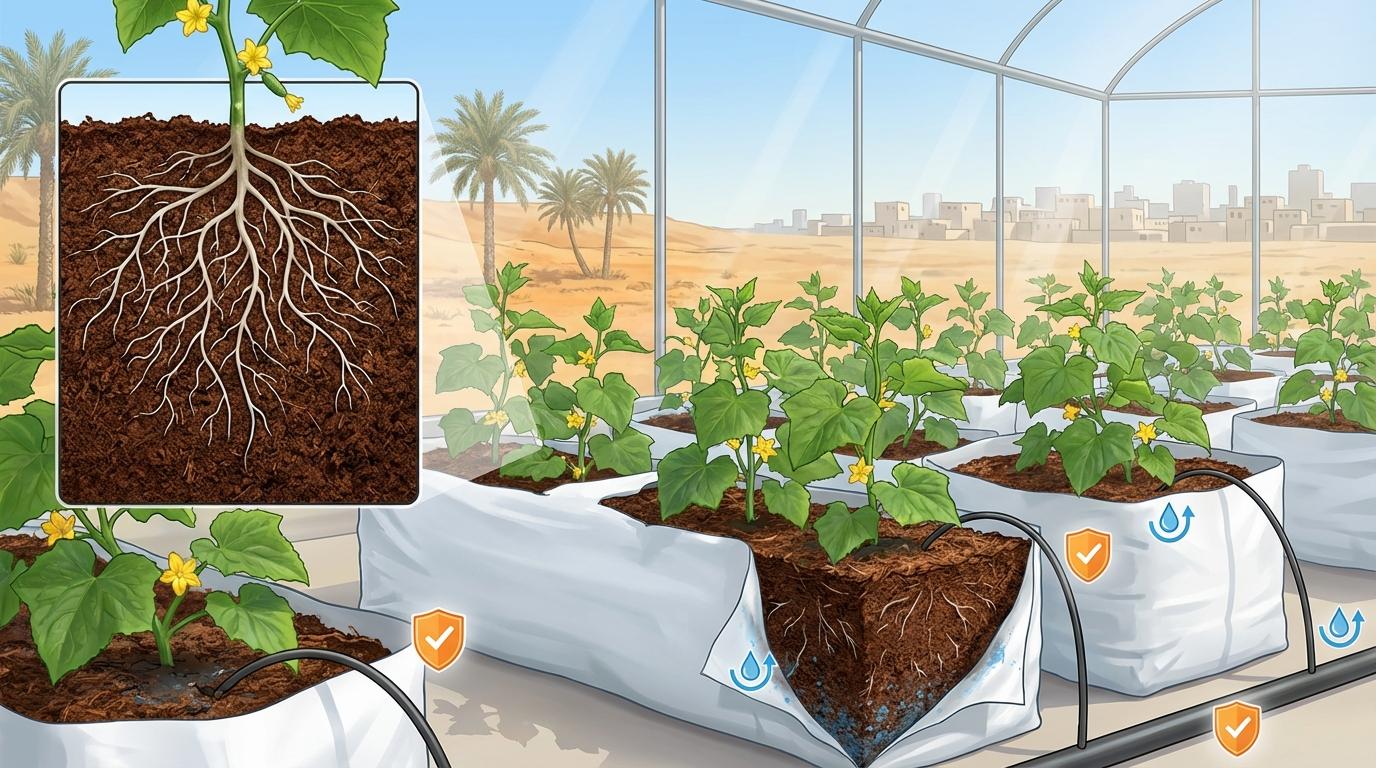
Substrate to Strategic Advantage
When most people in Arab countries hear the word cocopeat, they think of a brown, light growing medium for greenhouses and nurseries.
But for serious growers, traders and investors in Iraq, Kuwait, Qatar, Oman, Bahrain and the UAE, cocopeat is becoming much more than that:
It is a strategic tool to control water, stabilize yields, and protect investments in a climate that is getting hotter, drier and more unpredictable every year.
This article looks at cocopeat not as a commodity, but as a risk‑management and profit‑building tool for Arab agriculture – and explains why the way you source, mix and use cocopeat can decide whether your project succeeds or fails.
1. The reality of agriculture in many Arab countries
1.1. Same climate pressure, different systems
Across countries such as Iraq, Kuwait, Qatar, Oman, Bahrain and the UAE, farmers face similar pressures:
- Long, hot summers with intense solar radiation
- Limited freshwater and increasing pressure on groundwater
- Salinity problems in both water and soil in many regions
- Strong need for stable, high‑quality vegetables and fresh produce for growing cities
At the same time, the agricultural systems are different:
- Iraq still has a large share of open‑field farming, with fast‑growing greenhouse areas.
- More advanced Arab states with strong investment capacity rely heavily on greenhouses, net houses and hydroponics, often with imported technology.
- Oman and Qatar are somewhere in between, with both traditional and modern projects.
In all these cases, root‑zone control – water, air, salts and nutrients – is becoming the critical factor for success. And this is exactly where cocopeat enters the picture.
2. Cocopeat as a “root‑zone control system”, not just a substrate
2.1. What cocopeat actually does for you
From a technical point of view, high‑quality cocopeat:
- Holds 8–10 times its weight in water, acting like a micro reservoir around the roots
- Maintains air spaces even when wet, preventing suffocation of roots
- Has a useful cation exchange capacity (CEC) that helps buffer nutrients
- Offers a near‑neutral pH suitable for most horticultural crops
But for a farm or investor in Iraq or the wider Arab region, this translates into something more important:
- Fewer yield crashes due to irrigation mistakes
- Lower sensitivity to short‑term pump failures or pressure drops
- More stable EC and pH in the root zone, when used correctly
- Better use of every liter of water and unit of fertilizer
In other words, cocopeat is a technical insurance policy for the root zone.
2.2. Why this matters more here than in cooler regions
In northern Europe, if you make a mistake with irrigation or substrate, you might lose a bit of yield.
In Basra, Najaf, Kuwait City, Doha or Dubai:
- A few days of extreme heat plus irrigation problems can wipe out an entire greenhouse.
- Water and electricity are expensive, and technical teams are not always available 24/7.
- Many farms work with mixed skill levels, from highly trained agronomists to basic labor.
That is why cocopeat is not just “a medium” here – it is a way to build tolerance into the system.
3. Three invisible risks in Arab agriculture – and how cocopeat helps
3.1. Risk 1: Water stress and uneven irrigation
In many Arab countries, farms face:
- Uneven pressure in irrigation lines
- Limited ability to irrigate very frequently
- Fluctuations in water availability
With bare soil or sand, a small mistake in irrigation can cause severe stress within hours. With good cocopeat:
- The root zone holds a buffer of moisture, buying you time.
- Plants tolerate small delays or uneven distribution much better.
- You can design irrigation strategies with short, efficient pulses that match cocopeat’s properties.
For regions like southern and central Iraq or interior desert areas, this buffer is often the difference between a “recoverable stress” and a total loss.
3.2. Risk 2: Salinity shocks
Salinity is one of the most dangerous silent killers in the region:
- Water in parts of Iraq, Kuwait and coastal Arab states can have elevated EC.
- Soil in many fields has accumulated salts over years of irrigation and evaporation.
With cocopeat:
- If you choose low‑EC, well‑washed and properly buffered cocopeat, you start with a clean root environment.
- Good drainage design in cocopeat systems allows you to flush salts more effectively than in heavy soils.
However, this only works if:
- The cocopeat is truly low‑EC (not just on paper).
- The system is designed with drainage and leaching fractions in mind.
This is where professional suppliers and technical partners become essential.
3.3. Risk 3: Inconsistent quality and “cheap” substrate traps
One of the hidden risks in the Arab market is inconsistent substrate quality:
- Cocopeat from different sources can vary widely in salt level, fiber content and stability.
- Cheap material can look fine at first, but cause root problems and salinity issues after a few weeks.
For a greenhouse project worth hundreds of thousands of dollars, saving a small amount on cheaper cocopeat can be the most expensive decision you ever make.
Working with reliable, tested cocopeat – adapted to the water and crops of Iraq and neighboring Arab countries – is part of professional risk management, not a luxury.
4. Where cocopeat creates real value in Arab markets
Instead of repeating the usual “cocopeat is good for tomatoes and cucumbers”, let’s look at strategic use‑cases that matter for this region.
4.1. Iraq: turning fragile greenhouse projects into stable systems
In Iraq, especially around Baghdad, Najaf, Karbala, Basra and the Kurdistan region, many growers are:
- Moving from open fields to simple plastic greenhouses
- Experimenting with drip irrigation and basic fertigation
- Dealing with heavy soils outside and often saline water
Using cocopeat grow bags or slabs can:
- Separate root zones from problematic soil
- Give more precise control over water and fertilizer
- Allow year‑round or extended‑season production with less risk
For traders and investors targeting Iraq, offering complete cocopeat‑based packages (substrate + greenhouse film + drip systems + advisory) is far more powerful than just selling one product.
4.2. High‑investment Arab states: protecting advanced projects
In richer Arab states with strong investment capacity:
- Many projects use advanced greenhouses, climate control and fertigation
- Labor and energy are expensive
- The cost of a production failure is extremely high
Here, cocopeat adds value by:
- Providing a predictable, uniform root environment across thousands of plants
- Working well in recirculating or semi‑closed systems with good design
- Allowing integration with sensors, drain EC monitoring and data‑driven irrigation
For these markets, the demand is not just for cocopeat, but for:
- Customized cocopeat mixes (chips + pith, different densities, different slab designs)
- Technical protocols: how to hydrate, flush, start crops, manage EC, etc.
Suppliers who combine product with serious agronomic support will lead this segment.
4.3. Coastal and desert areas: managing heat and sandy soils
In many coastal zones and desert‑edge areas of Arab countries:
- Soils are often very sandy, with low water‑holding capacity
- Temperatures are high, but humidity can also be significant at certain times
Cocopeat in open fields or simple shelters can:
- Increase water retention in the root zone
- Provide organic matter and improve soil structure
- Reduce temperature fluctuations around roots
Combined with mulch and drip irrigation, cocopeat becomes part of a practical adaptation strategy to climate change.
5. Designing cocopeat solutions for Arab agriculture
Instead of thinking “Which cocopeat should I buy?”, a more professional question is:
“What cocopeat system do I need for this climate, this water and this crop?”
5.1. Key design variables
For Arab countries, a smart cocopeat system must consider:
- Water quality (EC, bicarbonates, sodium)
- Climate (extreme heat, humidity periods, wind and dust)
- Crop (tomato vs cucumber vs pepper vs strawberry vs leafy greens)
- Production model (seasonal vs multi‑season vs year‑round)
- Technical capacity of the team (basic vs advanced)
From these, you decide:
- Type of cocopeat (pith vs mixes with chips)
- Slab or bag size and volume per plant
- Whether to add perlite or other components for aeration
- Drainage strategy and leaching fraction
- Start‑up and flushing protocol
5.2. Typical examples
-
Mid‑range Iraqi greenhouse, tomato, moderate water quality:
- Cocopeat grow bags, mainly pith, moderate density, 70–80 L/m²
- Good drainage, 15–30% perlite mix if humidity is high
- Clear flushing plan at start and periodic leaching
-
High‑tech Arab greenhouse, tomato/cucumber, recirculation system:
- Calibrated cocopeat mixes with chips for structure stability
- Slabs designed for multi‑season use
- Integrated drain EC sensors and software‑driven irrigation
-
Coastal desert‑edge farm with simple tunnels:
- Cocopeat as a soil improver mixed into sandy soil
- Drip irrigation, mulch, and possible small percentage of perlite
- Focus on water savings and reduced temperature stress
6. How a professional partner can change the game
For traders and farmers in Arab countries, the real advantage does not come from “cheap cocopeat”. It comes from:
- Correct product selection for each project
- Training and support for farm teams
- Long‑term technical partnership
A strong technical partner can:
- Help evaluate water reports, climate data and crop plans
- Recommend cocopeat types, mixes and volumes for each project
- Integrate cocopeat with greenhouse plastics, insect nets, seedling trays and irrigation systems
- Provide ongoing support during the crop cycle, not just at delivery
This approach transforms cocopeat from a commodity into a strategic component of profitable agriculture.
7. Final message to Arab growers and traders
If you are active in Iraq, Kuwait, Qatar, Oman, Bahrain, the UAE or other Arab markets, and you see cocopeat only as:
“a brown substrate in a plastic bag”
you are underestimating its value.
Used correctly, cocopeat can help you:
- Reduce your water and salinity risk
- Protect your crops from heat and irrigation mistakes
- Stabilize your yields and quality
- Build more reliable and profitable greenhouse projects
The key is not just what cocopeat you buy, but who you buy it with – and whether they can support you from design to harvest.
If you want to explore cocopeat solutions tailored for Arab agriculture,
working with a technical team that understands both cocopeat and your local reality is the smartest first step.